

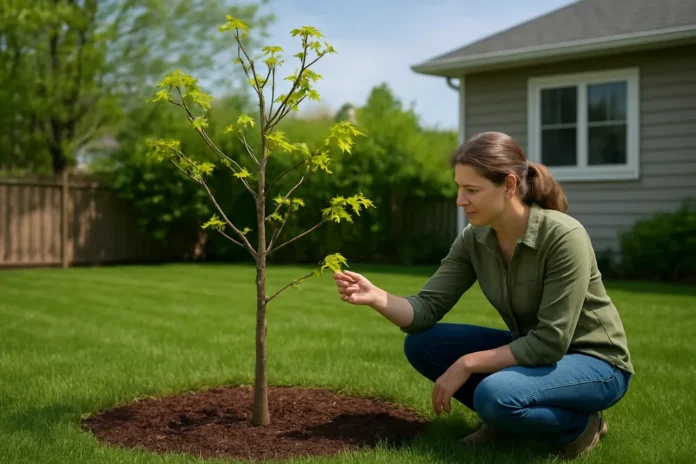
A maple tree that is not growing is usually struggling with root stress, poor planting depth, inconsistent moisture, limited sunlight, or soil problems. Some maples also grow slowly because they are establishing after planting or are naturally slower-growing varieties.
When a maple tree not growing the way you expected just sits there season after season, it can be frustrating. You water it, maybe feed it, and still the canopy barely fills out or the trunk diameter hardly changes. In my experience, slow growth in maples is often less about one dramatic problem and more about a few hidden stressors adding up.
The good news is that maples usually give clues if you know where to look. A tree planted too deep, roots trapped in compacted soil, lawn competition, too much shade, drought stress, or even winter injury can all hold growth back. Some maples also spend their first couple of years building roots instead of putting on a lot of visible top growth, which makes a healthy young tree seem stalled.
If your maple tree growth seems weak, the goal is to separate normal establishment from a real problem. Once you match the symptom pattern to the likely cause, the fix is usually straightforward and much more effective than guessing with fertilizer.
What Counts as Slow Growth in a Maple Tree
Before assuming something is wrong, it helps to know that maple growth rates vary a lot by species, age, and conditions. A young red maple in a favorable site can grow noticeably each year, while a Japanese maple or a recently transplanted sugar maple may add only modest new growth for a while. Newly planted trees often spend the first one to three years focusing on root establishment.
A maple may be underperforming if you see very short twig extension year after year, sparse leaves, a canopy that is not filling in, leaves that are smaller than normal, or dieback at branch tips. If the tree leafs out late, drops leaves early, or develops scorched edges in summer, those are also signs that growth is being limited by stress.
- Normal slower growth: a newly planted tree with healthy leaf color and no dieback
- Concerning slow growth: little to no annual extension plus thinning, discoloration, or branch tip death
- Very slow but normal growth: ornamental maples, especially Japanese maples, in containers or sheltered garden beds
- Misleading growth expectations: trees planted in shade, lawn, or poor soil rarely match nursery-tag growth rates
When I am judging a slow maple, I look at new growth length first, not just tree height. A tree can stay the same height for a season and still be healthy if the buds, leaf size, and branch extension look normal for that variety.
Recent Planting Shock and Establishment Lag
One of the most common reasons a maple is not growing is that it was planted recently and is still recovering from transplant shock. During digging, shipping, and planting, a tree loses a large share of its fine feeder roots. Until those roots regenerate, the tree may leaf out weakly and show very little visible growth above ground.
This is especially common with balled-and-burlapped trees and larger nursery stock. Bigger trees often look impressive at planting time, but they usually take longer to resume strong growth than smaller, younger trees. If your maple has been in the ground less than two years, slow progress may simply mean it is still settling in.
- Little top growth during the first growing season after planting
- Leaves that are present but somewhat smaller than expected
- Mild drooping or scorch during hot spells
- A generally healthy appearance without major dieback or trunk damage
Give a newly planted maple consistent moisture, mulch the root zone properly, and avoid the urge to push growth with heavy fertilizer. Too much fertilizer too soon can stress recovering roots instead of helping them.
Planting Depth and Root Flare Problems
A maple planted too deep often struggles for years without anyone realizing why. The root flare, which is the area where the trunk widens and transitions into major roots, should be visible at or slightly above soil level. If the trunk looks like a straight pole disappearing into the ground, the tree may be buried too deeply.
When soil or mulch covers the root flare, oxygen movement into the root zone is reduced and the base of the trunk stays too moist. That can lead to slow growth, bark problems, girdling roots, and long-term decline. Deep planting is a major reason a maple survives but never really thrives.
- Trunk enters the ground without a visible flare
- Mulch piled against the bark
- Bark staying damp or beginning to crack near the base
- Weak growth despite watering and fertilizing
If I find a buried root flare, I gently pull back mulch and excess soil before doing anything else. That single correction often explains years of poor growth better than any fertilizer schedule.
Water Stress From Drought or Overwatering
Maples need steady moisture while establishing, but they also need oxygen around their roots. Too little water slows photosynthesis and root growth. Too much water pushes air out of the soil and can suffocate roots. Both problems can make a tree look stalled.
Drought-stressed maples often show leaf scorch, curling, early color change, and small new growth. Overwatered or poorly drained maples may look similarly weak, but the soil stays wet, leaves can appear pale, and the tree may not perk up even after cooler weather. In heavy clay, overwatering can be especially damaging.
How Watering Issues Usually Show Up
- Underwatering: crispy edges, drooping in heat, early leaf drop, sparse twig extension
- Overwatering: yellowing leaves, limp growth, dark wet soil, possible root rot smell
- Inconsistent watering: repeated leaf stress after hot or dry swings, uneven growth from season to season
A deep soaking followed by time for the upper soil to begin drying is usually better than frequent shallow watering. Shallow irrigation encourages surface roots and leaves the deeper root zone dry.
Poor Drainage and Compacted Soil
Maples can adapt to many soils, but few do well when roots are packed into hard, oxygen-poor ground. Compacted soil from construction, foot traffic, or years of lawn equipment can prevent roots from spreading. A tree in compacted soil may survive, but it often puts on very little growth.
Heavy clay and low spots that stay soggy after rain are especially troublesome. Roots need both moisture and air. If the soil drains slowly, roots cannot expand well enough to support vigorous canopy growth.
- Water puddles around the tree after rain
- The ground feels hard and dense even when moist
- Grass grows right up to the trunk and dominates the root zone
- The tree adds little growth despite regular care
Improving the root zone over time with proper mulching and reducing traffic around the tree can help. Avoid aggressive digging close to the trunk, since damaged roots can set a stressed maple back even further.
Too Much Shade and Competition From Nearby Plants
Maples need enough light to make the energy required for strong growth. Some tolerate partial shade, but most will grow more slowly if they are crowded by taller trees, buildings, or dense hedges. A tree that gets only a few hours of direct sun may remain thin and weak even if everything else looks reasonable.
Competition below ground matters too. Turfgrass is a strong competitor for water and nutrients, especially around young trees. Shrubs, mature tree roots, and foundation plantings can also crowd the same root zone your maple is trying to establish.
Signs That Competition Is Slowing the Tree Down
- Growth is stronger on the sunnier side of the tree
- The canopy leans toward open light
- Grass under the tree stays thick right to the trunk
- Leaves are small even though color looks fairly normal
I see lawn competition overlooked all the time. A young maple ringed by thick turf often grows much better after the grass is removed and the root zone is mulched, even when no other major change is made.
Nutrient Imbalance and Unsuitable Soil pH
Home gardeners often assume a slow tree just needs fertilizer, but maples are more commonly limited by root stress or pH problems than by a simple lack of plant food. If the soil is too alkaline or otherwise out of balance, roots may struggle to take up iron, manganese, or other nutrients even when those nutrients are present.
This can lead to poor growth, pale leaves, and weak vigor. In many landscapes, repeated lawn fertilization also changes the root-zone environment in ways that do not necessarily benefit the tree.
- Nitrogen shortage can cause overall pale growth and smaller leaves
- Iron chlorosis often shows as yellowing between green veins, especially on newer leaves
- Improper pH can lock up nutrients and mimic deficiency symptoms
- Overfertilizing can burn roots or push weak, stress-prone growth
A soil test is the best way to know whether fertility or pH is part of the problem. Without that information, fertilizing is often just educated guessing.
Root Damage, Girdling Roots, and Restricted Root Space
A maple cannot grow vigorously if its roots are physically damaged or confined. Roots may be cut during trenching, sidewalk work, patio installation, or even repeated edging close to the trunk. Container-grown trees can also develop circling roots that eventually tighten around the trunk base or major roots.
Girdling roots are especially serious because they slowly restrict water and nutrient movement. The tree may leaf out every year but remain stunted, develop dieback on one side, or decline during heat stress much faster than expected.
Clues Pointing to Root Restriction
- Little growth several years after planting
- One-sided canopy decline
- Visible roots circling near the trunk base
- A tree planted in a narrow strip between pavement or foundations
- Recent digging or construction inside the root zone
Trees planted in tiny beds surrounded by hardscape often look fine for a while, then stall. Once the roots hit barriers, the canopy can only expand so much.
Cold Injury, Late Frost, and Winter Damage
Maples can lose a season of growth after a harsh winter or a late spring frost. Buds that start to swell early are vulnerable if temperatures suddenly drop. Even if the tree survives, those damaged buds may never produce the normal flush of leaves and shoots for that year.
Winter injury is more common on young trees, thin-barked trunks, and species planted near the edge of their climate comfort zone. Wind exposure, reflected heat from pavement, and warm winter days followed by sharp freezes can all contribute.
- Delayed leaf-out compared with previous years
- Dead bud tips or patchy branch growth in spring
- Splitting or sunscald on the trunk
- A weak season following an extreme winter event
A frost-damaged maple may recover and grow normally the following year if the roots and major limbs remain healthy. The key is not to confuse one bad season with a permanent decline.
Pests and Diseases That Can Stunt Maple Growth
Pests and diseases are not always the main reason a maple is not growing, but they can absolutely weaken a tree enough to slow it down. Aphids, scale insects, borers, and spider mites can reduce vigor, especially when the tree is already stressed. Diseases such as verticillium wilt, anthracnose, cankers, and root rots can also limit growth.
The challenge is that many of these issues show up alongside other stress factors. A maple dealing with drought, deep planting, or compacted soil is much more likely to suffer secondary pest or disease problems.
Symptoms Worth Investigating Closely
- Sticky leaves or black sooty mold from sap-feeding insects
- Branch dieback on scattered limbs
- Wilting on one side of the tree
- Sunken bark areas or cracks that do not heal well
- Sudden canopy thinning without an obvious watering issue
If you suspect a serious disease such as verticillium wilt or a borer infestation, diagnosis matters before treatment. A stressed tree can be harmed by unnecessary sprays or pruning done at the wrong time.
How to Help a Maple Tree Grow Better
Once you identify the likely cause, the best improvements usually focus on the root zone and overall tree stress. Fast fixes are rare with trees, but steady corrections can produce much better growth over the next one to three seasons.
- Expose the root flare if it is buried and pull mulch away from direct contact with the trunk.
- Water deeply during dry periods instead of giving frequent shallow sprinkles.
- Add a broad mulch ring two to three inches deep, keeping it a few inches back from the bark.
- Remove turfgrass and reduce foot traffic over the root zone.
- Test soil if leaf color suggests nutrient deficiency or pH problems.
- Avoid heavy fertilizing until you know the tree actually needs it.
- Prune only dead or damaged wood unless a certified arborist recommends more.
- Protect the tree from mower and string-trimmer injury around the base.
If the tree has major dieback, trunk damage, large girdling roots, or signs of wilt disease, it is worth getting an arborist's opinion. Some problems are much easier to correct early than after the canopy has already declined for several years.
When a maple is struggling, I try to change one major factor at a time and judge progress by the next flush of leaves and twig growth, not by instant results. Trees respond slowly, and chasing the problem with fertilizer, pruning, and extra watering all at once can make diagnosis harder.
FAQ
How Long Does It Take a Newly Planted Maple Tree to Start Growing Well?
Many maples need one to three years to establish after planting. During that time, root growth often happens faster than visible canopy growth, so a tree can be healthy even if top growth seems modest.
Will Fertilizer Make My Maple Tree Grow Faster?
Not always. If the real problem is deep planting, compacted soil, poor drainage, drought stress, or root damage, fertilizer will not solve it and can sometimes make stress worse.
How Do I Know if My Maple Is Planted Too Deep?
Look for the root flare at the base of the trunk. If the trunk goes straight into the ground like a post and no natural widening is visible, the tree may be planted too deeply.
Can Grass Around the Base of a Maple Slow Its Growth?
Yes. Turfgrass competes strongly with young trees for water and nutrients, and it often keeps the root zone drier and more compacted than a mulched area would.
Why Does My Maple Have Leaves but Still Not Grow Much?
A tree can leaf out and still be under stress. Limited root space, shade, pH problems, or chronic moisture issues often allow survival while holding back vigorous new shoot growth.
Do All Maple Species Grow at the Same Rate?
No. Red maples often grow faster than sugar maples, and Japanese maples are usually slower and more compact. Growth rate also depends heavily on age, climate, and site conditions.
Should I Prune a Slow-growing Maple to Stimulate Growth?
Usually only remove dead, damaged, or crossing branches unless there is a specific structural reason to prune more. Heavy pruning does not fix root-related growth problems and can add stress.
Need the right fix for a struggling tree? Read our related maple tree care and treatment guides to choose the best mulch, watering tools, fertilizers, and disease control options with confidence.
