

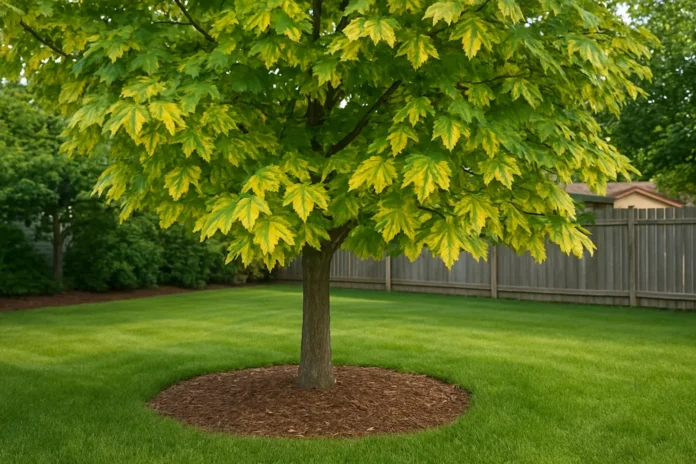
Chlorosis in maple trees is most often caused by iron deficiency brought on by alkaline soil, poor drainage, or damaged roots. The tree may have iron in the soil, but it cannot take up enough to keep leaves green.
If your maple tree leaves are turning yellow while the veins stay green, chlorosis is one of the first problems I would suspect. It shows up a lot in home landscapes, especially where soil runs alkaline, drainage is uneven, or roots have been stressed by construction, compaction, or repeated overwatering.
The tricky part is that chlorosis is a symptom, not a single disease. A maple may be short on usable iron, manganese, or sometimes other nutrients, but the deeper cause is often the soil environment around the roots. Once you understand what is blocking uptake, it becomes much easier to decide whether the tree needs a nutrient treatment, a soil fix, or both.
In many yards, maple chlorosis starts slowly. A branch or two looks pale one season, the canopy thins a bit the next, and then homeowners notice scorched leaf edges or poor growth. Catching it early matters because long-term chlorosis weakens the tree and makes it more vulnerable to drought, borers, and dieback.
What Chlorosis Looks Like on Maple Trees
Chlorosis means the leaves are not producing enough chlorophyll, so they lose their rich green color. On maples, the classic pattern is yellow leaf tissue with green veins, especially on newer leaves. In more advanced cases, leaves may become almost creamy yellow, develop brown margins, drop early, or look smaller than normal.
- Interveinal yellowing, where veins stay greener than the rest of the leaf
- Paler new growth at branch tips
- Scorched or browned leaf edges later in the season
- Slow growth and thinner canopy over time
- Dieback in stressed branches if the problem continues for several years
Not every yellow maple has chlorosis, though. General yellowing across the whole leaf can point more toward nitrogen deficiency or root damage. Browning without yellowing may be heat, drought, salt, or scorch. The vein pattern is one of the most helpful clues when you are trying to separate chlorosis from other leaf problems.
When I diagnose chlorosis, I look at several leaves from different parts of the canopy instead of judging by one branch. A true nutrient uptake pattern usually repeats itself, while random yellow leaves from injury or weather tend to be more patchy and inconsistent.
Iron Deficiency Is the Most Common Cause
The most common reason maple trees develop chlorosis is iron deficiency, or more accurately, iron unavailability. In many landscapes, the soil actually contains iron. The problem is that the roots cannot absorb enough of it to support healthy green foliage.
Iron is essential for chlorophyll production. When a maple cannot access enough available iron, the newest leaves often yellow first because iron does not move easily within the plant. That is why younger growth can look noticeably paler while older leaves remain somewhat greener in the early stages.
Red maples, silver maples, and some hybrid maples can be especially sensitive when planted in soils that do not match their preferences. Trees that naturally like slightly acidic conditions often struggle in urban and suburban soils that lean alkaline.
Alkaline Soil Often Blocks Iron Uptake
High soil pH is one of the biggest drivers of chlorosis in maple trees. When soil becomes too alkaline, iron changes into forms the roots cannot easily take up. That means a soil can test as having enough iron overall, yet the tree still behaves like it is deficient.
This is why chlorosis is so common in parts of the U.S. with naturally calcareous soils or where builders spread subsoil and limestone-heavy fill around new homes. Repeated applications of materials that raise pH can also contribute over time.
- Naturally alkaline native soil
- Limestone or concrete debris in the root zone
- Construction fill soil around new homes
- Irrigation water with high mineral content
- Heavy use of amendments that raise pH
If a maple has chlorosis year after year and grows near sidewalks, driveways, foundations, or recently disturbed building sites, alkaline soil jumps high on my list of likely causes. Trees in these spots often decline gradually because the soil chemistry keeps working against them.
Poor Drainage and Wet Soil Can Trigger Chlorosis
Even when soil pH is reasonable, wet and poorly drained soil can lead to chlorosis. Maple roots need oxygen. If the soil stays saturated, roots become stressed and less able to absorb iron and other nutrients efficiently.
This kind of chlorosis often shows up after periods of heavy rain, overwatering, or grading changes that trap water in the root zone. In some yards, the yellowing gets much worse in spring or early summer when the ground remains cool and wet for too long.
- Water stands in the area after rain
- The soil feels sticky or soggy several days later
- Grass or shallow-rooted plants around the tree also struggle
- Leaf yellowing is paired with weak growth and occasional twig dieback
I would rather improve drainage than keep adding nutrients to a waterlogged site. If the roots stay starved for oxygen, fertilizer rarely solves the problem for long.
Compacted Soil and Root Stress Are Common Hidden Causes
Soil compaction is one of the most overlooked reasons a maple turns chlorotic. Foot traffic, parked vehicles, repeated mower passes, and construction activity can compress the soil enough to reduce air space and limit root growth. When roots cannot spread and function normally, nutrient uptake suffers.
Root stress can also come from trenching, grade changes, patio installation, or simply covering the root area with too much fill soil. Sometimes homeowners notice chlorosis a year or two after a project and do not realize the tree is still reacting to that underground damage.
Maples are especially sensitive to root zone disturbance because many of their feeding roots sit fairly close to the surface. A tree may look fine above ground while the root system is slowly losing efficiency below it.
Other Nutrient Deficiencies Can Contribute
Iron gets most of the attention, but it is not the only nutrient involved in chlorosis. Manganese deficiency can create a similar yellowing pattern, particularly in high pH soils. Magnesium deficiency, though less common in shade trees, can also lead to yellowing, often on older leaves first.
Nitrogen deficiency usually looks different from classic iron chlorosis. Instead of green veins against yellow tissue, the whole leaf may fade more evenly, and the entire tree can look washed out or weak. Because these patterns overlap in real landscapes, soil testing and sometimes foliar analysis are useful when symptoms are persistent.
- Iron deficiency usually affects newer leaves first
- Manganese deficiency can mimic iron chlorosis in alkaline soils
- Magnesium deficiency often appears first on older foliage
- Nitrogen deficiency tends to cause broader overall pale color
Site Conditions Can Make Some Maples More Vulnerable
Not all maples react the same way. Species, cultivar, and planting site all matter. A maple planted in the wrong place may fight chlorosis for years, while the same species in a slightly different location stays healthy.
Red maples tend to prefer more acidic, organic, moisture-retentive soils, so they often show chlorosis in alkaline suburban landscapes. Sugar maples can also struggle where soils are compacted or pH is high. Silver maples may tolerate a wider range of conditions but can still develop symptoms if roots are damaged or drainage is poor.
- Planting an acid-loving maple in alkaline soil
- Trees surrounded by pavement that heats and dries the root zone
- Sites with shallow topsoil over compacted fill
- Areas exposed to road salt or runoff from hardscapes
I pay close attention to what else is growing nearby. If pin oaks, blueberries, azaleas, or other acid-loving plants also struggle in the same bed, that usually supports the idea that the site itself is driving the chlorosis.
How to Tell Chlorosis From Leaf Scorch, Drought, and Disease
Chlorosis is often confused with simple drought stress or leaf scorch. Drought-stressed maples may have browned edges, curling leaves, or early leaf drop, but they do not always show the green-vein yellowing pattern first. Leaf scorch also tends to appear more on exposed outer leaves during hot, dry periods.
Diseases can muddy the picture too. Some fungal leaf spots create yellow halos or blotches, and root diseases can weaken uptake enough to mimic nutrient problems. But chlorosis usually appears as a broad, repeating pattern across many leaves, especially on new growth, rather than isolated spots or lesions.
- Chlorosis: yellow tissue between greener veins
- Drought stress: wilting, curling, crisp edges, and premature drop
- Leaf scorch: browning on margins or tips after heat and sun exposure
- Leaf spot diseases: discrete lesions, spots, or patches rather than uniform vein patterning
Why Chlorosis Gets Worse Over Time
A mildly chlorotic maple can survive for a while, but the condition usually worsens if the underlying cause is not addressed. Repeated years of poor chlorophyll production mean reduced energy for root growth, branch extension, wound response, and stress recovery.
As the tree weakens, it may become more prone to secondary problems like borers, cankers, branch dieback, and winter injury. This is why a maple that only looked a little yellow a couple of years ago may suddenly seem to be declining quickly now. The yellow leaves were an early warning, not a cosmetic quirk.
The Best Way to Confirm the Cause
If symptoms are mild and the cause is obvious, such as a maple planted in visibly alkaline fill soil near concrete, you may not need much detective work. But for moderate or recurring chlorosis, testing is worth it. A basic soil test can reveal pH and general nutrient levels, while a more detailed test may identify low available iron or manganese.
In stubborn cases, an arborist or extension service may recommend a foliar tissue test. That helps distinguish between a true nutrient deficiency and a root-zone problem that is interfering with uptake. It is especially helpful when the tree has been fertilized before but symptoms keep returning.
- Look at the yellowing pattern on multiple leaves
- Review recent weather, watering, and any soil disturbance
- Check whether the site drains slowly after rain
- Test soil pH before adding repeated treatments
- Consider professional evaluation for mature or valuable trees
What the Cause Means for Treatment
The right fix depends on what caused the chlorosis in the first place. If soil pH is too high, temporary iron products may green the tree up, but longer-term improvement usually requires working on the soil environment. If drainage or compaction is the issue, root health has to come first.
For home gardeners, the most common responses include chelated iron treatments, organic mulching over the root zone, adjusting irrigation, reducing compaction, and avoiding more alkaline amendments. In severe cases, arborists may use trunk injections or soil-applied iron products formulated for high pH soils.
One important point: old yellow leaves may not turn fully green again even after the tree improves. Judge progress by the color and vigor of new growth. That is where you will see whether your correction is actually helping.
When to Worry About a Chlorotic Maple
A few pale leaves are not always an emergency, especially after weather swings. But you should take chlorosis more seriously when it affects much of the canopy, returns year after year, or is paired with thinning foliage, branch dieback, or poor annual growth.
Large mature maples represent a big landscape investment, so it is smart to act early. The longer root-zone problems continue, the harder they are to reverse. Younger trees can often recover well if the soil conditions are corrected before chronic decline sets in.
- More than a small portion of the canopy is yellow
- The tree has repeated chlorosis each growing season
- Leaf edges are burning brown after the yellowing starts
- New growth is sparse or branch tips are dying back
- The tree sits in a recently disturbed or poorly drained site
FAQ
Can a Maple Tree Recover From Chlorosis?
Yes, many maples recover well if the underlying cause is corrected early. Recovery is much more likely when the issue is soil pH, drainage, or compaction rather than long-term root loss or severe decline.
Is Chlorosis in Maple Trees Always Caused by Low Iron in the Soil?
No. The soil may contain iron, but alkaline conditions or stressed roots can keep the tree from absorbing enough of it. That is why chlorosis is often an availability problem rather than a simple lack of iron.
Which Maple Species Are Most Prone to Chlorosis?
Red maples are commonly affected in alkaline soils because they prefer more acidic conditions. Other maples can also develop chlorosis if the site is compacted, wet, or otherwise stressful to roots.
Will Iron Fertilizer Fix Chlorosis Permanently?
Not always. Iron products can help temporarily, but chlorosis often returns if high pH, poor drainage, or root stress remains unchanged. Lasting improvement usually requires addressing the site problem too.
What Time of Year Does Maple Chlorosis Show Up Most Clearly?
It often becomes noticeable in spring and early summer as new leaves expand. Symptoms may intensify through summer if the tree is already stressed by heat, wet soil, or poor root conditions.
Can Overwatering Cause Chlorosis in Maples?
Yes. Overwatering can keep the soil too wet, limit oxygen around the roots, and reduce nutrient uptake. That can produce yellowing that looks very similar to iron chlorosis.
Should I Remove a Maple with Chlorosis?
Usually not right away. Many chlorotic maples improve with proper diagnosis and treatment, but a tree with severe canopy dieback, major root damage, or repeated decline may need an arborist's opinion on whether it is worth saving.
Need help choosing the best iron treatment, soil amendment, or mulch for a struggling tree? Read our maple tree care guides and product roundups to find fixes that match your soil and your budget.
