

Note: This article contains affiliate links. If you click on these links and make a purchase, I may earn a small commission at no extra cost to you. This helps support my research and content. Read my full affiliate disclosure here.
Virginia buttonweed can quickly form dense patches that smother desirable turf and escape routine mowing. Choosing the right herbicide for Virginia Buttonweed matters because this weed grows low to the ground and spreads from seed and stolons, so you need a product that reaches the root system without harming the surrounding grass. This guide covers five top shortlisted herbicides suited to the use case, explaining how each option handles contact versus systemic control, timing for application, and considerations for different turf types. Below we explain what we looked for and the practical factors that should guide your choice, then move into the product shortlist and supporting advice.
Top Picks at a Glance
| Best Quality Built to a higher standard if you want something more solid | PBI-Gordon Aethon Herbicide SL Nutsedge and Broadleaf Killer, 32 fl oz |  |
| Best Budget The cheapest option that still gets the job done reliably | Image Herbicides Liquid Weed Killer Concentrate for Southern Lawns, 32 oz |  |
| Highest Rated A top-rated pick with lots of positive feedback | Primesource Triad TZ Select Herbicide, 2.5 Gallon |  |
| Most Popular A crowd favorite that many people choose with confidence | Select Source Triad TZ 4-Way Post-Emergent Broadleaf Herbicide (1 qt) |  |
| Best Seller A high-volume bestseller chosen again and again | T-Zone Turf Herbicide (1 Quart) by PBI Gordon |  |
PBI-Gordon Aethon Herbicide SL Nutsedge and Broadleaf Killer, 32 fl oz

| Item Form | Liquid |
|---|---|
| Coverage | 26,000 sq. ft. per quart |
| Unit Count | 32 Fluid Ounces |
| Active Ingredients | Penoxsulam, Pyrimisulfan |
PBI-Gordon Aethon is a soluble liquid concentrate designed for treating nutsedge, kyllinga, and more than 45 broadleaf weeds in warm-season lawns. You mix small amounts into a sprayer (1.2–1.7 fl oz per 1,000 sq ft) and apply evenly over established Bermudagrass, Zoysiagrass, Centipedegrass, or St. Augustine varieties. The product uses two active ingredients to move beyond leaf burn and reduce underground tubers and rhizomes, which produces longer suppression of hard-to-kill weeds like dollarweed and kyllinga. A single 32 oz bottle treats up to about 26,000 sq ft, and the soluble liquid formulation helps keep the tank suspension consistent and nozzles from clogging. It is labeled for use in hot conditions and allows re-entry once the spray is dry, which fits busy summer treatment windows. The main limitations are that it is a professional-strength herbicide that requires careful mixing and label compliance, and treated turf should be reseeded only after the recommended wait period.
Best for: Homeowners or groundskeepers with warm-season lawns who want a concentrated, professional-strength treatment that reduces recurring nutsedge, kyllinga, and persistent broadleaf weeds with fewer applications.
Less Ideal for: Gardeners with cool-season turf or those who prefer ready-to-use products and minimal handling of concentrated chemicals should consider gentler or premixed alternatives.
- Dual active ingredients target both foliage and underground tubers for longer nutsedge and kyllinga control
- High coverage from one quart treats up to 26,000 sq ft when mixed at label rates
- Soluble liquid formulation stays suspended for consistent spraying and reduced nozzle clogging
- Labeled for common warm-season turfgrasses and can be applied in high temperatures
- Requires careful dilution and strict adherence to label directions because it is a concentrated herbicide
- Not intended for cool-season grasses or newly seeded/establishing turf where reseeding intervals apply
Verdict: Choose Aethon if you need a concentrated, heat-tolerant herbicide that targets nutsedge and dollarweed at the root for long-lasting control on warm-season lawns.
Image Herbicides Liquid Weed Killer Concentrate for Southern Lawns, 32 oz

| Item Form | Liquid |
|---|---|
| Coverage | 5000 square_feet |
| Unit Count | 32 Fluid Ounces |
| Active Ingredients | Penoxsulam |
This Image Herbicides concentrate is a post-emergent liquid designed specifically for southern turfgrasses like St. Augustine, Floratam, Bermuda, centipede and zoysia. You mix the measured amount into a sprayer, apply evenly across the lawn and should see effects within hours on common broadleaf weeds such as dandelion, clover and chickweed. The product uses penoxsulam as the active ingredient and advertises coverage up to 5,000 square feet from the package volume. Practical benefits include a formulation tuned for warm-season grasses that claims to be safe when applied as directed and a fast-acting result on roots as well as foliage. Important limitations are that it is intended for use in spring or summer when temperatures are between about 45 and 90 F and it targets broadleaf weeds rather than grasses or all weed types. Like all concentrated herbicides it requires careful measuring and proper sprayer application to avoid off-target damage to desirable plants.
Best for: Homeowners with warm-season southern lawns who want a targeted, fast-acting solution for broadleaf weeds and prefer a concentrated product to treat multiple areas.
Less Ideal for: Gardeners needing a non-selective or grass-targeting herbicide or those with cool-season lawns should look for products formulated for their turf type or broader weed control needs.
- Formulated specifically for warm-season southern turfgrasses so less risk to those lawns when used correctly
- Fast-acting on broadleaf weeds with root-killing activity
- Concentrate format treats a large area from one bottle (coverage listed as 5000 sq ft)
- Not a non-selective or grass weed killer so it will not control grassy weeds
- Use window limited to warmer seasons and specific temperature range
- Requires accurate mixing and sprayer application to avoid harming nearby plants
Verdict: A concentrated, fast-acting broadleaf herbicide made for warm-season southern lawns that treats large areas when applied correctly.
Primesource Triad TZ Select Herbicide, 2.5 Gallon

| Unit Count | 320 Fluid Ounces |
|---|---|
| Item Form | Liquid |
| Coverage | Broadleaf weeds |
| Liquid Volume | 2.5 gallons |
| Active Ingredients | T-Zone herbicide |
Primesource Triad TZ Select is a concentrated post-emergent liquid herbicide designed for professional and homeowner use on cool-season turfgrass. It combines four active ingredients with two modes of action to deliver dependable control of many stubborn broadleaf weeds such as Virginia buttonweed, dandelion, clover, ground ivy and others. The product is taken up quickly through leaves and stems so weed growth slows within hours and visible decline occurs over days to weeks depending on weed sensitivity and conditions. Labeled use sites include residential lawns, athletic fields, golf courses and other turf areas, and it is generally rainfast in about three hours which helps reduce reapplication after light rain. Important limitations: it is not labeled for use in several states so always check local eligibility and follow safety directions carefully, and the time to complete weed death can vary by species and environment. Because it is a concentrated liquid, accurate measuring and proper protective gear are required during mixing and application.
Best for: Homeowners and turf managers who prioritize consistent, dependable post-emergent control of Virginia buttonweed and other broadleaf weeds in cool-season lawns and managed turf.
Less Ideal for: Users in states where this product is not labeled or gardeners who want an organic or non-chemical weed control method.
- Targets a broad list of tough broadleaf weeds including Virginia buttonweed
- Four active ingredients with two modes of action for more reliable control
- Quick foliar uptake with effects visible within hours to days
- Formulated for use on common turf sites like lawns, athletic fields and golf courses
- Not labeled for use in AK, AZ, CA, FL, HI, or OR, limiting where it can be applied
- Concentrated liquid requires careful measuring, mixing and protective equipment
Verdict: Choose Triad TZ Select when you need a proven, fast-acting herbicide for reliable post-emergent control of Virginia buttonweed and other broadleaf weeds in cool-season turf.
Select Source Triad TZ 4-Way Post-Emergent Broadleaf Herbicide (1 qt)

| Unit Count | 32 Fluid Ounces |
|---|---|
| Item Form | Liquid |
| Coverage | 48 to 96 fluid_ounces per acre |
| Active Ingredients | triclopyr, 2,4-D, Dicamba, Sulfentrazone |
Triad TZ is a concentrated post-emergent herbicide designed to stop and kill broadleaf weeds in lawns and other turf sites. It combines four active ingredients including triclopyr and is absorbed through leaves and stems, with weed growth typically halting within hours and visible decline within days to weeks. You use it with a properly calibrated sprayer at rates recommended on the label, applying when weeds are actively growing and avoiding mowing for two to three days around treatment. Notable features include multi-mode action for tougher species such as spurge, dandelion, ground ivy, and wild violet, plus labeled use on lawns, athletic fields, and utility rights-of-way. Practical benefits are rapid knockdown on susceptible broadleaves and flexibility across common turf settings. Important limitations are that it must be mixed and applied carefully with protective gear, it is not for food crop areas, and results depend on correct rate, timing, and environmental conditions so sensitive species may take up to four weeks to die.
Best for: Gardeners and turf managers who prioritize fast, reliable control of stubborn broadleaf weeds and are comfortable following label rates and using a sprayer for targeted applications.
Less Ideal for: Casual users who want a ready-to-use, no-mixing product or anyone needing an herbicide safe for food crops or untreated adjacent ornamentals.
- Four active ingredients with two modes of action for robust control of many broadleaf weeds
- Works quickly to stop weed growth and delivers visible control within days to weeks
- Labeled for a wide range of turf sites including residential lawns and athletic fields
- Concentrated liquid formula suitable for calibrated sprayer applications
- Requires careful mixing, protective clothing, and calibrated equipment to be effective and safe
- Not labeled for use where food crops are grown or near combustible materials
Verdict: Choose Triad TZ when you need a concentrated, multi-active post-emergent product that delivers fast, dependable control of tough broadleaf weeds like spurge in turf.
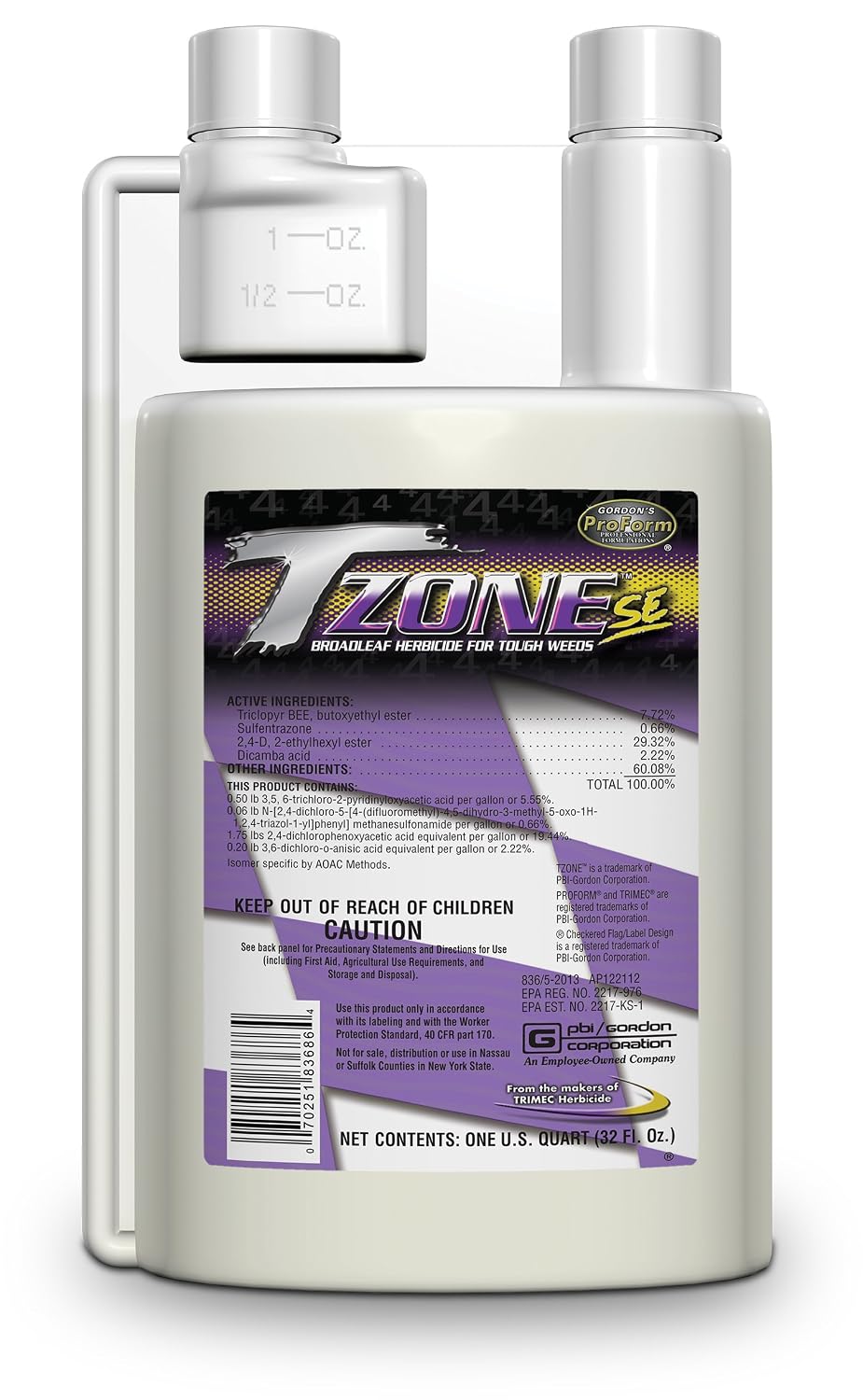
T-Zone Turf Herbicide (1 Quart) by PBI Gordon
| Unit Count | 32 Fluid Ounces |
|---|---|
| Item Form | Liquid |
| Coverage | broad-leaf weeds, grassy weeds |
| Active Ingredients | Dicamba, triclopyr, others |
T-Zone Turf Herbicide is a concentrated liquid formula intended for spot and broadcast treatment of tough broadleaf and grassy weeds in lawns and turf areas. It contains multiple active ingredients including triclopyr and dicamba that give a fast visual response and help suppress difficult targets such as yellow nutsedge and oxalis when used according to label directions. Typical use is mixing to label rates and applying with a handheld sprayer or professional equipment on cool, calm days to avoid off-target movement. Notable features include suitability for residential, commercial, and golf sites and effectiveness at lower temperatures down to about 50°F. Practical benefits are reliable performance on persistent broadleaf weeds and a multi-ingredient formula that reduces the need for repeat applications. Important limitations are the need for protective gear during handling, restrictions and careful timing to prevent damage to desirable plants, and the potential for off‑target drift, so precise application technique is required.
Best for: Buyers who prioritize reliable, professional-strength control of persistent lawn weeds and who are comfortable following label directions and using proper protective equipment. Ideal for property owners or groundskeepers who need a solution that performs in cool weather and on challenging species.
Less Ideal for: Casual gardeners who want an all‑purpose, low‑risk product for mixed plantings or those unwilling to follow pesticide safety practices should consider gentler, selective options.
- Multi‑ingredient formulation targets a broad spectrum of stubborn broadleaf and grassy weeds
- Works in cool conditions (around 50°F) so seasonal timing is more flexible
- Fast visible weed control that can reduce repeat treatments
- Suitable for use on residential, commercial, and golf turf sites
- Contains potent active herbicides that require careful handling and PPE
- Risk of off‑target movement means application must be precise and weather‑aware
Verdict: Choose T-Zone when you need a dependable, professional-strength herbicide to knock back stubborn oxalis and other persistent turf weeds.
Choosing the Right Herbicide for Virginia Buttonweed: Key Factors to Consider
Active Ingredient and Mode of Action
Different active ingredients work in distinct ways. Some are contact herbicides that desiccate aboveground tissue quickly but may not kill deep roots or creeping stems, while systemic herbicides are absorbed and translocated to roots, improving long-term control of perennial or stoloniferous weeds.
Knowing the mode of action helps set expectations about how many treatments are needed and whether follow-up cultural controls will be required. Rotate modes of action across seasons to reduce the risk of resistance developing in persistent populations.
Turfgrass Safety and Label Directions
Label-specified turf tolerances are crucial. Herbicides vary in what lawns they are safe on; some are formulated for warm-season grasses, others for cool-season lawns, and a few list specific acceptable species and establishment intervals.
Applying a product outside its labeled turf types or before the recommended establishment period can cause thinning, discoloration, or longer recovery times. Always match the herbicide label to your lawn species and follow rate and temperature restrictions to protect turf health.
Timing and Growth Stage of the Weed
Virginia buttonweed responds differently depending on growth stage and season. Young, actively growing plants are more vulnerable to uptake and translocation of systemic herbicides, while mature or drought-stressed patches may need repeat applications when growth resumes.
Spring and early summer applications during active growth often give the best results. Pay attention to label guidance about mowing windows before and after application since cutting too soon can reduce contact and uptake.
Application Method and Coverage
Spot treatment concentrates product where it is needed and limits exposure of desirable turf and landscape plants. Broadcast applications cover larger areas but require precise rate calibration to avoid overuse.
Proper nozzle selection, spray volume, and even coverage influence efficacy. For ground-hugging weeds, ensure spray reaches low foliage and avoid drift onto non-target plants.
Residual Activity and Follow-Up Needs
Some herbicides leave residual activity in the soil that can prevent re-emergence for weeks, while others act only on contact or systemic uptake with no lasting barrier. Residual control can reduce follow-up labor but may restrict overseeding or planting in treated areas for a set period.
Plan follow-up scouting and possible retreatment based on whether the chosen product provides lasting suppression or primarily short-term control.
Environmental and Safety Considerations
Consider runoff risk, temperature and rainfall windows, and buffer distances for water features. Read label instructions for personal protective equipment and post-application re-entry intervals.
Choosing lower-risk formulations and applying when weather conditions minimize drift and runoff protects pollinators, beneficial organisms, and nearby plantings.
When to Treat Buttonweed in the Lawn
Treat when plants are actively growing and the leaves are turgid, typically in late spring through summer for most regions. Applications during slow growth, or when plants are drought-stressed, yield uneven uptake and reduced long-term control.
- Avoid treatment during extreme heat or drought.
- Leave unmowed for a brief period before application to increase leaf area for contact and uptake.
- Monitor weather forecasts and avoid rain within the label-specified rainfast window.
Spot Treatment Best Practices
Spot treating patches allows you to use higher effective rates in problem areas while limiting turf exposure. Mix small batches as needed and apply with a handheld sprayer for accuracy. Use a targeted nozzle and maintain consistent walk speed to ensure even coverage.
- Apply until foliage is uniformly wet but not dripping.
- Record treatment dates and rates for each patch to avoid over-application.
- Consider flagging treated spots to prevent accidental reseeding until control is evident.
Combining Cultural Controls With Herbicide Use
Herbicide treatment is more durable when paired with cultural practices. Improve turf density through appropriate fertilization, irrigation scheduling, and overseeding with a compatible grass species to reduce space available for re-infestation. Mechanical removal of large mats after herbicide weakening can speed recovery.
- Core aeration helps grass roots recover in compacted areas.
- Adjust irrigation to favor turfgrass health without encouraging buttonweed spread.
- Reseed with a turf species listed as tolerant on the herbicide label after any required waiting period.
Managing Treatment in High-Value Landscapes and Beds
When buttonweed invades planting beds, use shielded wands or hand-painting to protect ornamentals. Non-selective sprays are risky around desirable plants; selective products or localized applications help limit injury. Consider temporary physical barriers when treating adjacent turf to prevent drift.
- Test a small hidden area if you are unsure about a plant's tolerance.
- Use absorbent materials to catch overspray on hard surfaces and dispose according to local guidance.
- Wait recommended intervals before transplanting or sowing in treated areas.
Monitoring and When to Reapply
After an initial application, scout treated patches every 2 to 3 weeks. Look for new growth from the margins or deeper crown recovery, which indicate the need for a follow-up treatment. Recovery of green tissue may take days to weeks depending on the mode of action and weather.
- Record whether regrowth is from seed or vegetative structures to inform future control strategies.
- Space follow-up applications according to label minimum intervals.
- Combine retreatment with corrective cultural actions in persistent areas.
How We Chose the Best Herbicide for Virginia Buttonweed
We selected products that give gardeners practical, repeatable control of Virginia buttonweed while minimizing collateral damage to turf and landscape plants. Editorial filters prioritized herbicides with documented activity against broadleaf ground-hugging weeds and formulations appropriate for broadcast or spot treatment in lawns. We required clear, labeled directions for timing, rates, and turf tolerances so homeowners can follow safe application practices. Evaluation criteria included the active ingredient's mode of action and systemic reach, label-listed turfgrass safety and species tolerances, application flexibility (spot spray versus broadcast), and residual control versus need for repeat treatments. We excluded products without explicit labeling for common lawn grasses or those lacking guidance for repeated use in a single season. Also excluded were generic mixes without clear active ingredient concentrations. The selected dimensions reflect what matters when managing a stubborn, low-growing weed in a lawn setting and align with the per-product scoring bars used on this page.
FAQ
Can I treat Virginia buttonweed in newly seeded lawns?
Usually not until the turf is well established. Most labels require a waiting period after seeding or sodding to avoid injury. Check the product label for specific establishment intervals before treating newly seeded turf.
Will a single application eliminate established buttonweed patches?
A single application often reduces top growth but may not eliminate deep-rooted or stoloniferous patches. Multiple treatments timed during active growth plus cultural corrections are commonly needed for lasting control.
Is spot treatment better than full-area spraying?
Spot treatment limits exposure of desirable grass and landscape plants and is efficient for isolated patches. Full-area spraying may be appropriate for widespread infestations but requires careful rate calibration and attention to turf tolerances.
How long after rain should I wait to apply a herbicide?
Wait until leaves are dry and follow the label rainfast interval, which commonly ranges from a few hours to a day. Applying when rain is imminent can reduce uptake and increase runoff risk.
Can I overseed right after treating buttonweed?
That depends on the product. Some herbicides have residual soil activity and require a waiting period before overseeding. Check the label for the specific replanting or reseeding interval to avoid damage to new seedlings.
Final Verdict
Control of Virginia buttonweed is most successful when you match the herbicide's mode of action and label turf tolerances to your lawn species and apply at the right growth stage. Prioritize products that offer systemic uptake for deep control when managing established patches, and use spot treatments to limit risk to desirable plants. Balance expectations: expect follow-up treatments and cultural corrections for persistent infestations. With careful timing, accurate application, and attention to turf safety, you can reduce buttonweed presence and restore dense, competitive grass cover.
