

Note: This article contains affiliate links. If you click on these links and make a purchase, I may earn a small commission at no extra cost to you. This helps support my research and content. Read my full affiliate disclosure here.
Picking the right budget sprinkler system matters because an inexpensive layout that sprays unevenly or wastes water will cost more over time in repairs and higher bills. In a typical yard or small commercial patch, you need reliable coverage, simple installation, and parts that hold up to seasonal use. This guide shortlists five top budget sprinkler systems suited to homeowners and small commercial properties. We focus on practical criteria like spray coverage, ease of installation, water efficiency, and durability so you can choose a setup that meets your watering schedule and maintenance preferences. Read on for the evaluation framework and what each shortlisted option delivers.
Top Picks at a Glance
| Best Overall The best all-around choice for most situations | Orbit All-in-One Automatic In-Ground Sprinkler System Kit (1-Zone) with Blu-Lock Tubing and Digital Timer | 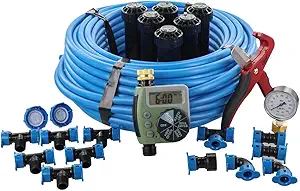 |
| Best Quality Built to a higher standard if you want something more solid | Rain Bird 32ETI Easy-Install In-Ground Automatic Sprinkler System Kit |  |
| Best Value The sweet spot between price and what you get | Bluepro 100ft Drip Irrigation Kit with 360° Adjustable Copper Nozzles |  |
| Best Budget The cheapest option that still gets the job done reliably | LZMYIVE 50 ft 360° Adjustable Drip Irrigation System Kit with 15 Copper Nozzles |  |
| Most Popular A crowd favorite that many people choose with confidence | Eden Weighted Essential Oscillating Sprinkler with Quick Connect Starter Set |  |
Orbit All-in-One Automatic In-Ground Sprinkler System Kit (1-Zone) with Blu-Lock Tubing and Digital Timer

| Power Source | Battery Powered |
|---|---|
| Hose Length | 125 feet |
| Maximum Pressure | 100 psi |
| Included Components | Poly Cutter, Gauge, 15 Blu-Lock Fittings, 6 Saturn III, Timer, Instructions |
| Material | Stainless Steel |
The Orbit All-in-One Automatic Sprinkler System kit turns a standard hose faucet into a simple one-zone underground-style irrigation system without tapping into household plumbing. It uses the Blu-Lock tubing and stainless steel retaining ring to speed installation and reduce leaks, and the kit includes six adjustable pop-up gear-drive sprinkler heads intended to give head-to-head coverage for small to medium lawns. A battery-powered digital timer with oversized controls handles scheduling and rain delay so you can set and forget routine watering. Practical benefits include substantially faster assembly than barb fittings, adjustable heads that can be fine-tuned in place, and a weatherproof timer that adds programmability without needing Wi-Fi. Limits to expect are single-zone coverage only, so larger or multi-zone properties will need additional kits or a different controller, and some buyers may prefer a hard-plumbed valve for a permanent installation. Overall the kit is a tidy, durable option for homeowners who want reliable automated watering with an easier install process.
Best for: Homeowners who want an efficient, easy-to-install automatic watering solution for a single lawn zone and prefer to optimize time and water use with programmable scheduling.
Less Ideal for: Large properties, multi-zone irrigation needs, or users who want a fully integrated Wi-Fi smart controller or a permanent hard-plumbed system should consider other options.
- Blu-Lock tubing with stainless steel retaining ring for quicker, stronger fittings and fewer leaks
- Six adjustable pop-up gear-drive sprinkler heads for uniform head-to-head coverage
- Includes battery-powered digital timer with programmable runtime and rain delay
- Kit ships with common installation tools and fittings so no extra parts are usually required
- Designed for a single zone only, so it does not cover larger multi-zone lawns by itself
- Not intended as a permanent hard-plumbed system to in-ground water mains
Verdict: A practical, faster-to-install one-zone automatic sprinkler kit that gives reliable, programmable watering without plumbing changes.
Rain Bird 32ETI Easy-Install In-Ground Automatic Sprinkler System Kit

| Maximum Pressure | 70 psi |
|---|---|
| Maximum Flow Rate | 12 gpm |
| Included Components | 6 pop-up rotors, 125' 1/2" tubing, hose-end timer and fittings |
The Rain Bird 32ETI kit turns a garden hose into a basic in-ground automatic sprinkler system for medium-sized lawns. The kit includes six pop-up rotary rotors, 125 feet of 1/2" tubing, a pro-grade hose-end timer and a full set of fittings and tools to complete a one-afternoon DIY install. The rotors use Rain Bird's Rain Curtain nozzle technology and adjustable arcs so you can tune coverage to avoid overspray and dry spots, while the hose-end timer supports daily scheduling, rain delay and two start times per day. For a performance-focused buyer this system delivers professional-style rotors and dependable timer controls without the need to tap into household plumbing. Limitations are that it relies on a single hose bib for supply so coverage and run times depend on your faucet pressure and flow, and the plastic components mean long-term durability will be lower than a hard-plumbed system. Expect a straightforward install and solid watering performance for lawns in the 1,000 to 3,000 sq ft range when used within recommended pressure and flow specs.
Best for: Homeowners who want professional-style sprinkler performance without hiring a plumber and prefer a DIY kit that installs to an outdoor faucet for medium lawns.
Less Ideal for: Large properties, landscapes that need multiple dedicated zones, or buyers who want a permanent hard-plumbed underground system tied to household irrigation lines.
- Includes everything needed for a single-afternoon DIY install (rotors, tubing, timer and fittings)
- Professional-grade 32SA rotors with Rain Curtain nozzle for even coverage and wind resistance
- Hose-end electronic timer with multiple start times, rain delay and easy programming
- Designed to water 1,000 to 3,000 sq ft from a standard outdoor faucet
- Depends on faucet pressure and flow so performance varies by home water supply
- Plastic fittings and tubing are less durable than a permanently plumbed system
Verdict: If you want near-professional rotor performance on a budget and prefer an easy DIY install that runs from a hose bib, this kit delivers reliable coverage for medium lawns.
Bluepro 100ft Drip Irrigation Kit with 360° Adjustable Copper Nozzles

| Size | 100FT |
|---|---|
| Included Components | 100ft 1/4" tubing, 16pcs nozzles, connector |
| Special Features | 360° adjustable nozzles; 4 flow modes; Push-Fit/Quick-Connect |
| Fit Type | Push-Fit/Quick-Connect |
The Bluepro 100ft drip irrigation kit supplies targeted water to beds, containers, and greenhouses using 1/4-inch tubing and 16 bendable 360° copper atomizing nozzles. It is set up by laying the tubing, attaching nozzles with the included push-fit connectors and diverters, then connecting to an external timer for automated schedules. Notable features include four flow modes on each brass nozzle for misting seedlings or delivering a steady drip to roots, leak-resistant quick-connect fittings that make reconfiguration fast, and UV/weather-resistant tubing with an aluminum core for added durability. In practice this kit reduces water waste by focusing moisture at plant bases and is easy to expand or shorten as beds change. Important limitations are that it is a surface micro-drip system rather than buried dripline so tubing can be exposed in high-traffic areas, and very hard water may require occasional nozzle cleaning despite brass construction. For someone wanting an affordable, no-fuss way to move from hand-watering to scheduled, efficient irrigation this kit covers the essentials well.
Best for: Gardeners who want to cut watering time and water use with an easy-to-install, reconfigurable system that works across raised beds, containers, and small vegetable plots.
Less Ideal for: Large-acreage irrigation or buried dripline installations where heavy machinery or permanent underground lines are required.
- Comes with 100 ft of 1/4" tubing and 16 adjustable 360° brass nozzles for targeted coverage
- Push-fit quick-connect fittings enable tool-free, leak-resistant assembly and fast reconfiguration
- Four flow modes per nozzle let you tailor output from fine mist to wide spray for different plant needs
- Weather-resistant tubing and metal nozzle components resist UV and corrosion for longer outdoor life
- Surface tubing remains exposed and can be a trip or mower hazard in some layouts
- Will require periodic nozzle cleaning if water is hard or contains sediment
Verdict: A practical, budget-friendly kit to automate and conserve water in small to medium gardens with easy tool-free setup and adjustable nozzles.
LZMYIVE 50 ft 360° Adjustable Drip Irrigation System Kit with 15 Copper Nozzles

| Size | 50 feet |
|---|---|
| Number of Pieces | 28 |
| Power Source | Water Pressure Driven |
| Special Features | 360° Adjustable Nozzles |
| Material | Copper |
This LZMYIVE kit provides a practical, low-cost way to set up targeted irrigation for raised beds and small garden plots. The kit includes a 50 foot hose, 15 copper nozzles with 360 degree adjustment and a range of snap-in connectors, nails and ties so you can run lines along bed edges, hang them in a greenhouse, or position emitters beside individual plants. No electricity or complex plumbing is needed because it runs on normal water pressure and the brass nozzles let you choose drip, spray or mist patterns and finely tune flow by the faucet. Installation is straightforward with the provided quick-connect tees, hose cutter and tape, and the metal nozzles should hold up better than plastic options. Limitations are that the kit is sized for small to medium beds only and you may need additional tubing or connectors for larger layouts, and water pressure at your spigot will affect reach and uniformity.
Best for: Gardeners on a tight budget who want an easy, no-fuss irrigation solution for small to medium raised beds or greenhouse benches and prefer durable metal nozzles over inexpensive plastic.
Less Ideal for: Those planning large multi-bed installations or drip systems requiring precise pressure regulation and professional-grade flow control should consider more scalable irrigation systems.
- 360° adjustable copper nozzles let you direct water precisely to plants
- Runs on household water pressure so no electricity or pumps required
- Comes with snap-in connectors, nails, ties and hose cutter for quick installation
- Includes multiple nozzle modes (drip, spray, mist) to match different plant needs
- 50 foot kit may be too short for larger raised-bed layouts without extra tubing
- Performance depends on household water pressure which can limit spray distance
Verdict: A budget-friendly, ready-to-install 50 ft kit that delivers targeted, adjustable watering for small raised beds using durable copper nozzles.
Eden Weighted Essential Oscillating Sprinkler with Quick Connect Starter Set

| Maximum Pressure | 60 psi |
|---|---|
| Maximum Flow Rate | 30 gpm |
| Nozzle Count | 16 precision nozzles |
| Coverage | Up to 3,600 sq. ft. |
The Eden Weighted Essential Oscillating Sprinkler delivers steady, even watering across mid‑to‑large lawns and garden beds up to about 3,600 square feet. It mounts on a weighted base so it stays put while a sealed turbo drive motor oscillates a bar with 16 precision nozzles for consistent spray distribution. Sliding range tabs let you limit how wide the spray is, and a built‑in nozzle cleaning tool helps clear clogs without disassembly. The included quick connect starter set and stainless steel filter washers simplify hookups and let you swap tools without shutting off the water. In practice this model is quiet, simple to position, and keeps water patterns uniform on level turf. Expect best results on relatively flat lawns where the coverage matches the stated footprint; very large properties will need multiple units or a different sprinkler type to avoid gaps. The unit is plastic, so durability under heavy seasonal use may lag behind metal alternatives, but the design and filters reduce maintenance and leaks for routine garden watering needs.
Best for: Buyers who want a reliable, easy‑to‑use sprinkler that produces uniform coverage for medium to large lawns and value social proof and low maintenance features when choosing a dependable product.
Less Ideal for: Not a great choice for very large estates or professional irrigation needs where metal, higher‑capacity, or multi‑zone systems are preferred.
- Even coverage from 16 precision nozzles for consistent watering patterns
- Weighted base provides stability during operation
- Adjustable range tabs allow precise area control to target lawns or beds
- Quick connect starter set and stainless steel filters simplify hookups and reduce leaks
- Built‑in nozzle cleaning tool makes maintenance fast and simple
- Plastic construction may wear faster than metal sprinklers under heavy seasonal use
- Coverage limited to about 3,600 sq. ft., so large properties may need multiple units
Verdict: A user‑friendly oscillating sprinkler that combines even coverage, a stable weighted base, and quick‑connect hookups for dependable mid‑sized lawn watering.
Choosing the Right Budget Sprinkler System: Key Factors to Consider
Coverage Pattern and Adjustability
How a sprinkler distributes water defines both lawn health and water waste. Good coverage pattern and simple adjustability let you aim spray to corners, flower beds, and narrow strips without soaking sidewalks or driveways.
Look for options with multiple nozzle trajectories and adjustable arc settings. Pop-up heads with easily changeable nozzles help dial in range and droplet size, which affects how quickly water soaks in versus running off. For irregular yards, systems that let you swap or fine-tune nozzles will save time and reduce dry spots.
Water Efficiency and Flow Control
Efficient systems match precipitation rate to soil infiltration and plant needs. Features such as low-flow nozzles, pressure regulation, and zone control reduce runoff and lower water use without sacrificing coverage.
Pay attention to advertised flow rates and whether the design includes pressure regulation or adjustable flow. Systems that break a yard into smaller zones let you water turf and beds on different schedules, optimizing water use for each plant type and soil condition.
Durability and Material Quality
Budget systems still need parts that survive sun, freezing cycles, and physical wear. Durability depends on materials for risers, valve housings, and nozzles, plus how well seals and springs resist degradation.
Plastic components vary widely. Thicker-walled polymers and brass valve parts last longer. Consider whether key parts like nozzles and seals are replaceable; a system with a few durable replaceable pieces often outlasts a cheaper all-in-one unit.
Ease of Installation and Compatibility
One of the biggest advantages of budget sprinkler systems is the potential to install without professional help. Clear piping diagrams, common fittings, and straightforward zone wiring reduce installation time and mistakes.
Verify compatibility with your water supply, existing controllers, and backflow prevention requirements. Systems that use standard PVC or polyethylene fittings and include simple trenching guidance will be easier to place and adjust for most DIY gardeners.
Serviceability and Spare Parts
Even inexpensive systems need occasional nozzle swaps, seal replacements, or valve servicing. Systems with modular components and widely available spares are simpler and cheaper to keep running.
Check whether manufacturer or third-party nozzles and replacement seals match common standards. Valve bodies that accept generic solenoids and pop-up heads with replaceable nozzles mean you can repair a system without replacing whole assemblies.
Zoning Flexibility and Controller Options
How many zones a system supports and how the controller schedules those zones affects water distribution across different areas. Good zoning lets you tailor run times for turf, shrubs, containers, and shaded areas.
Consider whether the system works with basic mechanical timers, smart controllers, or both. Flexibility to expand a system later by adding zones or connecting to a weather-based controller helps future-proof a budget installation.
Planning Your Layout Before You Buy
Start by sketching your yard and marking plant types, sun exposure, and slope. Note areas that need frequent watering such as new sod or thirsty bedding plants versus low-water ornamentals.
Measure distances for head spacing and identify potential water pressure limits. Planning zones around similar water needs reduces constant trial and error during setup.
- Map hardscapes to avoid overspray
- Group similar plant types into zones
- Measure water pressure at the tap if possible
Choosing Nozzles and Sprinkler Head Types
Different heads suit different purposes: fixed sprays are good for small beds, rotary nozzles cover larger turf efficiently, and micro-spray or drip adapters work for narrow borders. Matching head type to area size improves performance and reduces waste.
Consider droplet size and wind sensitivity. Fine mist nozzles lose more water to wind and evaporation, while larger droplets soak in better during short run times.
- Use rotary nozzles for larger, open turf areas
- Use fixed spray heads for small or irregular sections
- Use micro-sprays or drip for beds and near foundations
Typical Installation Steps and Common Pitfalls
A typical install includes laying out pipe runs, setting heads at correct heights and spacing, installing valves in a manifold, and wiring zones to a controller. Test runs during installation catch alignment errors and pressure issues before backfilling.
Common mistakes include overlong head spacing, ignoring pressure losses across long runs, and burying heads before testing. Leave easy access to valves and service points to simplify future repairs.
- Test each zone before burying pipes
- Account for pressure drops over long lateral runs
- Label valve wires and keep manifold accessible
Maintaining a Budget System Through Seasons
Seasonal maintenance keeps a low-cost system functioning. Flush lines at the start of the season, check for clogged nozzles and replace seals as needed, and winterize by draining or blowing out water where freezing occurs.
Regularly inspect heads for alignment and lawn damage. Small fixes early prevent larger leaks or dry patches that are harder to troubleshoot later.
- Flush and test at season start
- Replace worn nozzles and seals annually if needed
- Winterize according to local climate
Upgrading Parts Without Replacing the Whole System
You can often extend the life and performance of a budget sprinkler system by swapping in higher-quality nozzles, adding a pressure regulator, or replacing valve internals with more durable parts. These targeted upgrades are cost-effective and reduce waste.
Plan upgrades around the weakest link observed during the first season: if heads clog often, try better nozzles; if zones suffer from low pressure, consider a pressure-regulating valve or smaller-radius nozzles.
- Start with nozzles, then move to valve internals
- Add pressure regulation if you observe misting or runoff
- Keep a small parts kit on hand for quick repairs
How We Chose the Best Budget Sprinkler System
We focused on attributes gardeners and property managers actually interact with when installing and maintaining a budget sprinkler system. Selection started with systems designed for small to medium lawns and light commercial turf, excluding specialty agricultural or high-end landscape irrigation because those follow different engineering standards. We reviewed product literature, installation guides, user serviceability notes, and materials specifications to judge real-world suitability. Our editorial filters emphasized coverage pattern and adjustability so an entry-level system can water corners and narrow beds without overspray. Durability of key components such as nozzles, risers, and valve bodies was weighed to predict life under seasonal use. Ease of installation and compatibility with common water supplies and controllers mattered for gardeners who want minimal contractor work. Water efficiency metrics and nozzle options were considered to limit runoff and meet typical outdoor water restrictions. We also assessed repairability and parts availability since inexpensive systems vary widely in how easy they are to maintain or upgrade.
FAQ
Can a budget sprinkler system save water compared with hose watering?
Often yes. A properly zoned and timed sprinkler system applies water more evenly and can reduce overwatering pockets compared with a hose. Efficiency depends on nozzle choice, run times, and matching precipitation rates to soil infiltration.
Do I need a professional to install a budget system?
It depends. Many budget systems are designed for DIY installation with common fittings and clear instructions. However, complex yards, backflow requirements, or uncertain water pressure are reasons to consult a pro.
How do I winterize a budget sprinkler system?
Typical winterizing involves draining lines or using compressed air to blow out water where freezing is a risk. The exact method depends on local climate and whether the system has automatic drains. Follow manufacturer guidance for safe winter care.
What maintenance should I plan for the first year?
Expect to flush the system at startup, check and clean nozzles, adjust head alignment, and verify zone timing. Inspect valve boxes for leaks and replace small seals as needed. Early attention prevents many common failures.
Will a budget system work with smart controllers?
Usually yes. Many basic systems use standard zone wiring compatible with a wide range of controllers. Confirm voltage and wiring conventions before connecting a smart controller and consider adding a rain or soil moisture sensor for better efficiency.
Final Verdict
When choosing a budget sprinkler system, prioritize coverage pattern, water efficiency, and the replaceability of wear items. Those factors determine how well the system waters diverse planting areas and how affordable long-term ownership will be. Balance initial simplicity and DIY installability against the ability to service and upgrade parts later. If you plan zones thoughtfully and select adjustable, easily replaceable components, a budget system can deliver reliable, water-efficient performance for years.
