

Note: This article contains affiliate links. If you click on these links and make a purchase, I may earn a small commission at no extra cost to you. This helps support my research and content. Read my full affiliate disclosure here.
Keeping insects under control in a yard changes how you use outdoor space. The right bug spray for yards reduces biting pests, lowers tick and mosquito activity near patios and play areas, and can protect landscape edges and shrub lines without reapplying every hour. This guide covers the top short list of seven yard-focused products and explains the practical differences gardeners and homeowners should expect. We evaluate coverage area, how long protection lasts, application method, and environmental handling so you can pick the option that fits your yard size and outdoor routine.
Top Picks at a Glance
| Best Overall The best all-around choice for most situations | Spectracide Bug Stop Home Barrier 1.33 Gal AccuShot Sprayer Refill |  |
| Best Quality Built to a higher standard if you want something more solid | Ortho Home Defense Insect Killer for Indoor & Perimeter, 1.33 gal. with Comfort Wand |  |
| Best Value The sweet spot between price and what you get | Ortho BugClear Insect Killer for Lawns & Landscapes Ready-to-Spray, 32 oz |  |
| Best Budget The cheapest option that still gets the job done reliably | Spectracide Triazicide Insect Killer for Lawns & Landscapes, 32 oz |  |
| Highest Rated A top-rated pick with lots of positive feedback | Talstar One Insecticide Concentrate, 1 Gallon |  |
| Most Popular A crowd favorite that many people choose with confidence | Cutter Backyard Bug Control Spray Concentrate, 32 oz (2-Pack) |  |
| Best Seller A high-volume bestseller chosen again and again | Atticus Talak 7.9% Bifenthrin Indoor/Outdoor Insecticide Concentrate (32 oz) |  |
Spectracide Bug Stop Home Barrier 1.33 Gal AccuShot Sprayer Refill

| Unit Count | 170.24 Fluid Ounces |
|---|---|
| Item Form | Liquid |
| Target Species | Insects |
| Specification Met | Unscented |
| Included Components | 1.33 gallon refill |
This Spectracide Bug Stop Home Barrier refill is a large, water-based concentrate made to snap into the AccuShot continuous-power sprayer for targeted perimeter and indoor crack-and-crevice treatments. It kills on contact and lists ants, roaches, spiders, fleas and other common pests, and claims up to 12 months of control for cockroaches on non-porous surfaces. The clear, unscented formula leaves no oily residue, so it is practical for use along baseboards, door and window frames, and building foundations. Using it with the AccuShot wand reduces hand fatigue and the extendable wand improves reach and accuracy for treating foundations or tight gaps. Because it is a refill, you need the AccuShot sprayer to take full advantage of the continuous-spray wand, and the concentrate is intended for spot and perimeter treatments rather than broadcast lawn spraying. For a balanced yard-focused solution this delivers long-lasting indoor perimeter control and convenient application when paired with the compatible sprayer.
Best for: Homeowners who want a straightforward indoor and perimeter treatment that delivers long-lasting control and prefers a refillable spray system to avoid frequent small bottles.
Less Ideal for: People who need a product for broadcast lawn spraying or who do not have and do not want to buy the compatible AccuShot sprayer should consider alternative application formats.
- Large 1.33 gallon refill reduces the need for frequent repurchasing
- Water-based, clear formula leaves no odor or oily residue
- Kills on contact and lists long residual control for cockroaches on non-porous surfaces
- Designed for use with AccuShot wand for reduced hand fatigue and improved reach
- Requires the AccuShot sprayer to access continuous-power wand and extendable reach
- Formulation and packaging are for spot and perimeter treatments rather than broad lawn applications
Verdict: Buy this refill if you want a large, unscented indoor and perimeter insect treatment that pairs with the AccuShot wand for easy, accurate application.
Ortho Home Defense Insect Killer for Indoor & Perimeter, 1.33 gal. with Comfort Wand

| Item Form | Spray |
|---|---|
| Target Species | Insects |
| Liquid Volume | 1.33 gallons |
| Active Ingredients | Bifenthrin 0.05%, Zeta-Cypermethrin 0.0125% |
This 1.33 gallon Ortho Home Defense spray is designed to treat both indoor problem spots and the outdoor perimeter of a home to reduce ants, roaches, spiders and many other crawling and flying insects. It comes with a battery-powered Comfort Wand that delivers a continuous spray so you can apply a uniform band around foundations, patios and entry points without bending or pumping. The formula with bifenthrin and zeta-cypermethrin is intended to kill on contact and establish a barrier that the manufacturer says lasts up to 12 months for ants, roaches and spiders on non-porous indoor surfaces. In real-world use that means fewer repeat treatments in busy yard perimeters and around doors and windows. The spray dries clear with minimal fumes which helps for indoor use near kitchens and living areas. Limitations are that this is a chemical insecticide so users should follow safety directions around children, pets and plants and it is not a specific solution for pests not listed on the label. For homeowners focused on strong, perimeter-level protection this product simplifies application and covers a large area per container.
Best for: Homeowners who want a performance-focused perimeter treatment to reduce recurring yard and entry-point insect problems and prefer a ready-to-use product that is easy to apply.
Less Ideal for: People seeking organic or non-chemical control methods or those who need a targeted solution for pests not listed on the label should consider alternative products.
- Includes battery-powered Comfort Wand for continuous, fatigue-free application
- Ready-to-use 1.33 gallon container covers large perimeters without mixing
- Formula creates a barrier claimed to provide up to 12 months protection against ants, roaches and spiders on non-porous indoor surfaces
- Dries clear and gives off minimal fumes, making indoor use more practical
- Contains synthetic insecticides so precautions are required around children, pets and ornamentals
- Protection claims are specific to certain species and surfaces so results vary by pest and conditions
Verdict: A powerful, ready-to-use perimeter and indoor spray for homeowners who want long-lasting, performance-oriented protection against common yard and household insects.
Ortho BugClear Insect Killer for Lawns & Landscapes Ready-to-Spray, 32 oz

| Item Form | Aerosol |
|---|---|
| Target Species | Ant |
| Liquid Volume | 32 fluid ounces |
Ortho BugClear Ready-to-Spray is a hose-attached insect control designed for homeowners who want quick, broad protection across a yard without mixing concentrates. Attach the bottle to your garden hose, follow the label directions and spray lawn turf, foundation perimeters, ornamentals, trees and listed vegetables; one 32 oz bottle treats up to about 5,300 sq ft of lawn or smaller targeted areas. The formula kills a long list of pests on contact and claims fast activity within minutes plus extended residual control. Notable features include an odor-free, non-staining formulation and active ingredients (bifenthrin and zeta-cypermethrin) commonly used in landscape products. Practical benefits are fast application with a hose, coverage for both turf and foliage, and multi-pest control that helps prevent pest-damage and reduce biting insects. Important limitations are that it is a pesticide so you must follow safety directions to protect people, pets and pollinators and avoid spraying blooming plants; effectiveness can be reduced if applied shortly before rain; and it is not intended for indoor use or for gardeners who prefer non-chemical or organic options.
Best for: Buyers who want an efficient, no-mix solution to quickly treat lawns and perimeter areas and who prioritize ease of application and broad pest coverage.
Less Ideal for: People seeking organic, non-chemical pest control or those who need an indoor-safe product should consider alternative approaches.
- Ready-to-spray hose connection for fast, no-mix application
- Broad-spectrum control labeled for many common lawn and landscape pests
- Covers a large area from a single 32 fl oz bottle when used as directed
- Non-staining and low odor formulation suitable for residential use
- Contains synthetic insecticides that require protective clothing and careful application around pollinators
Verdict: If you want fast, no-mix yard protection delivered from a hose-ready bottle, this product delivers broad, easy-to-apply control for common lawn and landscape pests.
Spectracide Triazicide Insect Killer for Lawns & Landscapes, 32 oz
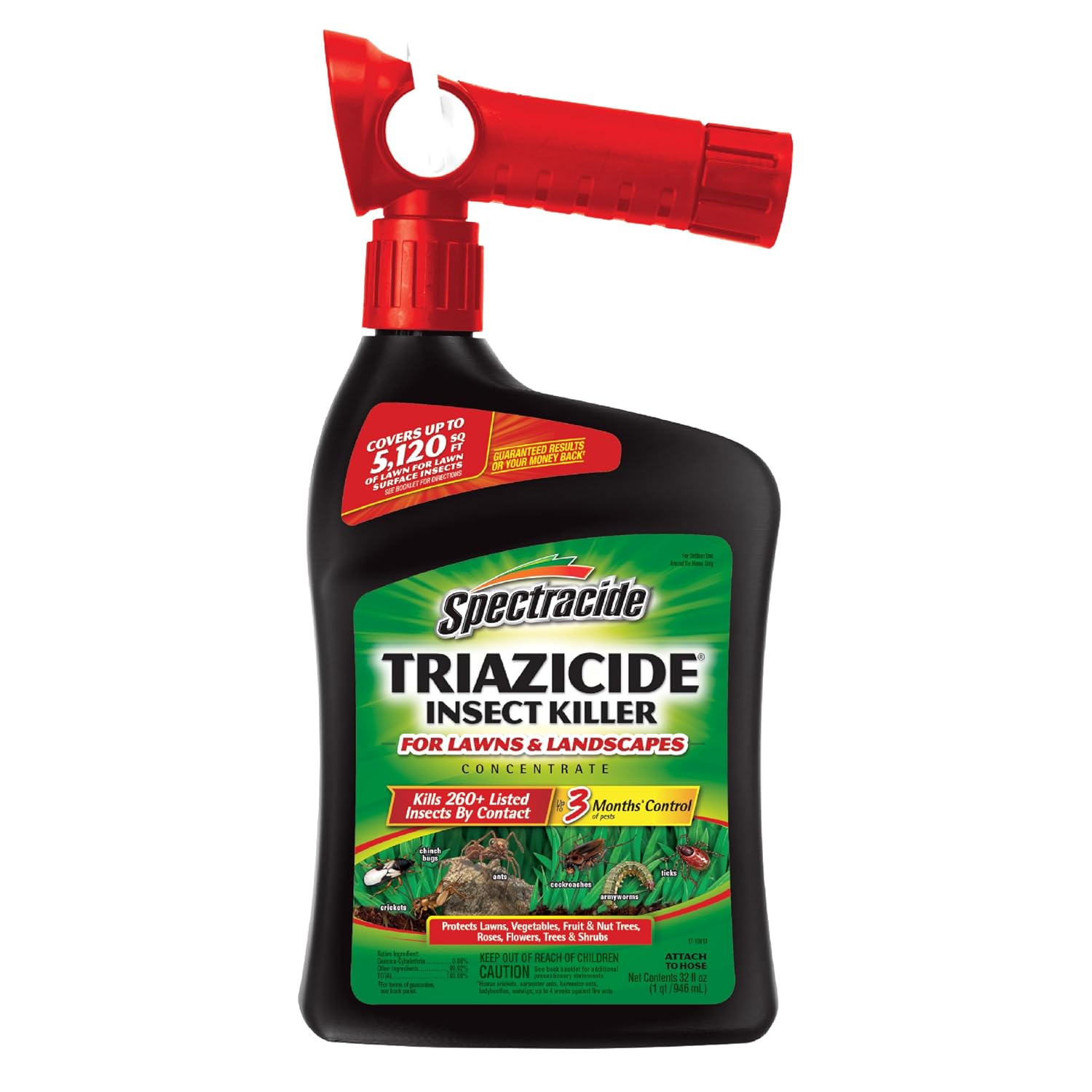
| Unit Count | 32 Ounce |
|---|---|
| Item Type Name | Lawn Insect Killer |
| Active Ingredients | Gamma-Cyhalothrin (0.08%) |
| Liquid Volume | 32 fluid ounces |
Spectracide Triazicide is a ready-to-dilute concentrate designed to protect lawns, flower beds, shrubs and around trees from a wide range of pests. You mix the concentrate with water and apply it with a tank sprayer or the hose-end applicator to treat surface and soil insects; the label claims coverage for large areas and knockdown in about 24 hours for many pests. Notable features include a broad-spectrum active ingredient (gamma-cyhalothrin 0.08%), stated protection for up to three months, and use instructions for turf, ornamentals and vegetable areas. In practice this product is effective for homeowners who need fast contact control of ants, fleas, ticks, Japanese beetles and many listed insects across lawns and landscaped beds. Important limitations are safety and environmental precautions: it is highly toxic to fish and bees, requires careful application to avoid drift and runoff, and users must follow label directions for timing and reentry. For budget-minded yards that need a strong, multiuse insecticide, this concentrate stretches coverage when mixed correctly but must be used responsibly around pollinators and water.
Best for: Homeowners looking to treat whole-yard pest problems on a budget who want a concentrate they can dilute to cover large areas and handle a wide variety of insects.
Less Ideal for: People who need an organic, pollinator-safe, or water-safe option for sensitive sites or small container gardens should consider gentler alternatives.
- Broad-spectrum concentrate that lists control for more than 260 insects including ants, fleas, ticks and Japanese beetles
- Can be mixed for tank or hose-end application to cover large lawn and landscape areas
- Fast knockdown for many pests with label guidance for up to three months of protection when used as directed
- Non-staining when used according to label and suitable for use on lawns, flower beds, shrubs and around trees
- Highly toxic to fish and dangerous to bees if applied to blooming plants or allowed to drift
- Requires careful mixing and application to avoid runoff and environmental harm
Verdict: A cost-effective concentrate for homeowners who need broad, large-area insect control across lawns and landscapes.
Talstar One Insecticide Concentrate, 1 Gallon

| Active ingredient | Bifenthrin 7.9% |
|---|---|
| Formulation | Concentrate, water-based |
| Intended use | Perimeter, structure, lawns, ornamentals, indoor crack-and-crevice |
Talstar One is a 1-gallon bifenthrin concentrate formulated for perimeter, structural and limited indoor spot treatments. It mixes with water to create sprays for foundations, doorways, lawns and ornamental plantings, and the label allows both outdoor perimeter use and targeted crack-and-crevice indoor application. Notable features include a water-based, low-odor formula that dries clear and delivers residual activity, so a single application can protect treated areas for weeks. Because it is a concentrate, it stretches farther than ready-to-use products and is practical for larger yards or seasonal maintenance. Users should follow label directions closely since bifenthrin is a professional-grade pyrethroid and not suitable for broadcast use where label restrictions apply. Also avoid treating flowering plants while bees are active and keep pets away from freshly treated surfaces until dry. For homeowners seeking dependable, long-lasting perimeter control, Talstar One offers a professional-strength option that reduces the need for frequent reapplications.
Best for: Homeowners responsible for yard and perimeter protection who prioritize a dependable, long-lasting solution and are comfortable using concentrated insecticide according to label instructions.
Less Ideal for: Gardeners who need an all-purpose pollinator-safe product or those unwilling to follow safety and application restrictions should consider gentler alternatives.
- Controls a wide range of pests including ants, spiders, fleas, ticks and mosquitoes
- Concentrated formula mixes with water so one gallon treats large areas or multiple jobs
- Low-odor, water-based formula that dries clear and is suitable for use around homes and outdoor living spaces
- Provides residual protection so treated areas remain effective for weeks
- Professional-strength active ingredient requires careful reading and strict adherence to label directions
- Not appropriate for application to flowering plants while pollinators are active
Verdict: Choose Talstar One when you want a concentrated, professional-strength perimeter treatment that delivers reliable, long-lasting control for yards.
Cutter Backyard Bug Control Spray Concentrate, 32 oz (2-Pack)

| Unit Count | 64 Fluid Ounces |
|---|---|
| Item Form | Spray |
| Target Species | Insects |
| Active Ingredients | Lambda Cyhalothrin |
The Cutter Backyard Bug Control Spray Concentrate is a hose‑end insect control for lawns, shrubs and outdoor surfaces that kills mosquitoes, ants, fleas and other listed insects. It comes with a QuickFlip hose‑end sprayer so you attach it to a garden hose and apply a thorough cover spray without pre‑mixing. In practice you measure the treatment area, spray until foliage and turf are wet, and repeat as directed to maintain control. The formula is positioned to give extended control up to about 12 weeks for several common pests and one bottle covers large yards up to 5,000 square feet. Practical benefits include fast knockdown of listed insects, easy coverage of broad areas with the hose‑end nozzle, and guidance for foliar or landscape use. Important limitations are that it is a chemical insecticide so treated areas must remain dry until the product dries and you must follow label restrictions around water bodies and vegetable gardens. Also safety precautions are required around children and pets until the spray has dried.
Best for: Homeowners who want a proven, easy‑to‑apply yard insect control that covers large lawns and provides extended knockdown without mixing products.
Less Ideal for: People who prefer nonchemical or organic pest control approaches or who need a product approved for use around edible gardens without strict label constraints.
- QuickFlip hose‑end sprayer lets you apply directly from the bottle with no measuring or mixing
- Covers up to 5,000 square feet per bottle for large yards
- Claims residual control up to 12 weeks against several common lawn pests
- Targets a range of insects including mosquitoes, listed ants and fleas
- Contains a chemical insecticide that requires keeping children and pets away until treated areas dry
- Not suitable for application near drains or aquatic habitats and has label restrictions for some regions
Verdict: A convenient hose‑end concentrate that quickly treats large yards and provides extended control of common lawn insects.
Atticus Talak 7.9% Bifenthrin Indoor/Outdoor Insecticide Concentrate (32 oz)

| Liquid Volume | 32 fluid ounces |
|---|---|
| Active Ingredients | Bifenthrin |
| Item Form | Liquid |
| Specification Met | EPA |
| Target Species | Insects |
Talak 7.9% is a concentrated liquid insecticide formulated for both yard and limited indoor perimeter use. You dilute the product with water and apply it with a pump or handheld sprayer to lawns, shrubs, foundations, patios, eaves, and interior baseboards to create a residual barrier. The 7.9% bifenthrin formulation kills on contact and is labeled to control a long list of common yard pests including ants, ticks, mosquitoes, chiggers, and many chewing and sucking insects, and one application can last up to three months. The water-based formula dries clear, leaves no odor or residue, and is described as non-phytotoxic so it is safe on treated plants when used as directed. Practical benefits include flexible dilution rates for turf, landscape, and surface treatments and an easy-pour bottle for measured mixing. Important limitations are that mixed solution should not be stored and the product is not approved for fogging or sale in a few states, so check the label and local regulations before use. Follow label directions carefully for safe application around people, pets, and food areas.
Best for: Homeowners who want a reliable, long-lasting perimeter and landscape insect control solution and who prefer a labeled product with established active ingredient effectiveness.
Less Ideal for: People seeking an immediate ready-to-use spray without mixing or those who need fogging applications or products available in states where this concentrate is restricted.
- Broad-spectrum control of more than 75 indoor and outdoor insect pests including mosquitoes and ticks
- Residual activity up to three months per labeled application
- Water-based formula dries clear, is odor-free, and is labeled non-phytotoxic to plants
- Flexible dilution rates allow treatments for turf, landscapes, and perimeter surfaces
- Easy-pour bottle design for measured mixing and less mess
- Mixed spray cannot be stored and must be used the same day
- Not approved for use in foggers
- Product not available for sale in some states
Verdict: A flexible, water-based bifenthrin concentrate that gives homeowners long-lasting, broad-spectrum yard and perimeter protection when mixed and applied per label instructions.
Choosing the Right Bug Spray for Yards: Key Factors to Consider
Coverage Area Per Application
Coverage area matters because it determines how much product you need and how long treating a yard will take. A concentrate that dilutes to treat several thousand square feet reduces trips to the store and lowers the frequency of reapplication for larger properties. For small yards, a ready-to-use option might be faster, but those often cost more per treated square foot.
Think in square feet rather than bottle size. Coverage estimates assume correct mixing and even application. Overlapping sprays and treating hard-to-reach edges can increase real-world use, so plan a modest margin over the stated coverage figure.
Residual Protection Duration
Residual protection is how long treated vegetation, perimeter zones, or turf continue to repel or kill pests after application. Longer residuals mean fewer applications during peak mosquito or tick season and less labor for maintenance treatments. However, residual length depends on weather, UV exposure, and mowing or irrigation patterns.
If you need continuous protection for patios or play areas, prioritize products with documented multi-week residuals and clear instructions on reapplication timing. For ephemeral events, a shorter-residual product applied the day of use may be more appropriate and reduce cumulative environmental load.
Application Method and Equipment
Application method affects accuracy, speed, and coverage uniformity. Hose-end sprayers are convenient for border and turf treatments but deliver less precise droplet sizes. Handheld pump sprayers or battery-powered backpack sprayers provide better control around shrubs, under eaves, and in dense plantings. Some products are formulated only for certain delivery systems, which limits flexibility.
Also consider mixing convenience and whether the product requires special PPE for handling. Ease of cleaning equipment after use matters because residues left in sprayers can contaminate future mixes or damage nozzles.
Target Pest Spectrum
Different yard bug sprays target different pest groups. Some focus on mosquitoes and black flies, others add hard-bodied pests like ticks and chiggers, and a few include flea control for yards with pets. Knowing which pests are your primary problem helps narrow options and avoid overuse of broad-spectrum chemistries when a narrower product will suffice.
Check label directions for specific pests and life stages controlled. Some formulations are more effective against adult insects, while others interrupt larval development or have ovicidal activity, which affects long-term yard population control.
Environmental and Pollinator Considerations
How a product behaves in the environment matters for safety around pollinator plantings, vegetable gardens, and water features. Labels will indicate restrictions near water and provide guidance for minimizing runoff. Products with lower persistence on foliage and clear pollinator precautions reduce risk when treating near flowering plants.
If pollinators are present, treat nonflowering periods, apply in the evening, and avoid spraying directly on blooms. Also consider the compound's breakdown profile and whether it binds to soil or washes into gutters during heavy rain.
Residual Odor and Human Safety
Some yard sprays leave a noticeable odor that can bother family members or neighbors and affect outdoor gatherings. Odor intensity is a practical factor for proximity to living spaces and can influence when you choose to treat a yard. Also review personal protective equipment recommendations for mixing and application to ensure you are comfortable following label directions.
Look for clear re-entry intervals on labels for treated areas and guidance on when it is safe for children and pets to return. Shorter re-entry times increase flexibility for homeowners who use outdoor spaces frequently.
Understanding Active Ingredients
Active ingredients determine how a product interacts with pests and the environment. Pyrethroids and pyrethrins are common in yard sprays for quick knockdown and short-to-moderate residual control. Other chemistries provide longer-lasting control against ticks but may carry stricter environmental precautions.
Read label language about turf, ornamental, and perimeter use. Some actives are labeled for spot treatments only and should not be applied over large garden plantings. Match the active ingredient profile to your target pests and yard layout.
- Pyrethroids: good knockdown and moderate residual
- Pyrethrins: organic-derived, shorter residual
- Insect growth regulators: disrupt development rather than immediate kill
Application Timing and Weather
Timing matters for efficacy. Apply treatments late in the day or in the evening when pollinators are less active and mosquitoes are most active. Avoid spraying before heavy rain or irrigation since water will reduce residual protection and increase runoff risk.
Wind and temperature affect droplet drift and evaporation. Choose a calm day and follow label temperature limits to get the best results and avoid non-target exposure.
- Spray in low wind conditions
- Avoid immediate pre-rain windows
- Evening applications reduce pollinator impact
Targeted Perimeter and Hotspot Treatments
Treating the perimeter and known hotspots is a practical strategy that reduces overall chemical use while targeting the areas pests use to enter or breed. Focus on shrub bases, fence lines, under decks, and shady moist zones where ticks and mosquitoes rest. Creating a treated barrier around seating and play areas can lower bite risk without treating the entire lawn.
Spot treatments also let you avoid spraying pollinator-attractive beds and vegetable gardens while still protecting high-use outdoor spaces.
- Treat edges and dense vegetation where pests hide
- Reserve full-lawn treatments for severe infestations
- Inspect and retreat high-traffic zones more often
Safe Practices Around Children and Pets
Follow label directions for re-entry intervals and pet safety. Keep children and animals off treated areas for the recommended time and store mixed solutions out of reach. Some products permit pet-safe re-entry after drying, while others require longer waits.
Rinse application equipment outdoors away from water drains and wash hands and clothing after use to reduce incidental exposure.
- Observe label re-entry intervals
- Prevent pets from grooming treated foliage until safe
- Store and dispose of unused product per instructions
Combining Cultural Controls with Treatments
Reducing standing water, maintaining lawn height, and removing leaf litter all lower pest habitat and amplify chemical treatments. Cultural practices reduce the need for frequent spraying and help slower-degrading products remain effective longer.
Integrating nonchemical tactics, such as moving bird feeders or pruning dense shrubs, targets the habitats pests use and improves long-term yard comfort.
- Eliminate standing water to cut mosquito breeding
- Mow and edge to reduce tick-friendly habitat
- Use traps and lighting adjustments to lower night-flying pests
How We Chose the Best Bug Spray for Yards
We prioritized features that matter in real yard and landscape use rather than lab-only metrics. Key evaluation criteria included coverage area per application because yard size determines how often you need to treat; residual protection duration so readers know how long treated zones remain effective; application method and equipment compatibility since one option might suit a hose-end spray while another is better for backpack sprayers; and target pest spectrum to ensure products control mosquitoes, ticks, fleas, and other common yard pests. We also assessed safety and environmental handling: signal words, whether the active ingredients are labeled for turf and ornamentals, and guidance on runoff and pollinator exposure. Ease of use and cleanup were considered so a product that is hard to mix or rinses poorly does not score as highly. We excluded products labeled only for indoor use, aerosol personal repellents intended for skin, and options that lack clear yard or turf labeling. Our shortlist focuses on scalable yard treatments and garden-safe usage instructions that fit common residential landscapes.
FAQ
How long after spraying is it safe for kids and pets to re-enter the yard?
Re-entry intervals vary by product and formulation. Many ready-to-use sprays are safe once treated surfaces are dry, often within a few hours, while concentrates or longer-residual products may require longer waits. Always follow the label's re-entry and pet-safety instructions.
Can I spray near flower beds without harming pollinators?
You can minimize pollinator exposure by avoiding direct sprays to blooms, treating in the evening when pollinators are inactive, and using targeted perimeter applications instead of blanket sprays. If pollinators are active, avoid spraying flowering plants altogether.
How often should I reapply treatments during peak mosquito season?
Reapplication frequency depends on product residual claims and local weather. Some products provide multi-week protection under dry conditions. Heavy rain, frequent irrigation, or high UV exposure shortens residual time, so inspect treated areas and follow label reapplication intervals.
Are natural or botanical sprays effective for yard pest control?
Botanical options can offer short-term knockdown and are attractive for low-to-moderate pest pressure or around pollinator plantings. They typically have shorter residual activity and may require more frequent applications compared with synthetic chemistries.
Will treating my yard affect nearby water features or drainage?
Some actives have restrictions near water and can be harmful to aquatic life. Read label directions for setbacks and runoff precautions, avoid spraying before heavy rain, and take steps to prevent treated water from entering ponds or storm drains.
Final Verdict
Choose a yard bug spray by matching coverage and residual needs to your property size and outdoor use. Prioritize products with clear label instructions for the pests you face, and pick an application method that fits your equipment and comfort level. Balance protection goals with environmental and pollinator precautions. For frequent outdoor use, favor options with longer residuals and straightforward re-entry guidance; for occasional events or pollinator-sensitive yards, choose targeted or shorter-residual solutions.
