

Note: This article contains affiliate links. If you click on these links and make a purchase, I may earn a small commission at no extra cost to you. This helps support my research and content. Read my full affiliate disclosure here.
Picking the right insecticide spray for home matters because indoor pest treatments affect people, pets, and the surfaces you live with. You need a product that stops crawling and flying insects quickly without leaving overly toxic residues or damaging fabrics and finishes. This guide covers seven top picks shortlisted for home use and explains the key tradeoffs gardeners and homeowners face when treating infestations inside or in adjacent entry areas. We evaluate each option for indoor safety, residual effectiveness, ease of application, and suitability for common household pests.
Top Picks at a Glance
| Best Overall The best all-around choice for most situations | Ortho Home Defense Insect Killer Refill, 1 gal. |  |
| Best Quality Built to a higher standard if you want something more solid | Ortho Home Defense Max Indoor Insect Barrier, Wand, 1 gal |  |
| Best Value The sweet spot between price and what you get | Spectracide Bug Stop Home Barrier 1.33 Gal AccuShot Sprayer Refill |  |
| Best Budget The cheapest option that still gets the job done reliably | Raid Ant & Roach Killer Spray, Lemon Scent, 17.5 oz |  |
| Highest Rated A top-rated pick with lots of positive feedback | Envu Tempo SC Ultra Insecticide Concentrate, 240 ml |  |
| Most Popular A crowd favorite that many people choose with confidence | Mighty Mint Peppermint Oil Insect Repellent Spray, 16 oz |  |
| Best Seller A high-volume bestseller chosen again and again | Atticus Talak 7.9% Bifenthrin Indoor/Outdoor Insecticide Concentrate (32 oz) |  |
Ortho Home Defense Insect Killer Refill, 1 gal.

| Unit Count | 128 Fluid Ounces |
|---|---|
| Item Form | Liquid |
| Target Species | Insects |
| Active Ingredients | Bifenthrin, Zeta-Cypermethrin |
This one-gallon Ortho Home Defense refill is designed to top up a reusable applicator for indoor and perimeter insect control. It contains bifenthrin and zeta-cypermethrin in a ready-to-use liquid that dries clear and gives up to 12 months of residual protection against ants, roaches and spiders on non-porous indoor surfaces. Typical use is spraying a 4-inch band indoors or a 12-inch band around foundations, patios and doorways until surfaces are slightly wet. The formula offers practical benefits for busy homeowners: it is low-odor thanks to Invisi-Shield Technology, covers large areas from a single container, and works on a wide range of pests including fleas, ticks and mosquitoes. Important limitations are that the month-long residual claim applies specifically to certain pests and non-porous indoor surfaces, and it is a chemical control that requires following safety directions around children, pets and treated areas. This refill is best paired with the original Ortho applicator or comfort wand for easy, controlled application.
Best for: Homeowners who want a practical, low-odor chemical barrier to reduce recurring indoor and perimeter insect problems and prefer using a refillable applicator for larger coverage.
Less Ideal for: People seeking non-chemical or organic pest control methods or those who need treatments specifically formulated for porous surfaces or sensitive indoor environments.
- Large one-gallon refill reduces frequency of repurchasing and is economical for whole-house perimeter treatments
- Invisi-Shield formula dries clear, gives off no noticeable fumes and is suitable for indoor use on non-porous surfaces
- Provides up to 12 months residual control for ants, roaches and spiders when applied as directed
- Ready-to-use liquid works with existing Ortho applicator bottles and comfort wand for straightforward application
- Residual protection claim is limited to specific pests and surface types and may not apply outdoors for all insects
- Contains synthetic insecticides so users must follow safety precautions around children, pets and treated plants
Verdict: Buy this refill if you want an economical, low-odor ready-to-use insecticide that creates a long-lasting indoor and perimeter barrier for common household pests.
Ortho Home Defense Max Indoor Insect Barrier, Wand, 1 gal

| Item Form | Spray |
|---|---|
| Target Species | Insects |
| Liquid Volume | 1 gallons |
| Active Ingredients | bifenthrin 0.05% |
Ortho Home Defense Max is a one-gallon ready-to-use insect barrier designed for indoor use with the included Extended Reach Comfort Wand for easier application. It targets ants, cockroaches, spiders, fleas, ticks and many other listed pests and is intended for spot treatments around windows, doors, kitchens, bathrooms and basements or applied to foundations outdoors as a perimeter barrier. Notable features include a fast-drying, low-odor formula that is non-staining and an active ingredient of bifenthrin 0.05% that provides residual control; the label claims protection up to 365 days against ants, roaches and spiders on nonporous surfaces. Practical benefits are simple application without mixing, reduced bending when treating baseboards and a product framed for both immediate knockdown and seasonal prevention. Limitations are that lasting efficacy depends on surface type and reapplication schedule, it is formulated for nonporous indoor surfaces, and standard safety precautions are required to keep children and pets away until treated areas dry.
Best for: Buyers who prioritize strong, long-lasting indoor pest control and want a simple, professional-style application without mixing concentrates, especially for treating baseboards, entry points, and perimeter areas.
Less Ideal for: People seeking an all-natural or organic indoor insecticide or those who need a product specifically formulated for porous surfaces or heavy outdoor infestation control.
- Ready-to-use formula requires no dilution or measuring
- Extended Reach Comfort Wand makes treating baseboards and tight spots easier
- Fast-drying, low-odor, and non-staining for indoor use
- Contains bifenthrin 0.05% for residual protection against common pests
- Performance on porous surfaces and outdoors varies and may require more frequent reapplication
- Contains a synthetic active ingredient that requires adherence to label safety instructions
Verdict: Choose this ready-to-use spray when you want a powerful, easy-to-apply indoor insect barrier that delivers long-lasting control with a comfort wand for hard-to-reach spots.
Spectracide Bug Stop Home Barrier 1.33 Gal AccuShot Sprayer Refill

| Unit Count | 170.24 Fluid Ounces |
|---|---|
| Included Components | 1.33 gallon refill |
| Item Form | Liquid |
| Target Species | Insects |
| Specification Met | Unscented |
This 1.33 gallon Spectracide Bug Stop Home Barrier refill is made to convert the AccuShot sprayer into a ready-to-use indoor and outdoor insect control tool. The clear, water-based liquid kills on contact and is labeled for ants, roaches, spiders, fleas, silverfish and other listed insects, and claims up to 12 months control of cockroaches on non-porous surfaces. In practice it is used to spray cracks and crevices indoors, baseboards, under appliances and along foundation lines outside to form a perimeter barrier. The AccuShot cap and battery-powered wand give continuous spray with a two-finger trigger and extendable wand to reduce hand fatigue and improve accuracy. Because the formula is unscented and leaves no oily residue it is practical for use inside living areas when directions are followed. Limitations are that it is a refill only so you need the AccuShot sprayer to apply, and as with any contact insecticide repeat treatments or integrated prevention may be required for heavy or persistent infestations.
Best for: Homeowners who want a practical, low-fuss perimeter and spot-treatment solution and who already own or plan to use the AccuShot sprayer to minimize application effort.
Less Ideal for: People without the AccuShot sprayer or those seeking a one-off aerosol can for occasional spot use should consider ready-to-use spray products instead.
- Large 1.33 gallon refill reduces the need for frequent repurchases
- Water-based, clear formula that leaves no odor or oily residue
- Kills a broad range of common household insects and provides up to 12 months cockroach control on non-porous surfaces
- Works with AccuShot power sprayer for reduced hand fatigue and better reach
- Sold as a refill only so it requires the AccuShot sprayer to apply
- Effectiveness for long-term control depends on correct application and may need follow-up treatments
Verdict: If you need a cost-effective, unscented refill for routine indoor and perimeter insect control and plan to use the AccuShot sprayer, this provides large-volume, easy-to-apply protection.
Raid Ant & Roach Killer Spray, Lemon Scent, 17.5 oz

| Unit Count | 17.5 Ounce |
|---|---|
| Item Form | LIQUID |
| Active Ingredients | IMIPROTHRIN 0.060%, CYPERMETHRIN 0.100% |
| Residual Effect | Up to 13 weeks (claimed) |
Raid Ant & Roach Killer is a straightforward aerosol insecticide for indoor use that targets ants, roaches and a range of other crawling pests. Shake and spray directly on infested surfaces such as baseboards, under sinks, garbage cans and in basements or garages; the formula kills on contact and leaves a residual effect claimed to last up to 13 weeks for roaches and carpenter ants. Notable features include broad-spectrum efficacy against silverfish, crickets and household spiders, a lemon scent to reduce chemical odor, and a familiar brand formulation containing imiprothrin and cypermethrin. In practice this makes it a convenient spot-treatment for visible trails and harborages and for periodic maintenance of problem areas. Important limitations are that it is an aerosol meant for surface application only so it is not a substitute for baits or professional perimeter treatments, and it contains standard synthetic active ingredients that require careful use around pets, children and food-preparation areas per label instructions.
Best for: Homeowners who want an affordable, easy-to-use spray to quickly control visible ants and roaches and to maintain treated indoor areas between deeper interventions.
Less Ideal for: People looking for non-chemical, pet-safe long-term prevention or those who need outdoor perimeter control or bait-based solutions should consider alternatives.
- Kills on contact and provides claimed residual control for up to 13 weeks on treated surfaces
- Broad-spectrum activity against many common crawling household insects
- Lemon scent reduces strong chemical odor compared with unscented aerosols
- Easy aerosol application for quick spot treatments in kitchens, basements and garages
- Aerosol surface spray only so not a long-term replacement for bait stations or perimeter treatments
- Contains synthetic active ingredients that require following label safety precautions
Verdict: A budget-friendly, easy aerosol for quickly knocking down ants and roaches and keeping treated indoor spots clear for weeks.
Envu Tempo SC Ultra Insecticide Concentrate, 240 ml

| Item Volume | 240 ml |
|---|---|
| Item Form | Liquid |
| Target Species | Ants, flies, cockroaches, crawling pests, and ticks |
| Scent Name | Chalk-like |
Tempo SC Ultra is a water-based suspension concentrate insecticide designed for perimeter and targeted indoor/outdoor treatments against ants, spiders, cockroaches and other crawling pests. You mix the concentrate with water per label directions and apply it as general surface, spot, crack-and-crevice or perimeter treatments around foundations, doorways, garages and basements. The formula uses beta-cyfluthrin for quick knockdown plus residual activity, so treated surfaces continue to reduce pest activity between applications. Practical benefits include a low chalk-like odor, non-staining claim and a small-volume concentrate that treats large areas, which makes it convenient for routine maintenance. Because it is a professional-grade active ingredient in concentrate form, accurate dilution and label-following are required and personal protective equipment should be used during mixing and application. This product is best when used by people comfortable with concentrated insecticides who want reliable, long-lasting perimeter protection rather than occasional spot sprays.
Best for: Homeowners or property managers who prioritize dependable, long-lasting perimeter pest control and are comfortable mixing and applying a concentrated insecticide for routine maintenance.
Less Ideal for: Casual users who want an out-of-the-bottle ready-to-use spray or those unwilling to follow label safety and dilution instructions.
- Broad-spectrum active ingredient (beta-cyfluthrin) gives fast knockdown and residual control
- Concentrate formula treats large areas with small volume, useful for routine perimeter maintenance
- Suitable for indoor and outdoor use including cracks, crevices, foundations and entry points
- Low odor and non-staining formulation reduces nuisance during and after application
- Requires correct dilution and safety precautions since it is a concentrated professional-grade insecticide
- Not a ready-to-use spray so additional mixing equipment and time are needed
Verdict: Choose this concentrate when you want a reliable, low-odor insecticide that delivers fast knockdown plus lasting perimeter protection for routine home pest control.
Mighty Mint Peppermint Oil Insect Repellent Spray, 16 oz
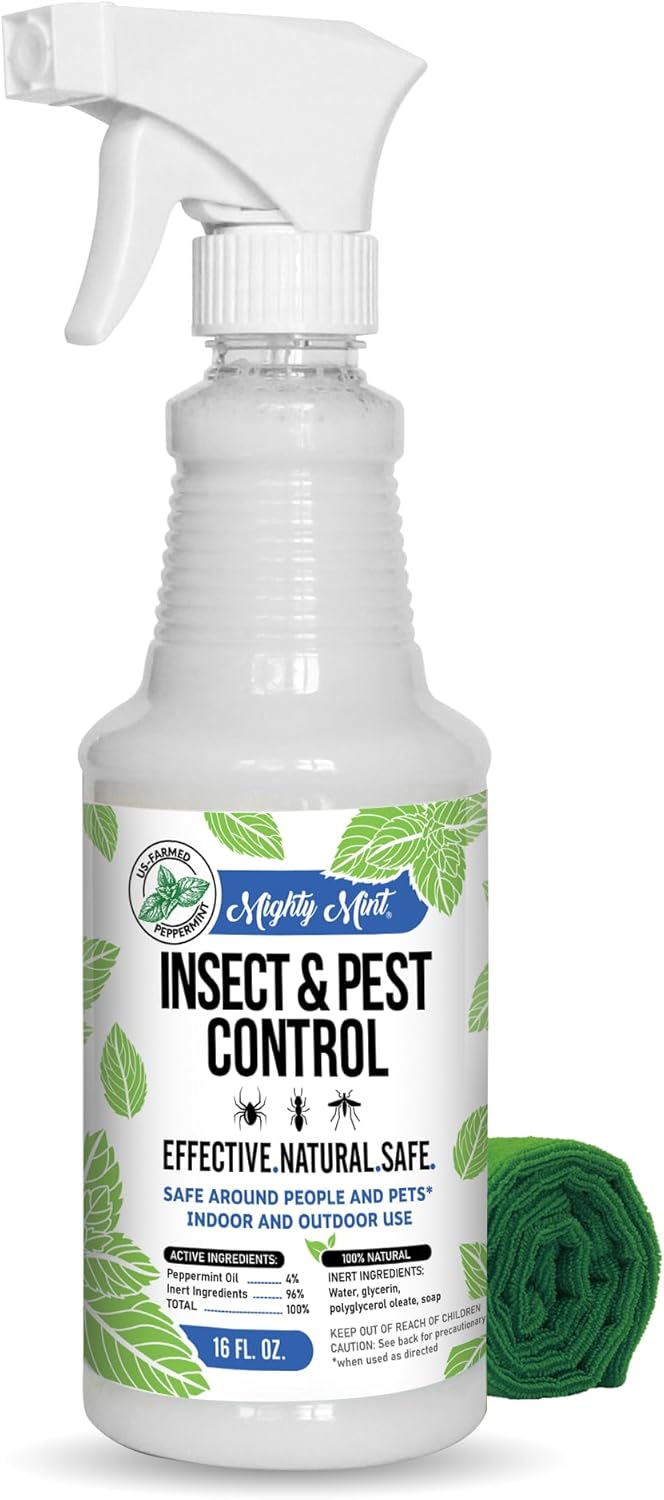
| Ingredients | Water, Glycerine, Polyglycerol oleate, Soap, Peppermint oil |
|---|---|
| Volume | 16 oz |
| Use areas | Indoor / Outdoor |
| Pests | Insects, Ants, Spiders, Roaches |
| Directions | Shake well; spray problem areas and repeat at least twice per week |
Mighty Mint Peppermint Oil Insect Repellent is a plant-based, ready-to-use 16 oz spray intended for targeted pest control around the home. You use it by shaking and spraying problem spots such as baseboards, entryways, patios and garages until surfaces are covered, then reapplying a few times per week for ongoing deterrence. The formula lists peppermint oil as the active botanical ingredient combined with water, glycerine and mild surfactants, which makes it low-odor compared with solvent-based products and safe for use around people and pets when directions are followed. Practical benefits include versatile indoor and outdoor use, quick spot treatment without mixing, and a pleasant mint scent that does not rely on synthetic fragrances. Important limitations are that it is a repellent rather than an immediate-kill insecticide so results depend on repeated applications, it should not be applied when pollinators are present, and the concentrated peppermint scent can irritate sensitive individuals or eyes until surfaces dry.
Best for: Buyers who prefer natural, low-fume pest control and want a proven, widely used spray for spot treatments around the home and outdoor entry points.
Less Ideal for: People who need fast-acting knockdown or long-term residual insecticide solutions for severe infestations should consider stronger chemical or professional options.
- Plant-based peppermint oil formula effective as a deterrent for common household pests
- Ready-to-use 16 oz spray for quick, targeted application without mixing
- Suitable for indoor and outdoor use on a variety of surfaces when tested first
- Pleasant mint scent that is milder than many chemical repellents
- Acts primarily as a repellent and requires repeat applications for sustained effect
- Contains a strong concentration of peppermint oil that can irritate sensitive people or pets until dried
Verdict: A convenient, plant-based peppermint spray for buyers who want a low-fume, widely used repellent for routine spot treatments around the home.
Atticus Talak 7.9% Bifenthrin Indoor/Outdoor Insecticide Concentrate (32 oz)

| Formulation | Suspension concentrate |
|---|---|
| Active Ingredient | Bifenthrin |
| Liquid Volume | 32 fluid ounces |
| Target Species | Insects |
| Specification Met | EPA |
Atticus Talak 7.9% is a liquid concentrate formulated to control more than 75 common indoor and outdoor pests using 7.9% bifenthrin. You mix the concentrate with water at label rates and apply it as a spray for lawns, landscapes, patios, eaves and around baseboards and cabinets indoors. The product dries clear, is odor‑free once applied, and the manufacturer notes one gallon of mixed solution treats about 1,000 sq ft depending on the dilution. Talak is advertised to kill on contact and provide up to three months of residual control, which makes it useful for perimeter barrier treatments, turf pest control, and mound drenches for fire ants. Practical benefits include flexible use across multiple areas, a water‑based formula that minimizes staining and plant damage, and a bottle with pour markers for easier measuring. Important limitations are that mixed spray cannot be stored beyond the day of application and it is not approved for fogger use, so you need to plan and apply directly with a sprayer and follow safety instructions for people and pets until surfaces dry.
Best for: Buyers who want a single, familiar insecticide they can use around the home and yard with predictable, label‑driven applications and an emphasis on visible, low‑odor results.
Less Ideal for: Users who need ready‑to‑use sprays, want fogger‑style whole‑room treatments, or who prefer non‑pyrethroid active ingredients for resistance or safety reasons.
- Broad spectrum efficacy against 75+ listed pests including mosquitoes, ants, ticks and mites
- Single concentrate usable indoors and outdoors for perimeter, landscape and lawn treatments
- Water‑based formula dries clear and is low odor, reducing staining and plant phytotoxicity risk
- Long residual claim up to three months for perimeter and turf applications
- Measuring marks and easy‑pour bottle reduce mixing mess
- Mixed solution must be used same day and cannot be stored for later use
- Not approved for fogger application so cannot be used for whole‑room fumigation
Verdict: A single, water‑based bifenthrin concentrate for homeowners who want a low‑odor, long‑lasting indoor and outdoor perimeter treatment.
Choosing the Right Insecticide Spray for Home: Key Factors to Consider
Indoor Safety and Labeled Uses
Indoor safety is the top priority because sprays are used where people and pets breathe and touch treated surfaces. Look for clear labeling that lists indoor use on walls, baseboards, kitchen cabinets, and around windows and doors. Products with lower volatility and shorter airborne persistence reduce inhalation risk when used as directed.
Also check whether the label requires evacuation after application or recommends ventilation times. That affects whether you can treat an occupied room or need to plan a temporary relocation. Consider whether the formulation is water-based or solvent-based, since solvents can increase odors and irritation even if the active ingredient is effective.
Residual Control Time
Residual effectiveness determines how long treated areas remain protected against returning pests. Longer residuals reduce the need for repeat treatments but can leave persistent residues on surfaces and fabrics. Shorter residuals may be preferable in high-contact living areas but require more frequent reapplication.
Think about the pest type when weighing residuals. Crawling insects that contact baseboards and cracks benefit from longer-lasting residues, while flying insects often need spot treatments or lure strategies. Match the expected reinfestation risk of your home to the product's labeled residual performance.
Application Method and Coverage
How a spray is delivered affects precision, waste, and exposure. Trigger sprays with adjustable nozzles give control for spot treatments and cracks. Aerosol sprays are convenient for quick knockdown but may produce more airborne drift. Pump-up or hose-end systems can cover larger perimeters but are less useful indoors.
Also evaluate stated coverage per container and the tendency of the spray to settle or create overspray. Easier-to-control sprays reduce accidental wetting of fabrics and electronics. Consider whether a product requires mixing or is ready-to-use, as mixing increases user error risk.
Surface Compatibility and Staining Risk
Indoor treatments touch many surfaces, from painted walls to upholstery and countertops. Some formulations can discolor or leave oily residues on fabrics and wood. Review label guidance for use on painted surfaces, finished wood, carpets, and food-contact areas.
If you need to treat high-value furniture or delicate textiles, choose products labeled safe for those materials or use a targeted application technique. When in doubt, test a small hidden area first and avoid direct application to countertops or plates.
Pest Spectrum and Target Use
Different sprays are formulated to control specific groups of pests. Broad-spectrum products tackle both crawling and flying insects, which is useful for homes with mixed problems. Specialist sprays aimed at ants, roaches, spiders, or flies may contain actives optimized for that behavior and can be more effective in targeted situations.
Consider common household invaders in your region when choosing a spray. Also think about lifecycle control: products that affect both adults and immature stages reduce repeat outbreaks, while knockdown-only formulas may need complementary treatments.
Residue Persistence Near Food and Pets
Residues in kitchens and pet areas present different risks and require careful product selection. Look for formulations with explicit instructions for treating around food prep zones and pet resting spots. Some labels provide reentry intervals or surface cleaning instructions after application.
If you have indoor pets that groom themselves, minimize use of products that leave long-lasting residues on floors and baseboards. Consider nonchemical interim controls such as traps while you treat high-contact areas with lower-residue options.
Preparing Indoor Areas Before Treatment
Clear close-contact items from the treatment area before spraying. Remove pet bowls, children's toys, and food preparation tools from counters and open cabinets. Cover or remove delicate fabrics and electronics to avoid accidental wetting.
Open windows and doors if the label allows ventilation during and after application to reduce lingering odors. Use fans to move air out of the room, but avoid directing airflow across the treatment zone in a way that spreads droplets to unintended surfaces.
- Vacuum and sweep to reduce dust that can bind spray residues.
- Seal or cover aquariums and reptile enclosures prior to application.
- Mark treated areas and note reentry times suggested on the label.
Spot Treatment Strategies for Common Household Pests
Target cracks, baseboards, door thresholds, and window frames for crawling insects. Apply a thin, even band rather than soaking the area. For flying insects, focus on entry points and light fixtures where they congregate.
Combine mechanical controls such as traps and exclusion with sprays for faster results. Spot treatments limit exposure to people and pets while still controlling infestations when applied carefully.
- Apply small amounts along baseboards for ants and cockroaches.
- Use targeted sprays in attic or crawlspace access points where insects enter.
- Avoid treating entire rooms with broad sprays unless infestation levels justify it.
Minimizing Exposure to Family and Pets
Plan treatments when fewer people and pets will be in the house. Follow label reentry intervals and ventilate treated spaces thoroughly before allowing contact. Consider isolating treated rooms until residues have dried and odors have dissipated.
When treating near pet bedding or litter areas, remove bedding for laundering and replace it after the recommended drying and airing period. For households with small children, prefer products with clear, conservative safety directions and test small areas first.
- Keep treated kids' play areas out of bounds until surfaces are dry.
- Store all insecticides in locked cabinets away from children and pets.
- Use gloves and wash hands after applying sprays.
Combining Sprays With Nonchemical Controls
Chemical sprays work best as one part of an integrated approach. Seal entry points, repair screens, and reduce moisture sources to lower pest pressure. Physical traps and baits can capture survivors and reduce the need for repeat spray treatments.
Regular sanitation is essential. Removing food debris and standing water reduces attraction and makes residuals more effective because pests must contact treated surfaces to pick up the active ingredient.
- Use sticky traps to monitor activity before and after treatment.
- Fix leaks and dehumidify basements to deny pests shelter.
- Calibrate expectations: sprays reduce populations but rarely eradicate an infestation alone.
Safe Storage and Disposal of Leftover Spray
Store insecticide sprays in a cool, dry place away from direct sunlight and out of reach of children. Keep the original label intact for reference to first aid and cleanup instructions. Do not transfer contents to food containers or unlabeled bottles.
Dispose of empty containers following local regulations. Many communities treat aerosol and chemical containers as hazardous waste. Rinsing or puncturing containers is generally not recommended unless the label permits it, so check local guidance.
- Keep a small spill kit with absorbent material and gloves for accidental releases.
- Record purchase date and condition to avoid using old or degraded formulations.
- When in doubt, contact local waste management for disposal steps.
How We Chose the Best Insecticide Spray for Home
We prioritized products that match real indoor use cases and homeowner concerns. Evaluation focused on indoor safety characteristics such as labeled use on household surfaces and low inhalation risk for occupied spaces. We checked residual effectiveness to see how long a product controls returning pests on treated surfaces. Application ease and versatility were judged by delivery method, nozzle control, and whether the formula works on multiple pest types commonly found in homes. Surface compatibility and staining potential were considered so treatments do not damage fabrics, woodwork, or painted finishes. Finally, we weighed coverage per container to estimate how much area a typical home treatment will cover. We excluded outdoor-only formulations, foggers intended solely for vacant-space use, and products without clear indoor labeling. Products that rely exclusively on professional-only equipment were also left out. The filters ensured every shortlisted spray is positioned for homeowner or gardener use around entryways, basements, kitchens, and indoor living spaces. The criteria in this section align with the scoring metrics used on each product card so readers can compare tabletop numbers with real-world needs.
FAQ
Are insecticide sprays safe to use around children and pets?
Safety depends on the formulation and how it is used. Many sprays are labeled for indoor use with specific reentry and ventilation instructions. Follow label directions, remove people and pets during application if recommended, and ventilate treated areas thoroughly before reentering.
How long after spraying should I wait before using a treated room?
Reentry times vary by product and ventilation. Some ready-to-use sprays dry in minutes, while others recommend waiting several hours. Always follow the label guidance and ensure odors have dissipated and surfaces are dry before allowing normal activity.
Can I use the same spray for both flying and crawling insects?
Many broad-spectrum sprays claim efficacy against both groups, but targeted formulations sometimes work better for specific pests. Consider the pest behavior and whether a knockdown-only spray or a residual product that affects crawling insects is more appropriate.
Will indoor sprays stain my furniture or carpets?
Some solvent-based or oily formulations can leave residues or cause discoloration. Check the label for surface compatibility and test a small hidden area before widespread use. Use targeted applications to reduce staining risk on valuable fabrics.
How often should I reapply indoor insecticide treatments?
Reapplication frequency depends on the product's labeled residual period and infestation pressure. Low-residual treatments may need repeat visits every few weeks, while longer-residual formulas can last for months. Address underlying entry points and sanitation to reduce reliance on repeated sprays.
Can I spray near food preparation areas?
Treating directly on food-contact surfaces is not recommended. Many labels permit treatment of cracks and crevices in kitchens but advise covering or removing food and utensils before application. Follow label instructions for cleaning treated surfaces before normal food use resumes.
Final Verdict
Choose a home insecticide spray by balancing indoor safety, the pests you need to control, and how long you want protection to last. Prioritize products labeled for indoor use and that match your primary treatment zones, whether baseboards, attics, or entry thresholds. Combine sprays with exclusion, sanitation, and traps to reduce repeat treatments. Make decisions based on where you will apply the spray and who shares the house. For living spaces and homes with children or pets, lean toward lower-residue options and targeted applications. For persistent crawling insect problems, a product with longer residual control used alongside sealing and sanitation will usually give the most practical results.
