

Note: This article contains affiliate links. If you click on these links and make a purchase, I may earn a small commission at no extra cost to you. This helps support my research and content. Read my full affiliate disclosure here.
If mosquitoes are cutting short your time on the lawn, choosing the right lawn mosquito repellent makes a big difference. The wrong product can leave gaps in coverage, create safety concerns for children or pets, or require frequent reapplication that defeats convenience. This guide gathers seven shortlisted lawn mosquito repellents selected for common yard sizes and use patterns and explains how they perform in real outdoor conditions. We evaluated items for how well they cover typical lawn areas, how long protection lasts, ease of application, and safety around family and pets. Read on to see which product types suit different lawn sizes and lifestyle needs, and what tradeoffs to expect before you pick one for your yard.
Top Picks at a Glance
| Best Overall The best all-around choice for most situations | Thermacell Fuel-ZoneGuard Base Mosquito Repeller |  |
| Best Quality Built to a higher standard if you want something more solid | Thermacell E‑ZoneGuard Patio Max Mosquito Repellent with 12‑Hour Rechargeable Battery and Charging Dock |  |
| Best Value The sweet spot between price and what you get | Cutter Backyard Bug Control Spray Concentrate, 32 fl oz (2 pack) |  |
| Best Budget The cheapest option that still gets the job done reliably | Spectracide Triazicide Insect Killer for Lawns & Landscapes, 32 oz |  |
| Highest Rated A top-rated pick with lots of positive feedback | MKNXYD Natural Mosquito Repellent Pouches (14-Pack) |  |
| Most Popular A crowd favorite that many people choose with confidence | Summit Mosquito Bits Granules, 30 oz |  |
| Best Seller A high-volume bestseller chosen again and again | Atticus Talak 7.9% Bifenthrin Indoor/Outdoor Insecticide Concentrate (32 oz) |  |
Thermacell Fuel-ZoneGuard Base Mosquito Repeller

| Protection Zone | 15 Feet |
|---|---|
| Refill Hours | 12 Hours |
| Active Ingredient | D-Cis/Trans Allethrin 21.97% |
The Thermacell Fuel-ZoneGuard Base is a portable, fuel-powered repeller designed to keep mosquitoes away from a small outdoor area without sprays or lotions. You insert a repellent mat, twist in the included 12-hour fuel cartridge, and the unit heats the mat to diffuse repellent that reaches full effectiveness in about 15 minutes. It is typically used on patios, near outdoor dining, or while sitting around a campsite to protect a roughly 15-foot radius. Notable features include scent-free mats, DEET-free formulation, and clearly marked mats that change color when it is time to replace them. Practical benefits are immediate hands-free protection, no sticky residue on skin or furniture, and a compact form factor that is easy to move and set in the center of an activity area. Limitations are that it is for outdoor use only and relies on fuel cartridges and disposable mats, so operating costs and the need for replacements should be expected over a season. It also creates a defined protection zone rather than treating an entire yard.
Best for: Buyers who want a simple, moveable solution to protect a defined outdoor seating area from mosquitoes without applying products to skin and who value quick setup and low fuss operation.
Less Ideal for: People who need whole-yard mosquito control or want a maintenance-free, one-time treatment should consider yard-wide systems or professional services instead.
- Creates a measurable 15-foot zone of protection for outdoor seating areas
- Scent-free and DEET-free mats reduce skin exposure to repellents
- Quick setup and hands-free operation with 12-hour fuel cartridge
- Mats change color to indicate when replacement is needed
- Requires replacement fuel cartridges and repellent mats for continued use
- Protection is limited to a zone around the device rather than whole-yard coverage
Verdict: An easy, hands-free way to protect a seated outdoor area from mosquitoes with a scent-free 15-foot zone and 12-hour fuel run time.
Thermacell E‑ZoneGuard Patio Max Mosquito Repellent with 12‑Hour Rechargeable Battery and Charging Dock

| Power Source | Battery Powered |
|---|---|
| Maximum Range | 20 feet |
| Unit Count | 1 Count |
| Model Number | E95XA |
The Thermacell E‑ZoneGuard Patio Max is a portable, battery-powered mosquito repeller designed to create a roughly 20 foot protective zone around patios, campsites, or small outdoor seating areas. You power it on with a button and the heater disperses the included DEET-free repellent; the unit reaches maximum protection in about 15 minutes. Notable features are the built-in rechargeable lithium-ion battery rated for up to 12 hours per charge, a fast-charging dock for convenient turnaround, and 36 hours of refill material included so you can start using it right away. In practice it replaces sprays and lotions, is scent-free and flame-free, and is easy to move where you need coverage. Limitations to expect: the effective zone is centered on the unit so placement matters for full coverage and very large lawns or windy conditions will reduce range, and you will need to keep replacement refills on hand for extended seasons. For buyers focused on strong, hands-off perimeter protection around a seating area, it delivers a reliable, travel‑friendly solution.
Best for: Buyers who prioritize reliable, science‑backed perimeter protection for evening patio use and want a rechargeable, low‑maintenance alternative to sprays or candles. Ideal for people who host small outdoor gatherings and expect consistent performance across sessions.
Less Ideal for: Not a great fit for homeowners needing whole‑yard control or for those who want an immediate, instant barrier across very large or heavily windy lawns.
- Creates an EPA‑reviewed protection zone up to 20 feet for hands‑off mosquito control
- Rechargeable lithium‑ion battery with up to 12 hours run time and fast‑charging dock for easy reuse
- Includes 36 hours of DEET‑free refill so the device is ready to use out of the box
- Scent‑free, no smoke and no open flame compared with torches or topical sprays
- Protection is localized around the device so multiple units may be needed for larger or irregular areas
- Performance can be reduced in windy conditions
- Requires purchase of replacement refills for continued seasonal use
Verdict: For performance-oriented buyers who want dependable hands-off mosquito protection around a patio or seating area, this rechargeable Thermacell delivers the largest localized coverage without sprays or flames.
Cutter Backyard Bug Control Spray Concentrate, 32 fl oz (2 pack)

| Unit Count | 64 Fluid Ounces |
|---|---|
| Included Components | Cutter Backyard Bug Control Spray Concentrate (2 Pack) |
| Item Type Name | Backyard Fogger |
| Item Form | Spray |
| Active Ingredients | Lambda Cyhalothrin |
This Cutter Backyard Bug Control concentrate is a hose‑end spray designed for treating lawns, shrubs and outdoor surfaces to kill mosquitoes, listed ants, fleas and other insects. You attach the included QuickFlip nozzle to a garden hose and walk the yard while spraying; the product mixes with water automatically so there is no measuring or pouring. The label claims coverage up to 5,000 sq ft per bottle and residual control lasting up to 12 weeks for certain species, which makes it practical for seasonal perimeter treatments rather than daily spot control. Notable features include the ready‑to‑spray hose connector, instructions for foliar and landscape application, and a single active ingredient listed as lambda‑cyhalothrin. Trade‑offs to expect are that it is a chemical insecticide so treated areas must remain dry until residues settle and you must follow safety directions around children, pets and waterways. Also, the product is formulated for broad landscape use rather than for indoor or immediate knockdown only, so fast contact kill may vary by species and application thoroughness.
Best for: Buyers who want a low‑effort seasonal solution to reduce mosquitoes and other lawn pests across a whole yard and who prioritize ease of application and long intervals between treatments.
Less Ideal for: People seeking an organic, pet‑safe or indoor spray or those who need spot treatments with instant knockdown should consider alternative products.
- Hose‑end QuickFlip sprayer for easy, no‑mix application
- Label provides broad landscape use including lawns, shrubs and foliar spray
- Claims extended residual control up to 12 weeks for listed pests
- Covers a large area per bottle, reducing application frequency
- Contains a synthetic pyrethroid active ingredient requiring careful safety handling
- Not formulated for indoor use or immediate contact knockdown in all situations
Verdict: A convenient hose‑end concentrate that makes seasonal, whole‑yard mosquito and lawn insect control quick and low‑effort.
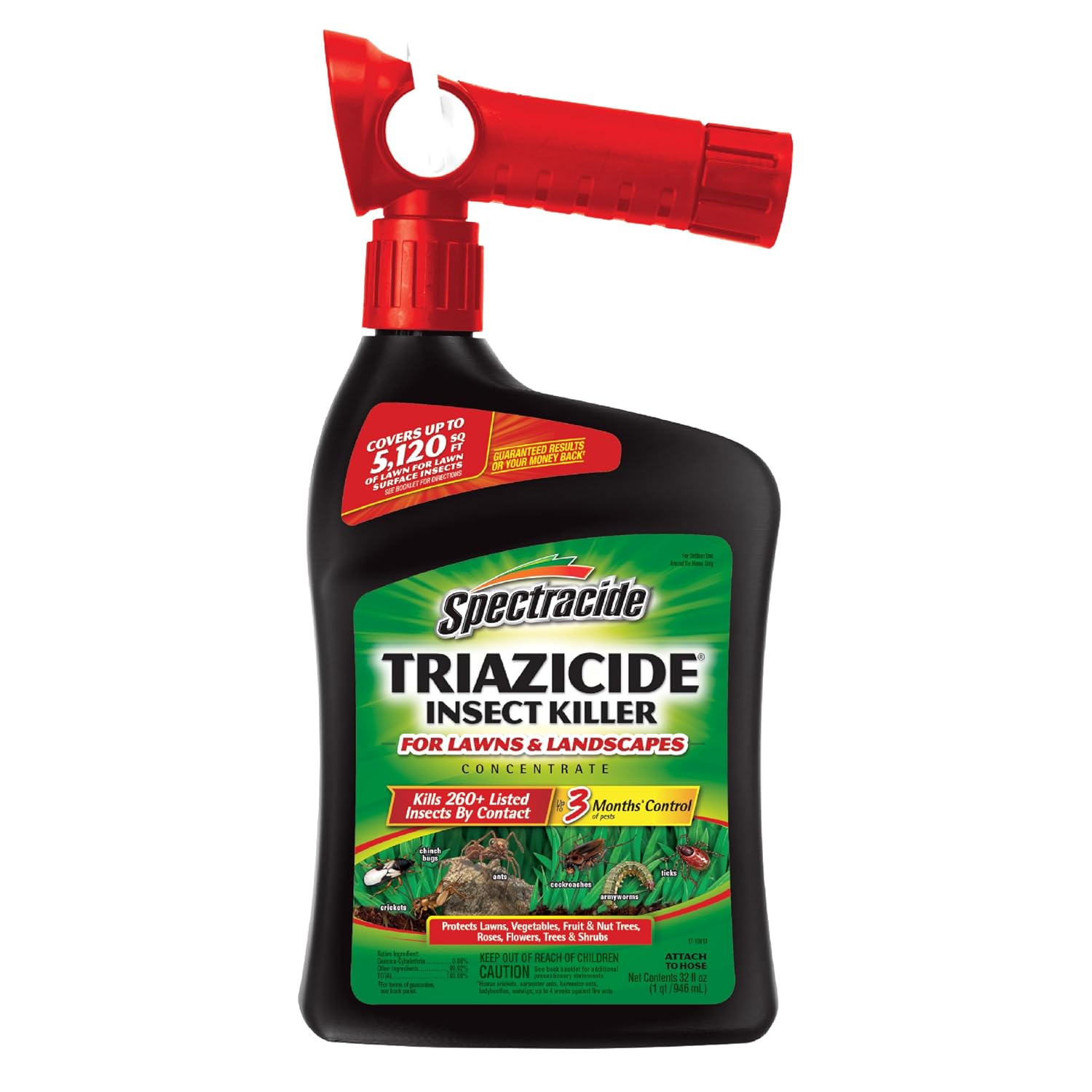
Spectracide Triazicide Insect Killer for Lawns & Landscapes, 32 oz
| Unit Count | 32 Ounce |
|---|---|
| Item Form | Spray |
| Target Species | Insects |
| Active Ingredients | Gamma-Cyhalothrin (0.08%) |
Spectracide Triazicide is a concentrated insecticide designed to be mixed with water and applied with a tank or hose-end sprayer to treat lawns, flowerbeds, shrubs, trees and vegetable areas. It lists more than 260 target insects and works by contact, with many users seeing knockdown within 24 hours and protection that can last up to three months when used as directed. The concentrate format makes it versatile for treating surface insects like ants, fleas and ticks and for drenching fire ant mounds. Practical benefits include broad-spectrum control, non-staining formulation when used properly, and the ability to cover large areas when mixed to recommended rates. Important limitations are that it is highly toxic to fish and bees and requires careful application to avoid runoff, drift, or treatment of blooming plants; it also requires reading and following label directions for safe use and correct mixing rates. This product is best used for scheduled preventive or targeted broadcast treatments rather than spot control in sensitive, pollinator-rich areas.
Best for: Buyers who want an economical, multi-purpose lawn and landscape insect control they can mix and apply themselves for seasonal or preventive treatments.
Less Ideal for: People who prioritize pollinator-friendly products or need a ready-to-use mosquito-only repellent for small yards or near water features should consider alternatives.
- Concentrate mixes with water for flexible application and large-area coverage
- Broad-spectrum formula that lists 260+ insects including fleas, ticks and Japanese beetles
- Non-staining when used according to the label for most home siding
- Provides up to three months of residual control for many landscape pests
- Extremely toxic to aquatic life and hazardous to bees if applied to blooming plants or allowed to drift
- Requires careful measuring and proper sprayer equipment to apply safely and effectively
Verdict: Choose this concentrate if you need an inexpensive, broad-spectrum lawn and landscape insect treatment that covers large areas when mixed and applied correctly.
MKNXYD Natural Mosquito Repellent Pouches (14-Pack)

| Scent Name | Citronella, Lemongrass, and Peppermint oils |
|---|---|
| Item Form | Granule |
| Material Features | Natural |
| Number of Items | 14 |
| Unit Count | 12.35 Ounce |
These MKNXYD repellent pouches release a blend of citronella, lemongrass, and peppermint oils to deter mosquitoes and other flying insects around patios, yards, and camping sites. Each pouch comes in a small granule-filled packet with a hanging string, so you can suspend them from eaves, railings, or place them near seating areas and entryways. The manufacturer claims 30 to 60 days of protection per pouch and coverage up to 120 square feet, which makes them convenient for treating multiple zones without daily maintenance. Because the formula is natural and labeled safe for people, pets, and children, they work well where you want a low-toxicity option. Note that these are passive repellents rather than insect traps or spatial foggers, so they are best used as part of a layered approach rather than as the only control method in heavy mosquito pressure. Expect gradual scent diffusion rather than an immediate knockdown of insects, and replace pouches as their aroma fades.
Best for: Buyers who prioritize a reliable, low-toxicity mosquito deterrent for routine outdoor use and want an easy, low-maintenance option to place around seating areas, patios, or campsites.
Less Ideal for: People needing immediate knockdown of large mosquito populations or who require coverage for wide open, windy areas should consider active control methods instead.
- Natural oil blend (citronella, lemongrass, peppermint) suitable for low-toxicity use around people and pets
- Designed for hands-free placement with included string bags for hanging or setting on surfaces
- Each pouch covers up to 120 sq ft and is claimed to last 30 to 60 days, reducing replacement frequency
- Compact, granular pouches are easy to move so you can protect different outdoor zones as needed
- Passive scent-based protection may be less effective in high mosquito pressure or windy conditions
- Effectiveness depends on scent strength and will decline as the pouch aroma dissipates
Verdict: A reliable, low-toxicity pouch you can hang or place around patios and campsites to provide weeks-long mosquito deterrence with minimal maintenance.
Summit Mosquito Bits Granules, 30 oz

| Unit Count | 30 Ounce |
|---|---|
| Item Form | Granules |
| Target Species | Insects |
| Active Ingredients | Bacillus thuringiensis strain SUM-4218 |
These mosquito bits deliver a practical, targeted way to reduce mosquito populations by applying Bacillus thuringiensis israelensis (BTI) granules to standing water where larvae develop. Use them by sprinkling or broadcasting small amounts into birdbaths, gutters, ponds, planters, and other stagnant water sources; the active bacteria kills larvae but is safe for most wildlife and pets when used as directed. The 30 ounce container is convenient for repeat treatments around a yard and the product is EPA registered for use across the U.S. Practical benefits include simple, low-effort application, compatibility with many outdoor water features, and quick action against larvae before they become biting adults. Limitations are that the bits do not repel adult mosquitoes or treat large bodies of water effectively and require regular reapplication after heavy rain or water turnover. For someone managing small, discrete breeding sites this is an effective component of an integrated mosquito control plan, but it should be paired with habitat reduction and other measures for broader yard protection.
Best for: Buyers who want a low-toxicity, evidence-backed way to treat small standing-water breeding sites and prefer products with established use and reviews.
Less Ideal for: Homeowners who need broad-area adult mosquito control or who want a single-product solution for large bodies of water should consider other or additional control methods.
- Contains BTI, a bacteria that specifically targets mosquito larvae
- EPA registered for use in all 50 states
- Granular form is easy to apply to small standing-water sites
- 30 oz size supports multiple treatments around a yard
- Does not repel or kill adult mosquitoes
- Not suitable as a standalone solution for large ponds or extensive wetland areas
Verdict: A straightforward, EPA-registered BTI granule that effectively treats small standing-water mosquito breeding sites when used regularly.
Atticus Talak 7.9% Bifenthrin Indoor/Outdoor Insecticide Concentrate (32 oz)

| Active Ingredients | Bifenthrin |
|---|---|
| Liquid Volume | 32 fluid ounces |
| Formulation | Suspension Concentrate |
| Length of Control | Up to three months |
| Target Species | Insects |
Talak 7.9% is a concentrated, water-based bifenthrin insecticide intended for both lawn perimeter and spot treatments around homes. You dilute the concentrate with water and apply it with a pump or hose-end sprayer to lawns, landscape plants, patios, eaves and indoor baseboards to create a contact and residual barrier that the maker says can last up to three months. Notable features include a clear, low-odor formula that dries without leaving residue and pre-marked pour sections on the bottle for easier measuring. For mosquito control you use the higher label rate and treat patio perimeters, vegetation and eaves to reduce mosquito activity for roughly two weeks between applications. Practical benefits are broad-spectrum control of 75+ pests including mosquitoes, ticks and ants and flexible use both inside and out. Limitations to consider are that it is a professional-strength pesticide requiring careful adherence to the label, it cannot be used in foggers, and mixed solutions should be applied the same day rather than stored. Always follow safety directions and local regulations when applying around people, pets and sensitive areas.
Best for: Homeowners who prioritize reliable, long-lasting perimeter control and want a single concentrated product to treat lawns, landscaped areas and outdoor living spaces with professional-strength results.
Less Ideal for: People who prefer non-chemical or organic mosquito solutions or those unwilling to follow pesticide label directions closely should consider alternative mosquito control methods.
- Broad-spectrum control that lists over 75 target pests including mosquitoes and ticks.
- Water-based formula dries clear and is low-odor so treated areas do not show residue or strong smell.
- Flexible indoor and outdoor uses from lawns and plants to perimeter and baseboard treatments.
- Concentrate mixes with water so one bottle treats large areas when diluted per label.
- Bottle has pour markings for easier measuring and application control.
- Contains a potent synthetic pyrethroid so careful handling and strict label compliance are required.
- Mixed spray solution cannot be stored and must be used same day.
- Not approved for use in certain states and not labeled for fogger applications.
Verdict: Choose Talak 7.9% when you want a single, concentrated indoor/outdoor insecticide that delivers broad, long-lasting perimeter control against mosquitoes and many other pests.
Choosing the Right Lawn Mosquito Repellent: Key Factors to Consider
Coverage Area and Lawn Size
Know your lawn dimensions and how the repellent specifies coverage. Some treatments list a square-footage per bottle or per device while others define radius coverage. Matching the product's stated range to your actual lawn size keeps you from under-treating zones where mosquitoes will still breed.
Consider irregular shapes, berms, and landscaped islands that require extra overlap. Coverage claims assume ideal placement and calm wind; plan for 10 to 30 percent extra material or additional devices for windy exposures or dense vegetation that reduces effective reach.
Duration and Frequency of Application
Different products deliver protection for widely varying lengths of time. Some provide several hours per application and need frequent re-sprays on active evenings, while others are designed to provide days or weeks of reduced mosquito activity after a single treatment.
Think about how often you use the lawn and whether you want low-maintenance seasonal treatment or frequent, event-based protection. Also check reapplication windows after rain or irrigation because many treatments lose effectiveness once saturated.
Safety for People, Pets, and Gardens
Safety is a primary concern when treating areas where children, pets, or edible plants are present. Look for repellents with explicit instructions on safe re-entry intervals, pet-safe labeling, and guidance about applying near vegetable beds or pollinator-friendly plantings.
Some formulations are designed to minimize exposure risks but still require temporary exclusion of people and animals during application and drying. Understand how long residues persist on grass blades and whether runoff into garden beds or water features is a concern for your property.
Application Method and Equipment
Application options include hose-end sprayers, pump sprayers, ready-to-place devices, or spreadable granules. Each method changes labor, coverage uniformity, and the precision of dosing. Hose-end sprayers are fast for large areas but can waste product in gusty conditions; granular spreaders give consistent coverage but need careful calibration.
Also consider storage, mixing steps, and whether you need additional equipment. If you prefer low-hassle solutions, look for plug-and-play devices or pre-measured treatments that reduce mixing errors.
Weather and Environmental Conditions
Performance often depends on temperature, humidity, and wind. Some active ingredients volatilize in heat, shortening protection windows, while light rains or heavy dew can wash away sprays. Wind reduces effective range for broadcast methods and can cause uneven distribution.
Plan treatments around favorable weather forecasts and pick products with proven tolerance to the conditions typical for your region. Consider whether the product requires dry lawns for application or offers rainfast periods after treatment.
Non-target Effects and Pollinator Safety
Mosquito control can affect beneficial insects and other wildlife. Some repellents are formulated to limit contact with pollinators or break down quickly to reduce ecological persistence, while others are broader-acting and more likely to impact non-target species.
If your lawn is adjacent to pollinator gardens, orchards, or natural areas, prioritize products with targeted delivery mechanisms or shorter environmental half-lives and follow label guidance to minimize collateral impact.
Types of Lawn Mosquito Repellents
There are several practical approaches to controlling mosquitoes on lawns. Broadcast liquid sprays applied with a sprayer coat vegetation and resting sites. Granular treatments can be spread for longer-lasting action and are useful where uniform distribution is needed. Continuous-release devices or stations create a treated perimeter without frequent reapplication and are suited to patios or seating areas. Lastly, integrated approaches pair habitat reduction with targeted treatments to reduce breeding sites and lower overall mosquito pressure.
- Liquid sprays: fast coverage, variable persistence
- Granules: steady release, useful for larger areas
- Continuous-release devices: low-maintenance perimeter protection
- Integrated habitat control: removes breeding sources to reduce need for chemicals
When to Apply Treatments
Timing matters. Apply treatments in the late afternoon when mosquitoes are active but dew has not yet formed, or as recommended by the product. Avoid spraying during high winds or imminent rain. For seasonal strategies, schedule the first treatment before peak mosquito activity and follow up according to the product's reapplication window.
- Avoid windy conditions to prevent drift
- Do not treat when rain is expected within the product's rainfast period
- Reapply after heavy irrigation or rainfall if required
Placement and Overlap for Even Protection
Placement of devices or where you focus sprays determines how evenly mosquitoes are suppressed. For broadcast sprays, maintain consistent swathes with overlap to avoid gaps. For point-source devices, space units according to the recommended radius and account for landscape features that block airflow or create sheltered mosquito habitats.
- Overlap spray passes by about 20 percent for uniform coverage
- Place devices upwind of areas you want protected to encourage treated air flow
- Treat shaded, damp spots where mosquitoes rest
Combining Treatments with Habitat Management
The most durable mosquito control programs combine product use with landscape changes. Remove standing water, keep gutters clear, and thin dense groundcover where mosquitoes hide. This reduces the number of treatments you need and improves the effectiveness of whatever lawn repellent approach you choose.
- Eliminate small water pools in planters and low spots
- Maintain lawn and edge vegetation to reduce resting sites
- Encourage natural predators by avoiding broad-spectrum treatments near water
Maintenance and Storage Best Practices
Store treatments in a cool, dry place out of reach of children and pets, following label temperature guidance. Keep mixing and application equipment clean to prevent clogs and uneven distribution. Keep a calendar of treatments tied to weather patterns so you reapply at appropriate intervals rather than on impulse.
- Rinse sprayers after use to avoid buildup
- Record application dates and weather conditions
- Dispose of unused material per local guidance
How We Chose the Best Lawn Mosquito Repellent
We focused on attributes that matter most when protecting a lawn from mosquitoes during typical outdoor use. Primary evaluation criteria included effective coverage area and duration of protection, so we favored repellents with clearly stated treated-square-foot guidance or measured active delivery times. Safety and exposure risk was another major filter, prioritizing options with clear instructions for use around children, pets, edible gardens, and water features. Application method and ease of upkeep were included because homeowners need solutions that fit maintenance rhythms, whether a one-time seasonal treatment, weekly spray, or continuous-release device. Environmental impact and persistence were assessed to avoid choices that leave long-lasting residues or harm beneficial insects when avoidable. Finally, formulation reliability and consistency were considered, including whether performance depends heavily on precise weather conditions. We excluded products lacking clear coverage claims, missing safety guidance, or those intended solely for personal wearable use rather than lawn-scale treatments. We also omitted items without verifiable application instructions or with unreasonable maintenance demands for typical homeowners.
FAQ
How long before a treatment becomes effective on the lawn?
Effectiveness timing depends on the formulation. Many sprays provide protection within a few hours after application once surfaces have dried; some continuous-release systems take longer to establish a treated perimeter. Check the product instructions for specific start times and follow re-entry guidance.
Can I treat my lawn if I have a vegetable garden nearby?
You usually can, but placement and product choice matter. Avoid direct application over edible beds and follow instructions about setbacks from garden areas. Some formulations have guidance for use near edibles or specify waiting periods before harvesting produce grown nearby.
Will treating my lawn reduce the number of mosquitoes the next morning?
Often you will see a reduction, especially in areas where adults rest or where treatments create a barrier effect. The degree of reduction depends on product type, coverage quality, and weather. Removing breeding sites also improves overnight results.
Are granular products safer around pets than sprays?
Granules can reduce spray drift but are not automatically safer. Safety depends on the active ingredients and label instructions. Keep pets away during application and until the product has settled or dried as directed by the manufacturer.
How does wind affect lawn mosquito repellent performance?
Wind can disperse sprays and shorten effective range, causing uneven coverage. Apply during calm conditions when possible and consider point-source devices or granules for breezier sites to maintain more reliable protection.
Can I rely on a single seasonal treatment?
That depends on the formulation and local mosquito pressure. Some treatments claim multi-week protection and can reduce the need for frequent applications, but high mosquito activity or heavy rains may require supplemental treatments or repeat applications.
Final Verdict
When choosing a lawn mosquito repellent, match the product type to your lawn size, how often you use the space, and any safety constraints like kids, pets, or edible plantings. Prioritize clear coverage guidance and realistic duration claims so you can plan applications around weather and events. Remember that combining a repellent with habitat reduction often yields the best long-term results. Focus on the tradeoffs between maintenance effort, safety, and environmental impact. With those priorities in mind, you can select a lawn mosquito repellent that keeps your outdoor space usable while minimizing risks to people and beneficial wildlife.
