

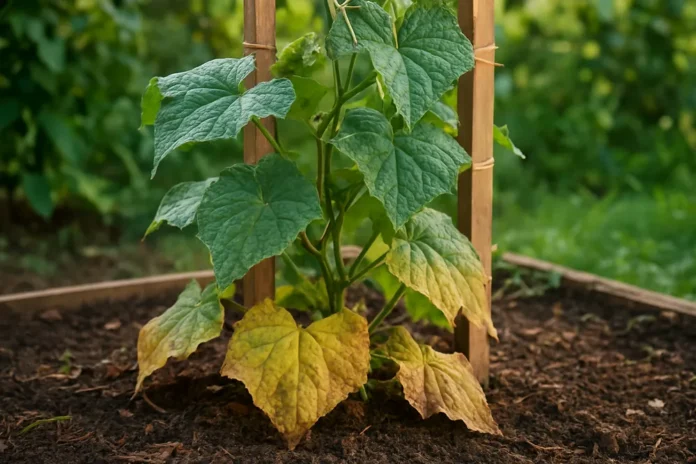
A cucumber plant that is dying from the bottom up is usually dealing with stress that starts in the oldest leaves, such as watering problems, nutrient deficiency, disease, or normal aging. Bottom leaves decline first because the plant sacrifices older growth before newer vines and fruit.
When a cucumber starts looking rough near the soil line while the top still seems decent, that bottom-up decline is a useful clue. In my garden, cucumber plants dying from the bottom up usually means the oldest leaves are reacting first to stress, whether that stress is uneven watering, a nutrient shortage, disease pressure, or simply the plant getting older and redirecting energy into fruit.
The good news is that this symptom pattern is easier to read than a plant that collapses all at once. If you look closely at what the lower leaves are doing, yellowing, spotting, crisping, wilting, or rotting, you can usually separate a fixable care issue from a serious disease problem. Cucumber leaves yellowing at the base is not always a disaster, but it is something to pay attention to early.
Below, I will walk through the most common reasons this happens, what each one looks like, and how I decide whether a plant can recover or should be pulled before it spreads trouble through the bed.
What Bottom-up Decline Usually Means in Cucumbers
Cucumbers naturally prioritize their youngest growth, flowers, and fruit. That means the oldest leaves at the bottom are often the first to fade when the plant is under strain. A few lower leaves yellowing late in the season can be normal, especially once vines are large and fruit production is heavy. But if the decline moves steadily upward, speeds up, or includes spotting, stem damage, or full-vine wilt, there is more going on than simple aging.
Think of the bottom leaves as the plant's early warning system. Because they sit closest to the soil, they are first in line for splash-borne disease, poor airflow, soil moisture swings, and root-zone problems. They are also the oldest leaves, so nutrient shortages and stress tend to show there first.
- If the lower leaves are plain yellow with no major spotting, think aging, nitrogen shortage, or watering stress.
- If they have brown spots, halos, or fuzzy growth, think fungal or bacterial disease.
- If the whole lower section wilts during the day and does not recover, think root injury, stem damage, or vascular disease.
- If leaves are dying back while fruit stays abundant, the plant may simply be at the end of its productive run.
When I diagnose cucumbers, I do not judge by one ugly leaf. I compare several lower leaves, a few middle leaves, and the newest growth at the tip. The more evenly the symptom repeats from old to new, the more likely it is a systemic issue like watering or nutrition rather than random leaf damage.
Normal Aging Versus a Real Problem
Not every yellow lower leaf means your cucumber is dying. Large vining cucumber plants regularly shed some old foliage, especially after the canopy thickens and light stops reaching the base. If only a handful of lower leaves turn yellow, dry up, and drop while the rest of the plant stays green and productive, that can be normal senescence.
It becomes a real problem when the pattern accelerates. Warning signs include multiple leaves yellowing every few days, spotting that climbs upward, vines that lose vigor, small or misshapen fruit, or a plant that wilts despite moist soil. Those signs mean the base decline is connected to a broader health issue.
- Usually normal: a few oldest leaves fading late in the season
- Usually not normal: yellowing plus spots, stem lesions, mushy tissue, or plant-wide wilt
- Borderline: heavy fruit load causing some lower leaf loss, especially in hot weather
Watering Problems That Start at the Roots
Underwatering and Heat Stress
Cucumbers are fast-growing, shallow-rooted plants, so they react quickly when the soil dries too much. Lower leaves may wilt first, then yellow and turn crispy at the edges. In hot weather, one missed watering can start a chain reaction, especially in raised beds or containers.
If the plant perks back up in the evening but keeps losing older leaves, it has likely been cycling through repeated dry stress. Fruit may become bitter, curved, or stunted as well. This is common when watering is deep but too infrequent, or light and frequent without actually soaking the root zone.
Overwatering and Poor Drainage
Too much water can cause similar yellowing from the bottom, but the leaf texture looks different. Instead of drying and crisping, leaves often turn limp, pale, and soft. Soil may stay wet for days, and stems near the base can begin to weaken. Roots need oxygen, and in soggy soil they begin to suffocate and rot.
This is especially common in clay soil, overmulched areas with poor airflow, or containers without enough drainage. Once roots are damaged, the plant cannot take up water and nutrients properly, so the lower leaves are sacrificed first.
I prefer to judge cucumber watering by soil feel, not the calendar. If the top inch is dry but the soil below still feels evenly cool and slightly moist, I wait. If it is dry several inches down, I water deeply and thoroughly rather than giving a quick sprinkle.
Nutrient Deficiencies That Show Up on Older Leaves First
Because lower cucumber leaves are the oldest, they are often where nutrient problems show first. Nitrogen deficiency is one of the most common. The plant pulls nitrogen out of older leaves to support new growth, so the bottom foliage gradually turns light green, then yellow, while newer leaves stay greener for a while.
Magnesium deficiency can also begin on older leaves, often as yellowing between the veins while the veins stay darker. Potassium shortages may show as scorched or browned leaf edges. These issues are more common in exhausted garden beds, containers that have not been fed consistently, or soil with pH problems that lock nutrients up.
- Nitrogen deficiency: overall yellowing of older lower leaves
- Magnesium deficiency: interveinal yellowing on older leaves
- Potassium deficiency: edge burn and weak fruit development
- General exhaustion: pale plant, slow growth, and fewer strong new leaves
If your cucumber is still actively growing and setting fruit, it needs a steady nutrient supply. A balanced vegetable fertilizer, compost-fed soil, or regular liquid feeding can help, but avoid overcorrecting. Too much fertilizer, especially high nitrogen, can push lots of leaf growth at the expense of fruit and can worsen salt stress in containers.
Common Diseases That Cause Lower Leaves to Die First
Fungal Leaf Diseases
Several cucumber diseases begin on the lower leaves because spores splash up from the soil and because the base of the plant stays more humid. Early blight is not the usual cucumber issue, but anthracnose, Alternaria leaf blight, and other fungal leaf spots can all start low. You may see yellow patches, brown lesions, dark margins, or leaves that quickly dry and collapse.
Powdery mildew often starts on older leaves too, though it is best known for its white dusty coating. Once lower leaves are heavily infected, they yellow, brown, and stop feeding the plant. In a dense cucumber patch, it can move surprisingly fast.
Bacterial Diseases
Angular leaf spot and bacterial wilt are two serious cucumber problems. Angular leaf spot creates water-soaked areas that become angular between veins, then brown and tear out. Bacterial wilt is more dramatic. Leaves may wilt even when soil moisture is fine, and the plant often does not recover overnight.
Crown and Root Rots
If the decline really starts at the base of the plant, inspect the crown where the stem meets the soil. Soft rot, stem cankers, and root diseases can all cause yellowing and collapse from the bottom up. The stem may look pinched, discolored, cracked, or mushy. In those cases, the leaves are not the main problem. They are reacting to a failing root or crown system.
Spotted lower leaves and plain yellow lower leaves are very different problems. When I see clean yellowing, I think stress or nutrition first. When I see distinct lesions with borders, holes, or fuzzy growth, I move disease much higher on the list.
Pests and Physical Damage That Mimic Disease
Sometimes the plant is not sick at all. It is being eaten, punctured, or mechanically damaged near the base. Cucumber beetles, squash bugs, aphids, and spider mites can all weaken plants enough to trigger bottom-up leaf loss. Beetles are especially important because they spread bacterial wilt.
Look under lower leaves and along stems for insects, egg clusters, sticky residue, or stippled foliage. Also check for stem breakage from wind, rough tying, pets, or harvesting. A partially damaged vine can still feed the top for a while, but older leaves below the injury often decline first.
- Cucumber beetles: chewing damage, wilt risk, disease spread
- Squash bugs: yellow speckling, wilting, decline over time
- Aphids: curling, sticky honeydew, weakened growth
- Spider mites: tiny stippling, bronzing, dry-looking leaves in hot weather
- Stem injury: sudden wilt or decline above a crease, crack, or damaged node
How to Tell Which Cause Is Most Likely
The fastest way to diagnose bottom-up decline is to combine symptom pattern with growing conditions. Do not start by guessing the treatment. Start by matching what you see to how the plant has been living.
- Check whether the oldest lower leaves are the only ones affected or whether the problem is moving upward quickly.
- Look closely at the damaged leaves for plain yellowing, edge burn, spotting, fuzzy growth, holes, or insect activity.
- Feel the soil several inches down to judge whether roots are staying too wet or too dry.
- Inspect the stem base and crown for discoloration, rot, pinching, or mechanical injury.
- Think back on recent weather, especially heavy rain, extreme heat, or long humid stretches.
- Consider feeding history, soil quality, and whether the plant is carrying a heavy fruit load.
If symptoms are mostly cosmetic and the top growth looks strong, the plant may recover with better care. If the plant has severe wilt, obvious crown damage, or rapidly spreading spotted leaves, it is less likely to bounce back fully.
What to Do to Save the Plant if It Is Still Recoverable
If the problem is caught early, cucumbers can recover surprisingly well. The key is to make targeted corrections instead of changing everything at once.
- Remove badly yellowed or diseased lower leaves to improve airflow and reduce splash-back.
- Water deeply and evenly, aiming to keep the root zone consistently moist but never soggy.
- Mulch lightly with clean straw or shredded leaves to reduce soil splash and moisture swings.
- Feed with a balanced vegetable fertilizer if the plant is pale and likely nutrient-starved.
- Trellis or gently lift vines when possible so foliage is not sitting on wet soil.
- Monitor daily for insects, especially cucumber beetles and mites.
If disease is involved, sanitation matters. Remove infected leaves promptly, avoid overhead watering, and clean up fallen plant debris. If a plant shows clear bacterial wilt, severe crown rot, or advanced collapse, removal is often the best move to protect nearby cucumbers.
Do not judge success by whether old leaves turn green again. I watch the newest growth. If fresh leaves emerge healthy and the upward spread stops, your fix is working even if the lower part of the plant still looks rough.
How to Prevent Bottom-up Decline in Future Cucumber Crops
Prevention is mostly about keeping the root zone steady and the lower foliage dry. Cucumbers grow fast, so they do best when they never swing too far from ideal conditions.
- Plant in loose, fertile, well-drained soil enriched with compost.
- Space plants generously so lower leaves dry quickly after rain or dew.
- Use mulch to prevent soil splash and stabilize moisture.
- Water at the base rather than wetting the foliage whenever possible.
- Rotate cucumbers and other cucurbits to reduce carryover disease pressure.
- Support vines on a trellis to improve airflow and keep fruit and leaves cleaner.
- Scout the lower leaves every few days so problems are caught before they move upward.
- Remove old vines promptly at the end of the season instead of leaving diseased debris in place.
If your area struggles with recurring mildew, wilt, or leaf spot, resistant cucumber varieties are worth seeking out. In my experience, resistant plants do not stay perfect forever, but they usually stay productive longer and decline more slowly.
When It Is Time to Pull the Plant
Sometimes a cucumber is simply finished. If most of the lower and middle foliage is gone, the crown is failing, fruit production is dropping, and new growth is weak or distorted, it may be more practical to remove the plant than nurse it along. This is especially true late in the season or when disease is clearly spreading.
I usually pull a cucumber plant when the problem is advancing faster than new healthy growth can replace it. A single struggling vine can become a source of insects or disease for the rest of the patch. Removing it can improve airflow and help healthier plants hold on longer.
FAQ
Is It Normal for Cucumber Plants to Lose Bottom Leaves?
Yes, a few older bottom leaves often yellow and die as the plant matures, especially in mid to late season. It becomes concerning when the decline moves upward quickly, includes spotting or wilt, or affects plant vigor and fruiting.
Can Overwatering Make Cucumbers Die From the Bottom Up?
Yes. Overwatering and poor drainage can damage roots first, which often causes lower leaves to yellow, soften, and collapse before the rest of the plant shows serious decline.
Should I Cut Off Yellow Cucumber Leaves at the Bottom?
If the leaves are mostly yellow, dead, or diseased, removing them is usually helpful. It improves airflow, reduces disease spread, and lets you monitor whether new growth is staying healthy.
How Can I Tell if It Is a Disease Instead of a Nutrient Deficiency?
Nutrient issues often cause more uniform yellowing, especially on older leaves. Disease is more likely when you see distinct spots, water-soaked patches, moldy growth, stem lesions, or rapid spread after humid or rainy weather.
Will a Cucumber Plant Recover After the Bottom Leaves Die?
Often yes, if the crown and roots are still healthy and the cause is corrected early. Recovery is more likely with watering or feeding issues than with severe bacterial wilt, crown rot, or advanced fungal disease.
Why Are My Cucumbers Dying From the Bottom After Heavy Rain?
Heavy rain can trigger root stress, waterlogging, soil splash, and fungal or bacterial infections on lower leaves. The bottom of the plant is hit first because it stays wet longer and sits closest to contaminated soil.
Does Powdery Mildew Start on the Lower Cucumber Leaves?
It often does, especially where airflow is poor and older leaves stay shaded. Early infections on the lower leaves can spread upward if the plant remains crowded or dry-stressed.
Need the right fix fast? Read our cucumber disease treatment and prevention guide to compare symptoms, choose effective products, and keep the rest of your crop productive.
