

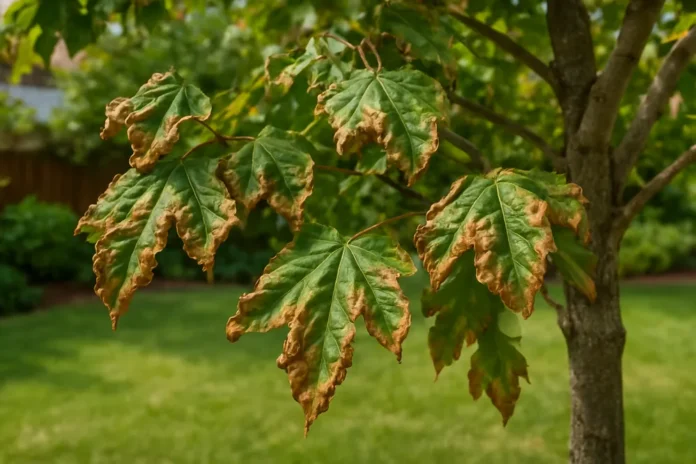
Maple tree leaves usually curl when the tree is stressed by drought, heat, inconsistent watering, pests, disease, or chemical exposure. In many cases, the exact cause shows up in the curling pattern, leaf color, and whether damage is limited to one part of the tree.
Curled leaves on a maple can look alarming, especially when the tree seemed fine just a week or two earlier. In my experience, maple leaves curling is usually the tree's way of reacting to stress rather than a mystery all by itself. The trick is figuring out whether that stress started above ground, like hot wind or pests, or below ground, like dry soil or root trouble.
Maples are quick to show discomfort in their foliage. Some leaves cup upward to reduce moisture loss, some twist and pucker after insect feeding, and some curl while also turning brown, yellow, or spotted. The pattern matters. If the whole canopy is affected, I usually suspect watering, heat, or root issues first. If only one branch or one side of the tree is affected, I look harder at pests, disease, or chemical drift.
The good news is that curled leaves do not always mean your tree is in serious danger. Mature maples often recover well once the underlying problem is corrected, while younger trees benefit from faster intervention. What matters most is matching the symptom to the cause instead of throwing several fixes at the tree at once.
What Curled Maple Leaves Are Telling You
Leaf curling is a stress response, not a diagnosis. A maple may curl its leaves upward, inward, or unevenly depending on what is bothering it. Some trees show soft rolling edges during hot, dry spells. Others develop puckered or crinkled leaves when insects feed on tender new growth. You may also see curl paired with scorch, spots, blackening, sticky residue, or early leaf drop.
Start by looking at the timing. Curling that begins during a summer heat wave often points to drought stress or root competition. Curling that shows up right after leaves emerge in spring can suggest aphids, leafhoppers, mites, fungal issues, or late cold injury. Sudden distortion after nearby lawn treatment or weed spraying raises the possibility of herbicide exposure.
- Leaves curling upward at the edges often suggest heat, drought, or wind stress.
- Leaves that are twisted, puckered, or misshapen are more often linked to pests, disease, or chemical injury.
- Curling with brown crispy margins usually means moisture stress or root dysfunction.
- Curling with sticky leaves or black sooty mold strongly suggests sap-feeding insects like aphids or scale.
- Damage limited to one side of the tree can point to herbicide drift, localized root damage, or branch-specific pest pressure.
When I diagnose a maple, I compare old leaves, new leaves, and leaves from different heights in the canopy. If only the newest leaves are distorted, I lean toward insects, disease, or chemical exposure. If older and newer leaves are both curling during hot weather, water stress jumps much higher on my list.
Water Stress Is the Most Common Cause
Drought and Shallow Watering
Maples have a reputation for showing drought stress quickly, especially Japanese maples, red maples, and newly planted trees. When soil dries too much, leaves may curl inward or upward to reduce water loss. You may also notice limp foliage during the afternoon, browning along the edges, or leaves dropping earlier than normal.
A common problem is watering too lightly and too often. That keeps only the surface damp and encourages shallow roots, while the deeper root zone stays dry. During hot spells, turfgrass and nearby shrubs can also compete with the maple for moisture, making the tree appear watered even though its roots are still thirsty.
Too Much Water Can Look Similar
Overwatering can also cause curling, because waterlogged soil starves roots of oxygen. In that case, leaves may curl while also looking yellow, soft, or dull rather than crisp and dry. If the soil stays soggy for days, root stress can progress to leaf drop, twig dieback, and poor growth.
- Underwatered maples often have dry soil several inches down, curling with browning edges, and a generally wilted look in heat.
- Overwatered maples often sit in wet soil, show yellowing or limp foliage, and may decline even when the weather is mild.
- Newly planted maples are much more vulnerable to both extremes than established trees.
If a maple is struggling, I prefer a slow, deep soaking over frequent sprinkles. Then I wait and judge the tree by how the new growth responds, because damaged leaves rarely flatten back out completely.
Heat, Wind, and Sun Can Curl Leaves Fast
Even when soil moisture is decent, intense summer weather can make maple leaves curl. Hot wind pulls moisture from leaves faster than the roots can replace it, and reflected heat from driveways, patios, or walls can intensify the effect. This is especially common on young trees and ornamental Japanese maples planted in exposed spots.
Sun and heat stress often show up as curling paired with scorched margins or bleached patches on the most exposed side of the canopy. The damage tends to be worse after a stretch of high temperatures, low humidity, or strong afternoon sun. The tree may not be truly diseased at all. It may simply be struggling to balance water loss.
- Leaf edges curl and turn tan or brown after hot, dry weather.
- Damage is heavier on the south or west side of the tree.
- Thin-barked or laceleaf Japanese maples are especially prone to scorch.
- Trees planted in turf, near pavement, or in windy corners dry out faster.
For these trees, mulch helps moderate soil temperature and preserve moisture, but keep it away from the trunk. If the maple is newly planted or naturally delicate in your climate, reducing afternoon stress can make a noticeable difference over the season.
Insects That Distort Maple Leaves
Aphids and Other Sap Feeders
Aphids are one of the most common reasons tender maple leaves curl, especially in spring and early summer. These small insects feed on plant sap, often clustering on the undersides of leaves or soft stem tips. Their feeding can cause leaf cupping, puckering, or twisting. You may also see sticky honeydew on leaves, cars, or patio furniture under the tree, followed by black sooty mold.
Mites, Leafhoppers, and Other Minor Feeders
Spider mites are tiny and easy to miss, but in hot, dry weather they can stress maples enough to cause stippling, bronzing, and some curling. Leafhoppers and similar piercing insects can also distort tender foliage. These problems are often worse on trees already stressed by drought.
What Insect Damage Usually Looks Like
- Curling is strongest on new leaves or shoot tips.
- Leaves may look puckered, sticky, speckled, or unevenly folded.
- Ant activity can increase because ants are attracted to honeydew from aphids or scale.
- You may see insects, cast skins, or fine webbing on the undersides of leaves.
Many insect outbreaks are temporary and controlled naturally by lady beetles, lacewings, and weather changes. Mild infestations often do not justify aggressive treatment on large established trees. The decision depends on the tree's age, the severity of distortion, and whether the problem is repeating year after year.
Diseases That Can Make Maple Foliage Curl
Anthracnose and Leaf Spot Problems
Fungal diseases can sometimes lead to curling, especially when they infect leaves early while the tissue is still soft. Anthracnose is one to watch for on maples. It can cause blotches along veins, browning, irregular dead patches, and distorted or curled leaves. Wet spring weather often sets the stage for this problem.
Tar Spot and Other Mostly Cosmetic Issues
Tar spot is common on some maples and easy to recognize by its black, tar-like spots later in the season. It is usually more unsightly than dangerous and does not typically cause major leaf curling by itself. However, a tree dealing with more than one stress at once may show several symptoms together.
Verticillium Wilt and Serious Vascular Stress
If leaves curl, wilt, and die back on one branch or one side of the tree, especially without obvious drought, verticillium wilt is a more serious concern. This soilborne disease blocks water movement inside the tree. Maples are among the trees it commonly affects. Symptoms can include curling, scorched margins, branch dieback, and uneven canopy decline.
I get more concerned when curling comes with dieback on specific branches rather than a tree-wide response to weather. That pattern makes me think beyond ordinary watering issues and toward wilt, root injury, girdling roots, or a damaged section of the vascular system.
- Disease is more likely when curling is paired with spots, blotches, blackened tissue, or branch dieback.
- Wet spring weather favors many leaf diseases.
- A one-sided decline is more serious than light curling scattered across the whole canopy.
- Fallen infected leaves can help reinfect susceptible maples if left in place year after year.
Herbicide Drift and Chemical Injury
Chemical injury is especially likely if the curling began shortly after spraying dandelions in the lawn, treating fence lines, or using a broadleaf herbicide on a breezy day. Damage may be worse on the side facing the spray source. In severe cases, twigs can also become distorted.
- Leaves are misshapen, twisted, or unusually narrow.
- Symptoms appear quickly after a spray event.
- Only one side or one layer of exposed growth may be affected.
- The tree may not show classic dryness, pests, or leaf spot symptoms.
Unfortunately, there is no direct cure for herbicide injury once it happens. Trees often recover if exposure was light and the roots remain healthy, but repeated exposure can weaken them over time.
Root Problems and Planting Issues
Newly planted maples are especially prone to planting-depth problems. If the root flare is buried too deeply, oxygen exchange suffers and the tree may slowly decline. Leaves can curl, scorch, or remain undersized because the root system never settles in properly.
Established maples can also struggle after driveway work, trenching, grade changes, or heavy foot traffic over the root zone. Unlike annual flowers, trees often react with a delay. A root injury from months ago can show up as curled leaves during the next period of heat stress.
- Curling repeats even after watering improves.
- Growth is sparse, leaves are small, or twigs are dying back.
- The trunk flare is not visible and seems buried under soil or mulch.
- The site has had recent digging, paving, or soil compaction.
How to Narrow Down the Cause on Your Tree
- Look at the whole canopy. Uniform curling suggests broad stress like watering, heat, or root trouble.
- Inspect the undersides of leaves for aphids, mites, webbing, or cast skins.
- Check the soil moisture several inches down instead of judging from the dry surface alone.
- Think back to recent weather such as heat waves, hard wind, late frosts, or heavy rain.
- Consider any recent chemical use nearby, including lawn weed control products.
- Notice whether leaves are also spotted, sticky, scorched, yellow, or dropping early.
Do not change five things at once. If you water differently, fertilize, spray, and prune in the same weekend, you lose the chance to see what actually helped and you may add more stress to the tree.
What to Do for Curled Maple Leaves
If Drought or Heat Is the Problem
Water deeply and slowly so moisture reaches the root zone. Apply 2 to 3 inches of mulch over the root area, but keep it a few inches away from the trunk. During prolonged heat, prioritize consistency over volume extremes. Soil that cycles from bone dry to saturated can stress maples almost as much as steady drought.
If Insects Are the Issue
Light infestations of aphids or mites often improve with strong water sprays on reachable branches and with better overall tree vigor. Avoid broad-spectrum insecticides unless the infestation is severe and repeated, because they can also kill beneficial insects that naturally control pests.
If Disease Is Suspected
Rake and remove badly infected fallen leaves when appropriate, improve airflow if the canopy is overcrowded, and avoid wetting foliage late in the day on smaller ornamental maples. If you suspect verticillium wilt or significant dieback, a certified arborist or local extension service can help confirm it. Serious vascular diseases require a different level of management than routine leaf spots.
If Herbicide or Root Injury Is Likely
Focus on supportive care. Keep watering steady, avoid extra fertilization unless a soil test shows a deficiency, and protect the root zone from further disturbance. Trees recovering from chemical or root stress need time more than they need quick-fix products.
- Remove only clearly dead or broken wood, not healthy limbs during a stress event.
- Avoid heavy fertilizing, which can push tender growth when the tree is already strained.
- Maintain a mulch ring instead of lawn right up to the trunk when possible.
- Watch the new leaves over the next several weeks for signs of improvement.
When Curled Leaves Mean You Should Call an Arborist
- A young or newly planted tree is declining quickly.
- One side of the canopy is dying back while the rest looks normal.
- Leaves curl along with severe wilting even when soil moisture is adequate.
- There are signs of trunk cracking, oozing, root damage, or fungal growth at the base.
- The tree is large enough that pest or disease treatment requires safe professional access.
Maples are valuable landscape trees, and an early diagnosis can prevent a manageable problem from turning into a removal decision later. If you are unsure whether the issue is environmental, insect-related, or systemic, a trained arborist can often sort that out much faster than trial and error.
FAQ
Will Curled Maple Leaves Straighten Back Out?
Usually not. Once a leaf has curled or become distorted, it often stays that way. What you want to watch is whether new growth looks healthier after the underlying problem is addressed.
Should I Fertilize a Maple Tree with Curled Leaves?
Not automatically. Curling is often caused by water stress, heat, pests, or root trouble rather than a nutrient shortage. Fertilizing a stressed tree can sometimes make things worse, especially in hot weather.
Can Too Much Mulch Cause Maple Leaves to Curl?
Yes, if mulch is piled too deeply or packed against the trunk. Excess mulch can trap moisture, reduce oxygen around the root flare, and contribute to root stress that shows up in the leaves.
Why Are Only the Leaves on One Branch of My Maple Curling?
That pattern often points to a localized problem such as branch injury, verticillium wilt, root damage affecting part of the tree, or chemical drift hitting one side more than the rest.
Are Curled Leaves on Japanese Maple Different From Curled Leaves on Other Maples?
Japanese maples are especially sensitive to heat, wind, and sun scorch, so weather-related curling is very common on them. They can also react quickly to shallow watering and exposed sites.
Can Aphids Alone Cause Maple Leaves to Curl?
Yes. Aphids feeding on tender new growth can make leaves cup, pucker, or twist. You may also notice sticky honeydew and black sooty mold if the infestation is active.
When Is Maple Leaf Curling Just Seasonal Stress?
If the tree curls lightly during a hot, dry stretch but otherwise has normal color, no branch dieback, and recovers when conditions improve, it is often temporary seasonal stress rather than a serious disease.
Need the right fix for a stressed landscape tree? See our guide to tree watering tools, mulch options, and homeowner-safe treatments so you can support recovery without wasting time on the wrong products.
