

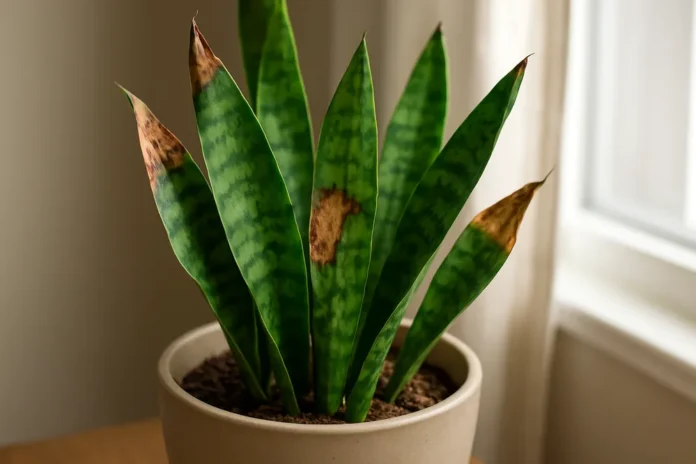
Snake plant leaves usually turn brown because the plant has been stressed by too much water, too little water, harsh direct sun, cold exposure, or root damage. Brown spots and edges are the plant’s way of showing that something in its care or environment is off.
A snake plant can put up with a lot, which is why brown leaves often catch people off guard. These plants have a reputation for being nearly indestructible, but when they start showing brown tips, crispy edges, sunken patches, or whole brown sections, they are reacting to stress that has likely been building for a while.
In my experience, brown leaves on snake plant usually come down to a handful of common causes: watering mistakes, root problems, too much direct sun, temperature stress, or pests. The good news is that the pattern of browning often tells you a lot. A dry brown tip suggests one issue, while mushy brown patches near the base point to something very different.
What the Browning Pattern Is Telling You
Before you change anything, look closely at where the brown tissue appears and what it feels like. Snake plants tend to show fairly readable symptoms. Crispy tips and dry margins usually point to dryness, salt buildup, or irregular watering. Soft brown spots, especially lower on the leaf, often suggest excess moisture or rot. Bleached tan or brown patches on the side facing a bright window often come from sun scorch.
- Brown, dry leaf tips: underwatering, low humidity stress, fertilizer salts, or inconsistent watering
- Soft brown patches near the base: overwatering, root rot, or crown rot
- Large tan or brown scorched areas: too much direct sun or sudden exposure to stronger light
- Brown edges with curling: prolonged dryness, root stress, or compacted soil
- Tiny brown speckles with webbing or stippling: spider mites or other sap-sucking pests
When I diagnose a snake plant, I do not focus on the ugliest leaf first. I compare several leaves and check whether the damage starts at the tip, the edge, the middle, or the base. That pattern is often more useful than the color alone.
Overwatering Is the Most Common Cause
If I had to pick the single most common reason a snake plant turns brown indoors, it would be too much water. These plants store moisture in their thick leaves and rhizomes, so they do not like sitting in wet soil. When the pot stays damp too long, roots begin to weaken and rot. Once that happens, the leaves can develop brown or mushy sections because the plant can no longer regulate water properly.
Overwatering is not only about frequency. A snake plant can also be overwatered if it is planted in dense soil, kept in a pot without drainage, or growing in low light where the mix dries slowly. In winter, this problem becomes even more common because growth slows down but many people keep watering on the same schedule.
- Leaves feel soft, yellowish, or weak before turning brown
- Browning starts low on the plant or near the soil line
- Potting mix stays wet for many days
- There is a sour or swampy smell from the pot
- Roots look dark, mushy, or hollow instead of firm and pale
If this sounds like your plant, remove it from the pot and inspect the roots. Trim away rotted roots with clean scissors, let cut surfaces dry briefly, and repot into a loose cactus or succulent mix with extra perlite or pumice. Make sure the container has a drainage hole. After repotting, wait a bit before watering so damaged roots can settle rather than staying wet again.
Underwatering and Long Dry Spells Can Also Cause Brown Tips
Snake plants are drought tolerant, but drought tolerant does not mean they want to be bone dry forever. If the soil is allowed to stay dry for very long periods again and again, the leaf tips and edges may dry out and turn brown. This kind of browning is usually crisp rather than mushy, and the leaf may look slightly wrinkled or folded before the color change becomes obvious.
Underwatering damage tends to show up more slowly than overwatering damage. A plant can look fine for a while, then develop dry tips that never recover. Once tissue turns brown, it stays brown, even after you correct the watering routine.
- Leaf tips are dry and brittle
- Leaves look thinner, puckered, or lightly wrinkled
- The potting mix pulls away from the sides of the pot
- Water runs straight through because the soil has become too dry and compacted
I like to water snake plants deeply, then let the soil dry well before watering again. Tiny sips on a strict weekly schedule often create more problems than a thorough watering followed by a real dry-down period.
Too Much Direct Sun Can Scorch Leaves
Snake plants handle bright light very well, but they can still burn if they are moved abruptly into harsh direct sun, especially through a hot south- or west-facing window. Sunburn typically creates pale, bleached, tan, or brown patches on the side of the leaf facing the light source. The damaged area may feel dry and papery rather than soft.
This is especially common when a snake plant that lived in moderate indoor light gets moved outside for summer or placed right up against intense glass. Variegated varieties can be a little more sensitive than darker green forms.
- Browning appears mostly on the window-facing side
- Patches are broad and flat instead of concentrated at the base
- The rest of the plant may still feel firm and healthy
- Damage appears after a move to a brighter location
Move the plant to bright indirect light or a spot with softer morning sun. The damaged patches will not turn green again, but new growth should come in clean if light levels are corrected.
Cold Drafts and Temperature Swings Stress Snake Plants
Snake plants are tropical by origin, and they dislike chilly conditions more than many people realize. Exposure to cold drafts, freezing window glass, unheated garages, or sudden temperature drops can cause brown patches or collapsing leaves. Even one cold night near a drafty window can mark the foliage.
Temperature stress often shows up as irregular brown areas rather than neat dry tips. Leaves may also soften, bend, or look water-soaked before the tissue dries out. This can resemble watering damage, so it helps to think back to any recent weather shifts or changes in placement.
- Damage appears after a cold snap or moving the plant outdoors
- Leaves touching cold glass develop localized injury
- Browning follows exposure to heating vents or air conditioning drafts
- The plant otherwise has a normal watering routine
Keep snake plants in temperatures that stay comfortably above 50 degrees Fahrenheit, with best growth in normal indoor room temperatures. Avoid placing them where leaves rest against winter glass or where HVAC airflow blows directly across them.
Root Rot and Poor Drainage Make Browning Worse Fast
Root rot deserves its own close look because it is often the reason browning spreads quickly from one leaf to another. A snake plant may start with a few brown patches, but if the rhizomes below the soil are decaying, the entire plant can fail in a short time. Heavy peat mixes, decorative cachepots that trap runoff, and oversized containers all increase the risk.
Healthy snake plant roots should be firm. The underground rhizomes should also feel solid, not mushy or foul-smelling. If you squeeze a rhizome and it gives way easily, that part is rotting and should be removed.
- Take the plant out of its pot and shake off wet soil.
- Cut away any black, mushy, or bad-smelling roots and rhizomes.
- Dust cuts lightly with cinnamon if you like, though clean, dry handling matters more than additives.
- Repot in a fast-draining succulent mix in a pot just slightly larger than the root mass.
- Do not resume a heavy watering routine right away.
If the lower leaves are browning but the top still looks decent, I always check the rhizomes before assuming the problem is minor. Snake plants can look surprisingly presentable above the soil while the base is already in trouble.
Pests Can Leave Brown Spots and Damaged Edges
Snake plants are not pest magnets, but they can get spider mites, mealybugs, or thrips, especially when stressed. These insects feed by piercing leaf tissue, which can leave pale stippling at first and brown specks or rough damaged patches later. Heavy infestations may also distort growth or make leaves look dusty and dull.
Spider mites are especially easy to miss because they are tiny. You may notice fine webbing where leaves meet, or a sandblasted look on the surface. Mealybugs show up as white cottony masses tucked into leaf bases or creases.
- Inspect both sides of the leaves and the leaf axils
- Wipe foliage with a damp cloth to remove pests and residue
- Treat with insecticidal soap or horticultural oil labeled for indoor plants
- Repeat treatments as directed because eggs and hidden pests often survive the first pass
- Isolate the plant from other houseplants until the problem is gone
Fertilizer Salts and Tap Water Buildup Can Burn Leaf Tips
Brown tips are not always a watering-volume problem. Sometimes the issue is what has been left behind in the soil over time. Excess fertilizer salts and mineral-heavy tap water can accumulate in the potting mix and damage root tissues, which often shows up as dry brown tips or margins.
This tends to happen when a snake plant is fed too often, fed at full strength, or watered lightly so salts never flush through the pot. You may even notice a white crust on the soil surface or around the rim of the container.
- Browning is limited mostly to tips and edges
- There is a visible white crust on soil or pot
- The plant has been fertilized frequently
- The soil is old and has not been refreshed in a long time
To fix this, flush the pot thoroughly if drainage is good, or repot with fresh mix if the soil is old or compacted. Going forward, fertilize lightly during active growth and skip feeding in winter. Many healthy snake plants do just fine with very modest feeding.
How to Fix a Snake Plant with Brown Leaves
Once a leaf section has turned brown, that tissue is dead and will not recover. The goal is to stop the cause so new growth stays healthy. Start by identifying whether the damage feels dry and crisp or soft and wet, then review recent watering, light, and temperature conditions. That usually narrows the diagnosis quickly.
- Check soil moisture and drainage first.
- Inspect roots if the soil has been staying wet or the base looks soft.
- Move the plant out of harsh direct sun if broad scorched patches are present.
- Relocate it away from cold drafts, heat vents, and window glass if temperature stress is likely.
- Look for pests on both sides of the leaves and in tight crevices.
- Trim badly damaged leaf tips or remove whole collapsed leaves with clean scissors if appearance matters.
When trimming, follow the natural shape of the leaf if you are only cutting off a tip. If a whole leaf is badly rotted or bent, remove it at the base. Clean cuts improve appearance, but do not over-prune. A snake plant still needs healthy foliage to fuel recovery.
How to Prevent Brown Leaves in the Future
Prevention is mostly about matching care to the plant's slow, sturdy growth habit. Snake plants do best when they are not fussed over too much. Give them bright indirect light, a gritty potting mix, a pot with drainage, and enough time to dry between waterings.
- Use a fast-draining succulent or cactus mix
- Choose a pot with a drainage hole
- Water only after the mix has dried well
- Reduce watering in fall and winter
- Keep the plant out of severe afternoon scorch unless it has been gradually acclimated
- Protect it from cold drafts and freezing windows
- Fertilize sparingly during spring and summer only
- Inspect leaves now and then for pests before damage spreads
One of the easiest ways to avoid repeat problems is to stop watering by the calendar. Light, temperature, soil, and pot size all change how fast a snake plant dries out. A plant in a sunny room in July may need water far sooner than the same plant in a dim corner in January.
FAQ
Should I Cut the Brown Parts Off My Snake Plant?
You can trim brown tips or edges if you want the plant to look neater, but the cut area will not turn green again. If a whole leaf is mushy, badly bent, or mostly brown, remove it at the base with clean scissors.
Can a Brown Snake Plant Leaf Turn Green Again?
No. Brown tissue is dead and will not recover. What you are looking for after fixing the problem is healthy new growth and no further spread of damage.
How Often Should I Water a Snake Plant to Prevent Browning?
There is no perfect schedule because light, season, pot size, and soil type all matter. In general, water only after the potting mix has dried well, and water less often in winter than in active growing months.
Why Are Only the Tips of My Snake Plant Turning Brown?
Brown tips usually point to dryness, inconsistent watering, fertilizer salt buildup, or mineral-heavy water. It is less often a sign of serious rot unless the base of the leaf is also soft or discolored.
Can Too Much Sun Make a Snake Plant Brown?
Yes. Harsh direct sun, especially after a sudden move into brighter light, can scorch the leaves and leave tan or brown patches. This is most common near hot south- or west-facing windows or after moving a plant outdoors.
What Does Root Rot Look Like in a Snake Plant?
Root rot usually causes softening at the base, mushy brown areas, foul-smelling soil, and dark damaged roots or rhizomes. The plant may also feel loose in the pot because healthy roots are no longer anchoring it.
Is Tap Water Causing My Snake Plant's Brown Edges?
It can contribute, especially if your water is high in minerals and the soil has not been flushed or replaced in a long time. Brown edges from mineral or salt buildup are often dry and gradual rather than sudden and mushy.
Need the right fix fast? Read our guide to the best soils, pots, and watering tools for snake plants so you can stop brown leaves and set up healthier growth.
