

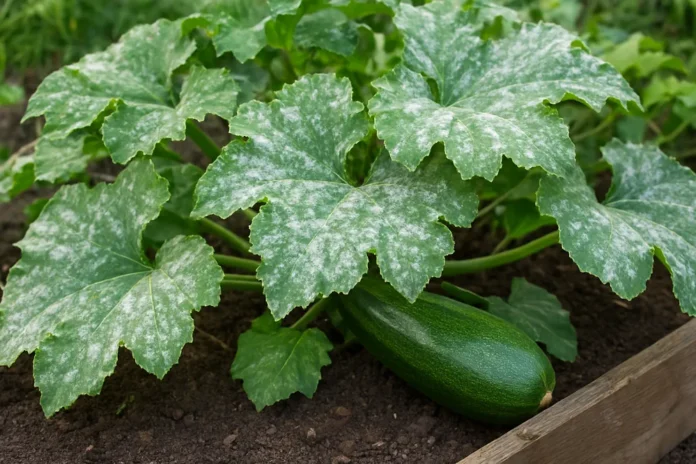
The white powder on zucchini leaves is usually powdery mildew, a very common fungal disease on squash plants. It can also be normal leaf variegation in some cases, but powdery mildew looks like a dusty coating that sits on the leaf surface.
If you have spotted a dusty white coating on zucchini leaves, the most likely cause is powdery mildew. This is one of the most common late-season problems on squash, and it tends to show up right when the plant looks big, healthy, and full of promise. The good news is that it is easy to recognize once you know what you are looking at.
That said, not every pale patch on a zucchini leaf is a disease. Many zucchini varieties naturally have silvery or light mottling on their leaves, and beginners often mistake that pattern for trouble. The key is learning the difference between white powder that can spread and natural leaf markings that are built into the plant.
In my garden, I usually start seeing true powdery mildew after the plants have filled in and air circulation drops. Once it appears, it can move quickly across older leaves first, then weaken the plant if it is left alone. Here is how to tell what you are dealing with and what to do next.
What the White Powder Usually Is
In most cases, the white powder on zucchini leaves is powdery mildew, a fungal disease that affects cucurbits such as zucchini, pumpkins, cucumbers, and melons. It looks like someone dusted the leaf with flour or baby powder. Early on, it may appear as a few small white spots. Later, those spots expand and merge until large parts of the leaf look chalky or gray-white.
Unlike some other fungal diseases, powdery mildew usually sits on the surface of the leaf where you can clearly see it. It often starts on older leaves, especially dense inner leaves that get less light and airflow. If conditions stay favorable, it can spread to stems, leaf stalks, and eventually many leaves on the plant.
- It often starts as round or irregular white patches on the upper leaf surface.
- The coating can look dusty, fuzzy, or talc-like.
- Severely affected leaves may yellow, dry out, curl, or turn brown around the edges.
- Fruit is usually not infected directly, but the plant can lose vigor and produce less.
When It Is Not Powdery Mildew
Zucchini leaves often have natural silver mottling or variegation. This is a normal trait in many varieties and does not mean the plant is sick. These pale areas are part of the leaf tissue itself, so they look flat and integrated into the leaf pattern rather than sitting on top like dust.
Natural Leaf Markings
Natural markings tend to appear symmetrically along the veins or in repeated patterns across several leaves. They are usually bright silver, pale green, or whitish, but the texture of the leaf stays normal. If you touch the leaf, nothing rubs off on your fingers.
True Powdery Mildew
Powdery mildew looks more random and more superficial. It may begin in blotches that do not match the leaf's natural shape. On badly infected leaves, the surface can look dull, dusty, and slightly fuzzy. If you wipe a fresh patch gently, some of the white coating may smear or come away.
When I am unsure, I compare several leaves at once. If every leaf has the same silver pattern in the same places, I assume it is normal. If only a few leaves have expanding dusty patches, especially older inner leaves, I start treating it like powdery mildew.
Why Powdery Mildew Shows Up on Zucchini
Powdery mildew is extremely common on zucchini because these plants grow fast, produce large overlapping leaves, and create a dense canopy that traps still air. Once the plant gets crowded, spores can settle and spread more easily.
Many gardeners are surprised to learn that powdery mildew does not need soaking wet leaves the way some fungal diseases do. It often thrives during warm days, mild nights, and humid conditions around the plant. Dry leaf surfaces do not necessarily protect zucchini from it.
- Poor air circulation between leaves
- Crowded plant spacing
- Warm weather, especially later in summer
- High humidity around dense foliage
- Plants stressed by uneven watering or declining vigor
- Spores blowing in from nearby squash, pumpkins, or wild hosts
It is also normal for older zucchini plants to become more vulnerable as the season goes on. Even a plant that looked flawless in early summer can suddenly show symptoms once nights cool slightly and the canopy gets heavy.
How to Confirm the Diagnosis
Before you spray or prune anything, take a close look. A good diagnosis matters because natural leaf variegation needs no treatment, while powdery mildew benefits from early action.
- Look at both the top and underside of the leaf.
- Check whether the white area appears dusty or embedded in the leaf.
- See whether the pattern is repeating evenly from leaf to leaf or spreading irregularly.
- Notice which leaves are affected first. Powdery mildew often starts on older leaves.
- Watch for yellowing, browning, or collapse around the white patches.
If the white area is flat, silvery, and part of a repeating pattern, it is probably normal. If it grows over time and begins to coat more leaf area, it is almost certainly powdery mildew.
Problems That Can Look Similar
- Hard water residue after overhead watering, which usually appears more spotty and does not spread
- Pesticide or spray residue, which may look chalky but stays where it was applied
- Natural variegation, especially on young vigorous zucchini leaves
- Dust or fine soil splashed onto leaves, which usually rinses off easily
What Powdery Mildew Does to the Plant
Powdery mildew is rarely an instant death sentence for zucchini, but it does reduce the plant's ability to photosynthesize. As more leaf surface gets covered, the plant has less energy to support new growth and fruit production.
Early infections may be mostly cosmetic. Heavy infections can cause leaves to yellow, crisp up, and die back. When that happens, fruit can become more exposed to sunscald, and yields often drop. The plant may keep producing for a while, but it usually becomes noticeably less vigorous.
If your zucchini is already mature and has produced well, a modest amount of powdery mildew late in the season is not always worth aggressive treatment. On the other hand, if the plant is still in its prime and infection is just getting started, acting quickly can extend the harvest.
How to Treat White Powder on Zucchini Leaves
The best treatment depends on how far the infection has progressed. Mild early powdery mildew can often be slowed with pruning, better airflow, and labeled fungicidal products. Severe infections are harder to reverse, so the goal becomes slowing spread and keeping the plant productive as long as possible.
Remove the Worst Leaves
If only a few older leaves are badly covered, prune them off and dispose of them in the trash rather than composting them. Do not strip the plant bare. Zucchini still needs plenty of healthy leaf area to feed developing fruit.
Improve Airflow
Thin only enough foliage to let light and air move through the center of the plant. If nearby plants are crowding your zucchini, cut them back or harvest surrounding crops. Good spacing will not cure powdery mildew, but it can slow it down.
Use an Appropriate Treatment
Home gardeners often use sulfur, potassium bicarbonate, neem oil, or horticultural oils labeled for powdery mildew on edible crops. Always read the label carefully and make sure zucchini or cucurbits are listed. Spray coverage matters. You need to coat affected surfaces thoroughly, including leaf undersides when the product directions call for it.
- Apply in the cooler part of the day if the label recommends it.
- Do not mix products unless the label says it is safe.
- Avoid spraying stressed plants during extreme heat.
- Repeat at the interval listed on the product label.
I avoid changing five things at once. If I prune heavily, fertilize, and spray all in the same day, it becomes hard to tell what helped and what stressed the plant. A lighter, steadier approach usually gives better results.
Skip Unnecessary Fertilizing
Do not push a mildew-covered zucchini with a lot of nitrogen fertilizer. That can trigger soft, crowded new growth that is just as vulnerable. If the plant is pale from a genuine nutrient issue, use a balanced feeding approach, but do not treat mildew as a fertilizer problem.
What Not to Do
A lot of well-meaning fixes either do little or create a new problem. Zucchini plants recover best when you keep the response simple and targeted.
- Do not remove every leaf with a speck of mildew. Over-pruning weakens the plant.
- Do not assume more water will solve it. Powdery mildew is not caused by drought alone.
- Do not spray homemade mixtures on edible crops unless you are confident they are safe and effective.
- Do not treat natural silver variegation as a disease and stress the plant unnecessarily.
- Do not ignore a fast-moving infection if the plant still has plenty of season left.
One mistake I see often is overhead watering late in the day on an already crowded patch. While powdery mildew does not need wet leaves to begin, keeping foliage damp for long stretches can still encourage other diseases and make the plant's overall condition worse.
Can You Still Eat the Zucchini
Yes, in most cases you can still eat zucchini from a plant with powdery mildew as long as the fruit itself is sound. Powdery mildew mainly affects the leaves. Harvest fruit while it is still tender and before the plant declines too far.
Wash the zucchini well as you normally would. If fruit is misshapen, sunscalded, soft, or beginning to rot because the plant is failing, skip it. The disease on the leaves does not automatically make the fruit unsafe, but poor-quality fruit is not worth keeping.
How to Prevent It Next Time
Prevention is mostly about reducing plant stress and making the environment less friendly to the fungus. You may not stop powdery mildew completely, especially in regions where it appears every year, but you can often delay it enough to get a much longer harvest.
- Give zucchini plenty of space so mature leaves do not form a tight wall of foliage.
- Water at the base instead of over the leaves when possible.
- Harvest regularly to keep plants productive and easier to inspect.
- Remove badly infected plant debris at the end of the season.
- Rotate cucurbit crops when your garden space allows it.
- Choose resistant or tolerant zucchini varieties if mildew is a yearly issue in your area.
I also make a habit of checking the oldest leaves once a week during midsummer. Catching the first few powdery spots is far easier than trying to rescue a plant that is already ghosted over from top to bottom.
In gardens where powdery mildew shows up every summer, I think in terms of delay rather than total prevention. If you can keep the foliage healthy two or three weeks longer, that often means a surprisingly bigger zucchini harvest.
When It Is Time to Pull the Plant
Sometimes the best move is to remove the plant and move on. If most leaves are heavily coated, yellowing, and collapsing, and fruit production has dropped off, treatment may not be worth the effort. This is especially true late in the season when cooler weather and shorter days are already slowing growth.
Pulling a spent plant can improve airflow for nearby crops and reduce the amount of infected debris left sitting in the garden. If you still want more zucchini, replanting is only worthwhile if you have enough warm growing time left in your region.
FAQ
Is the White Powder on Zucchini Leaves Always Powdery Mildew?
No. Many zucchini varieties have natural silver or whitish markings on the leaves. Powdery mildew looks like a dusty coating on the surface and tends to spread over time.
Can Powdery Mildew Kill a Zucchini Plant?
It can weaken a plant badly enough that production drops and leaves die back, but it does not always kill the plant outright. Mild cases often allow continued harvest, especially if caught early.
Does Powdery Mildew Spread to Other Squash Plants?
Yes. It commonly spreads among cucurbits such as zucchini, cucumbers, pumpkins, and melons. That is why early removal of badly infected leaves and better spacing can help.
Should I Cut Off Every Leaf with White Powder on It?
No. Remove the worst leaves first, especially older ones that are heavily covered. Leaving enough healthy foliage is important so the plant can keep feeding itself and finishing fruit.
Will Rain Wash Powdery Mildew Off Zucchini Leaves?
Usually not in a meaningful way. Even if some surface growth is disturbed, the disease often continues developing once it is established.
Can I Compost Zucchini Leaves with Powdery Mildew?
It is safer for most home gardeners to throw badly infected leaves away rather than compost them. Backyard compost piles often do not heat evenly enough to break down diseased material quickly.
What Is the Best Spray for Powdery Mildew on Zucchini?
The best option is a product labeled for powdery mildew on edible crops and approved for use on cucurbits. Sulfur, potassium bicarbonate, neem oil, and horticultural oils are common examples, but always follow the label.
Can Healthy New Leaves Appear After Powdery Mildew Starts?
Yes, if the infection is caught early and the plant is still vigorous. The goal is to protect newer growth and slow the spread rather than expect badly infected old leaves to turn green again.
Need the best products and methods to stop mildew fast? Read our guide to the most effective powdery mildew treatments for vegetables and choose the right fix for your zucchini patch.
