

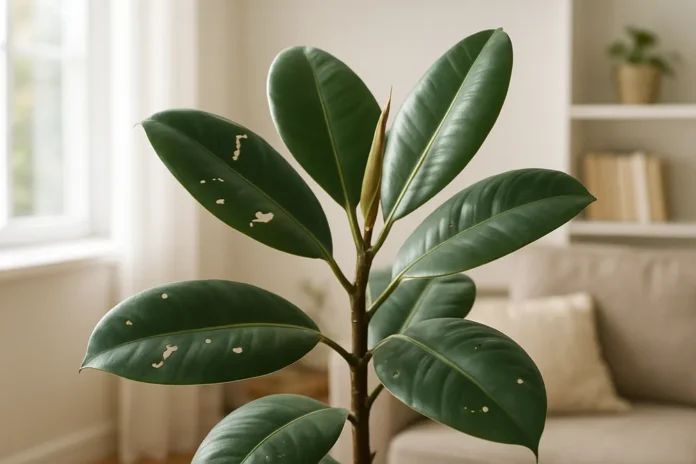
Rubber plant leaves usually get holes from pest feeding, physical tearing, or damage that happened when new leaves were still soft and unfurling. Less often, severe dryness, rubbing, or old stress leaves weakened spots that later split open.
Seeing holes in a rubber plant leaf can be frustrating because the damage looks dramatic even when the plant is otherwise healthy. In my experience, these holes are often not a mystery disease at all. They usually come from a small set of causes: insects chewing or piercing the leaf, mechanical damage, or stress that affected the leaf before it fully opened.
The tricky part is that a leaf can be damaged while it is still tightly rolled, then open later with clean-looking tears or missing spots. That makes people think something suddenly attacked the plant overnight. If your rubber plant leaves have holes, the best clue is not just the hole itself but the pattern around it, such as ragged edges, yellow halos, sticky residue, or holes appearing mostly on fresh growth.
What the Holes Are Telling You
Holes in rubber plant leaves are a symptom, not a diagnosis. A single clean tear on an older leaf often points to physical damage. Multiple small holes, especially with speckling or distorted new growth, lean more toward pests. If the hole edges look brown, dry, or papery, the leaf tissue may have been weakened by low humidity, inconsistent watering, or earlier stress before the leaf expanded.
- A few random holes on older leaves usually suggest bumping, rubbing, or tearing.
- Tiny holes that enlarge as the leaf grows often started as damage while the leaf was still folded.
- Ragged edges can mean chewing pests such as caterpillars or accidental tearing.
- Pinpoint stippling, silvery patches, or black specks often go with thrips or other sap-feeding pests.
- Brown-edged splits can show that the leaf dried unevenly or stuck while unfurling.
When I diagnose this on a rubber plant, I look at the newest two or three leaves first. If the freshest leaves are coming out clean, the problem was likely temporary. If each new leaf opens with similar damage, something is still actively stressing the plant.
Physical Damage Is One of the Most Common Causes
Rubber plants have thick leaves once mature, but new leaves are surprisingly vulnerable. They emerge wrapped and tender, then harden off over time. If a new leaf gets bent, squeezed, scraped, or snagged before it finishes opening, it can later unfold with holes or elongated splits. This is very common near doorways, vents, pet traffic, moving boxes, or when the plant is rotated and a leaf catches on a nearby surface.
Even routine handling can do it. Wiping leaves too aggressively, brushing past the plant, or letting one stiff stem rub repeatedly against another can leave marks that become holes. I have also seen decorative stakes, clips, and rough baskets scratch tender growth as it opens.
- Damage appears on one or a few leaves rather than across the whole plant.
- The holes may look clean or slit-like rather than chewed.
- Older, fully hardened leaves are often unaffected.
- There are no signs of insects, webbing, sticky residue, or leaf spotting.
Pests That Can Leave Holes or Hole-like Damage
Thrips
Thrips are one of the first pests I suspect when a rubber plant has damaged new leaves. They scrape and feed on tender tissue, especially before the leaf fully opens. Once that leaf expands, the damaged spots can turn into tiny holes, silvery scars, or distorted patches. Thrips are slender and easy to miss, but their feeding often leaves a dull, scraped look and small black specks of waste.
Caterpillars or Chewing Insects
Indoor rubber plants do not often get heavy caterpillar damage, but it can happen if the plant spends time outdoors or near open windows. Chewing insects usually leave more irregular holes with ragged edges. You may also find bits of frass, which looks like tiny dark pellets, on the leaf surface or soil.
Spider Mites and Other Sap Feeders
Spider mites, aphids, and similar sap-feeding pests do not usually chew true holes straight through thick rubber plant leaves. Instead, they weaken tissue by sucking plant juices. On tender new leaves, that damage can later crack or split as the leaf grows. Spider mites are especially common in dry indoor air and often leave fine stippling and faint webbing first.
Slugs or Snails on Outdoor Plants
If your rubber plant summers outside, slugs and snails can chew smooth-edged holes overnight. This kind of damage is less likely indoors, but it is worth considering if the problem began after moving the plant outside for warm weather.
If you think pests are involved, inspect both sides of the newest leaves and the seam where a new leaf emerges from its sheath. That is where I most often find the first evidence before the damage becomes obvious.
Low Humidity and Stuck Leaves Can Create Holes
Rubber plants tolerate average indoor humidity fairly well, but very dry air can still interfere with smooth leaf unfurling. When a new leaf sticks to itself or to the protective sheath, parts of the blade can tear as it tries to open. The result may look like random holes, narrow splits, or missing chunks near the middle or edges.
This tends to happen more in winter, especially near heating vents, fireplaces, or drafty windows. Inconsistent watering makes the problem worse because the plant cannot keep enough moisture moving into tender growth. Leaves that should expand evenly instead open under stress and tear at weak points.
- Damage shows up mainly on fresh leaves.
- The holes often line up with folds or creases from the rolled leaf stage.
- Leaf edges may look slightly browned or crisp.
- The plant sits near forced heat, AC, or a very dry room.
Water Stress Can Weaken Leaf Tissue
Rubber plants do best when the soil dries slightly between waterings but not so much that the root ball repeatedly goes bone dry. If the plant swings back and forth between drought and soaking wet soil, leaf development becomes uneven. A stressed leaf may emerge thinner, weaker, or slightly deformed, and those weak areas can later tear into holes.
Overwatering can contribute too, though usually in a less direct way. Roots sitting in overly wet soil struggle to supply steady moisture and nutrients to new growth. That can leave leaves softer, thinner, and more prone to splitting. You may not see classic yellowing first. Sometimes the first clue is just shabby-looking new foliage.
- Leaves droop often between waterings or the soil pulls away from the pot.
- The plant sits in compact, slow-draining soil.
- New growth looks smaller or weaker than older leaves.
- The damage appears alongside browning tips, curling, or sporadic leaf drop.
Sun Scorch, Rubbing, and Environmental Stress
A rubber plant moved suddenly into strong direct sun can develop scorched patches that dry out and become brittle. Those patches may crack or fall away, leaving hole-like damage. This is more common after a move from a lower-light room to a south or west window, or after putting the plant outside without a slow adjustment period.
Environmental friction matters too. Leaves pressed against blinds, curtains, walls, or rough baskets can wear thin over time. Repeated rubbing from fans or HVAC airflow can also stress one side of the plant. When I see holes that all face one direction, I start looking at what the foliage has been touching.
Pattern matters more than people think. If only the leaves nearest a wall, window, or vent are damaged, I treat the room setup as the likely cause before I blame pests or disease.
Disease Is Possible but Not the Usual Reason
Most rubber plant leaf holes are not caused by disease. However, certain leaf spot problems can kill small patches of tissue that later dry and drop out, creating a shot-hole effect. If this is happening, you usually see more than just holes. Expect dark spots, yellow halos, wet-looking lesions, or several affected leaves at once.
Fungal and bacterial issues are more likely when foliage stays wet for long periods, air circulation is poor, or the plant is crowded among other houseplants. A healthy indoor rubber plant in normal conditions is much more likely to have holes from stress or physical damage than from a pathogen.
- Look for round spots that turn tan in the center before tissue drops out.
- Check whether damage spreads across multiple leaves over time.
- Notice any yellow halos, mushy areas, or a bad smell from rotting tissue.
- Consider disease more seriously if leaves are regularly misted or splashed late in the day.
How to Tell Which Cause Fits Your Plant
To narrow this down, look at leaf age, hole shape, and surrounding symptoms. Damage only on older leaves often means past physical injury. Damage mostly on new leaves points more toward pests, stuck unfurling, or watering and humidity stress. Ragged edges suggest chewing. Smooth splits or tears often suggest mechanical damage or dry, stuck leaves.
Also check whether the problem is active. If you only have two damaged leaves from a month ago and current growth looks perfect, the issue may already be over. If every new leaf opens flawed, the plant is still dealing with an ongoing cause.
- Inspect the newest leaves, stems, and the undersides of foliage for pests or residue.
- Compare damaged leaves with healthy ones to see whether the issue is isolated or repeating.
- Think back to any recent move, repotting, dry spell, heat blast, or outdoor exposure.
- Check whether leaves were physically touching nearby surfaces when they opened.
- Review your watering rhythm instead of focusing on a single missed or extra watering.
What to Do Next Based on the Cause
If the Damage Is Physical
Move the plant to a spot where leaves can expand without rubbing walls, curtains, furniture, or pet traffic. Handle new growth gently and avoid forcing stuck leaves open. Damaged leaves will not heal, but the goal is clean new growth.
If Pests Are Present
Isolate the plant from your other houseplants. Rinse the foliage if practical, then treat according to the pest you find, such as insecticidal soap or another houseplant-safe control. Repeat treatments on schedule because eggs and hidden insects often survive the first pass.
If Dry Air or Stuck Unfurling Is the Issue
Keep the plant away from heating vents and intensely dry air. Increase humidity modestly with a humidifier or by grouping plants, and keep watering more even so new leaves can open normally. I would not peel open a stuck leaf unless it is clearly rotting or trapped for an unusually long time.
If Watering Is Inconsistent
Adjust your routine so the soil dries partially but not completely through the pot for long periods. Make sure excess water drains freely and the mix is not staying swampy. A well-aerated potting mix helps new growth stay stronger and less prone to tearing.
If Disease Seems Likely
Remove badly affected leaves if the spotting is spreading, improve air circulation, and avoid wetting the foliage. If symptoms continue on new leaves, a houseplant-safe fungicidal or antibacterial approach may be worth considering, depending on the diagnosis.
Should You Remove Leaves with Holes?
A leaf with holes can still photosynthesize, so you do not need to remove it just for looks unless the damage bothers you. If the leaf is mostly green and healthy, I usually leave it in place. The plant can still use it.
Remove the leaf if it is heavily damaged, diseased, mostly yellowing, or creating crowding that limits airflow. Use clean pruners and cut close to the stem without nicking the main branch. On a small rubber plant, keeping as much healthy foliage as possible usually helps it recover faster.
How to Prevent New Holes in Future Growth
Prevention is mostly about keeping new growth steady and protected. Rubber plants do not need perfect conditions, but they respond well to consistency. Strong indirect light, even watering, decent airflow, and enough space around the leaves go a long way.
- Place the plant where expanding leaves will not scrape nearby objects.
- Check new leaves regularly for thrips, mites, or other early pest signs.
- Water when the top portion of the soil has dried, but before the root ball stays dry too long.
- Keep the plant out of harsh midday sun unless it has been gradually acclimated.
- Avoid blasts of hot or cold air from vents and drafty windows.
- Use a potting mix that drains well but still holds enough moisture for steady growth.
- Clean leaves gently instead of rubbing hard, especially around tender new foliage.
FAQ
Can Holes in Rubber Plant Leaves Heal?
No. Existing holes do not close back up. What you are watching for is whether new leaves emerge without damage, which shows the underlying problem has been solved.
Do Spider Mites Make Holes in Rubber Plant Leaves?
Usually not directly. Spider mites more often cause stippling, fading, and weak tissue that may later crack or split on tender leaves.
Are Holes in New Rubber Plant Leaves More Serious than Holes in Old Ones?
They can be more useful diagnostically. Repeated damage on new leaves often points to an active issue such as thrips, stuck unfurling, or ongoing moisture stress.
Should I Mist My Rubber Plant to Stop Holes?
Misting is not usually the best fix. It gives only a brief humidity bump and can encourage leaf spot issues if foliage stays wet. A humidifier and steadier watering help more.
Can Low Humidity Alone Cause Holes?
Yes, indirectly. Very dry air can cause new leaves to stick and tear while opening, which later looks like random holes or splits.
Do I Need to Cut Off Every Damaged Leaf?
No. If the leaf is mostly green and healthy, you can leave it. Remove it only if it is badly damaged, diseased, or unattractive enough that you want a cleaner look.
Why Do the Holes Seem to Appear Overnight?
The injury often happened earlier while the leaf was still rolled up. Once it opens and expands, the damaged spots spread apart and suddenly become obvious.
Can Rubber Plant Leaves Get Holes From Too Much Sun?
Yes. Sun-scorched tissue can dry out, become brittle, and eventually crack or fall away, especially after a sudden move into direct sun.
Want cleaner, healthier new growth fast? Read our guide to the best houseplant pest treatments and humidity tools so you can stop leaf damage before the next rubber plant leaf opens.
