

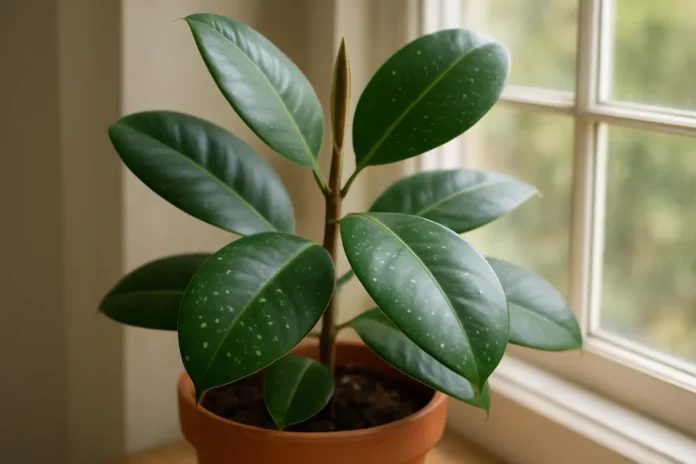
White spots on rubber plant leaves are usually caused by hard water residue, dried sap, pests like mealybugs or scale, or powdery mildew. Sometimes the spots are harmless, but fuzzy growth, sticky residue, or spreading patches point to a problem.
Seeing rubber plant leaves develop pale or chalky marks can be unsettling, especially on a plant that is usually known for big, glossy, dark green foliage. The good news is that white spots are not always a sign that your plant is in serious trouble. In many cases, they come from something simple like mineral residue from tap water or a little dried sap after a leaf was bumped or pruned.
That said, some white spotting does deserve quick attention. Mealybugs, scale, and powdery mildew can all show up as white patches or clusters, and they need a different response than harmless residue. When I troubleshoot a white spots complaint on a rubber plant, I focus less on the color alone and more on the texture, location, and whether the marks wipe off cleanly.
What White Spots Usually Mean on a Rubber Plant
Rubber plant leaves can show white spotting for a few very different reasons, and they do not all signal the same level of concern. Some causes sit on the leaf surface, like mineral buildup from misting or splashing with hard water. Others are part of the plant itself, like dried latex sap from a tiny wound. Then there are true plant problems, including sap-sucking pests and fungal disease.
- A thin chalky film or ring often points to mineral residue from tap water.
- A few irregular white crusty dots near a damaged area may be dried sap.
- Cottony clumps in leaf joints or along stems are commonly mealybugs.
- Small raised white or tan bumps that do not brush away easily can be scale insects.
- A dusty, flour-like coating that spreads across leaf surfaces may be powdery mildew.
The first thing I do is rub one spot with a damp fingertip. If it dissolves or smears, I think residue or mildew. If it feels sticky, cottony, or attached like a tiny shell, I start looking hard for pests.
Mineral Residue From Water Is the Most Common Harmless Cause
If your rubber plant is watered, misted, or wiped down with hard tap water, dissolved minerals can dry on the leaf surface and leave white spots. These often look like faint dots, rings, streaks, or a cloudy film. They are especially common on broad leaves because water sits on them longer before evaporating.
This kind of spotting is mostly cosmetic. It usually appears on the upper surface of older leaves, especially where droplets have dried. The leaf itself still feels firm and healthy, and the white marks usually wipe away with a damp cloth. If the marks disappear when cleaned and do not seem fuzzy or alive, residue is the likely culprit.
- Spots look flat rather than raised
- Marks often follow splash patterns or droplet outlines
- There is no sticky honeydew, webbing, or insect movement
- The leaf tissue underneath stays green and healthy
- New spots appear after misting or leaf cleaning with tap water
To prevent it, avoid misting with mineral-heavy water and wipe leaves with filtered, distilled, or rainwater when possible. Rubber plants do not need frequent misting indoors anyway, so if you have been doing it for humidity, it is usually better to raise humidity another way.
Dried Latex Sap Can Look Like White Specks or Crusty Patches
Rubber plants are ficus, and like other ficus species they produce a milky latex sap. When a leaf or stem is nicked, pruned, bent, or rubbed, a tiny amount of sap can ooze out and dry into pale white or cream-colored spots. These may look alarming if you have never seen them before, but they are often just the plant sealing a minor injury.
Sap spots tend to appear near torn tissue, along the midrib, at the base of a leaf, or where a leaf has been scraped against a wall or window. They are usually more localized than residue problems and not evenly scattered across many leaves. If you recently moved the plant, rotated it, repotted it, or pruned it, dried sap becomes even more likely.
- White spot is close to a scratch, tear, or crease
- Patch feels crusty rather than fuzzy
- Only one or two leaves are affected
- There is no spreading pattern from leaf to leaf
- The rest of the plant looks vigorous
You can gently wipe dried sap away if it bothers you, but do not scrub so hard that you injure the leaf further. Wear gloves if you are sensitive to plant sap, since ficus latex can irritate skin in some people.
Mealybugs and Scale Can Both Show Up as White Spotting
If the white spots look like tiny bits of cotton, lint, or wax, pests move high on the list. Mealybugs are especially common on indoor rubber plants. They cluster where leaves join stems, tuck into folds, and gather along veins on the undersides of leaves. Scale can also appear pale or whitish when young, though many become tan or brown as they mature.
These pests feed by sucking sap from the plant. Over time they can cause yellowing, leaf drop, sticky honeydew, and weak new growth. Mealybugs often leave a fluffy coating, while scale looks more like attached bumps. Both can be stubborn because they hide well and reproduce faster than many gardeners expect.
- Cottony clusters in leaf axils usually indicate mealybugs
- Raised shell-like bumps along stems or veins suggest scale
- Sticky leaves or nearby surfaces point to sap-sucking insects
- Ant activity indoors or on patio plants can accompany honeydew
- New growth may emerge distorted or weaker than usual
When I suspect mealybugs, I do not stop at the obvious leaves. I inspect the petioles, stem joints, undersides, and even the rim of the nursery pot because infestations often survive in tucked-away spots after a quick surface cleaning.
For a light infestation, isolate the plant first. Then remove visible pests with a cotton swab dipped in isopropyl alcohol, or wipe the leaves and stems with insecticidal soap according to label directions. Repeat treatments every several days to a week until you stop seeing new insects. Heavy infestations may require pruning badly affected growth and using a houseplant-safe horticultural oil or soap more consistently.
Powdery Mildew Is Less Common but Still Possible Indoors
Powdery mildew creates a white, dusty, flour-like layer on leaves. It is a fungal issue, and while it is more famous in outdoor gardens, indoor plants can get it too when air circulation is poor, leaves stay damp, and humidity stays high around crowded foliage. On a rubber plant, it may begin as small pale patches and expand into larger fuzzy areas.
Unlike mineral residue, mildew often looks alive in a way. It spreads over time, may appear on multiple leaves, and can affect both upper and lower surfaces. In more advanced cases, leaves may yellow, curl slightly, or lose some shine.
- White coating looks powdery rather than crusty
- Patches gradually enlarge or appear on new leaves
- Plant is in a stagnant or crowded indoor spot
- Leaves may have been misted often or kept damp
- The residue does not simply vanish with one gentle wipe
Start by improving air movement and stopping overhead wetting or misting. Remove the worst leaves if only a few are affected. Then treat with a houseplant-safe fungicidal product if the problem persists. Always follow the label and avoid coating the plant in homemade mixes that may burn glossy ficus leaves.
Less Common Causes Worth Checking
A few other issues can produce pale spotting that gardeners describe as white. Edema, residue from foliar sprays, dust mixed with guttation salts, and even sun stress on tender leaves can create oddly pale marks. These are not the first causes I suspect, but they are worth considering if the usual explanations do not fit.
- Foliar spray residue from neem, soap, or leaf shine products can dry into cloudy specks
- Edema can leave corky pale spots when watering and transpiration get out of balance
- Dust that sticks to sticky sap or moisture can look whitish from a distance
- Sunscald sometimes starts as faded patches before turning tan or brown
Think back over any recent changes. Did you move the plant into stronger sun, apply a treatment, or suddenly increase watering? White spotting that starts right after a change often provides a good clue.
How to Tell Which Cause You Have
A simple close inspection usually gets you most of the way to an answer. You do not need special tools, though a bright window and your phone flashlight help. Look at the top and underside of several leaves, then compare old leaves with new growth.
- Wipe one spot with a damp cloth to see whether it lifts easily.
- Check whether the marks are flat, fuzzy, sticky, raised, or crusty.
- Inspect leaf axils, stems, and the undersides for insects or cottony clusters.
- Notice whether the pattern is random droplets, concentrated near damage, or spreading across the plant.
- Look for related symptoms such as honeydew, yellowing, leaf drop, or distorted growth.
I pay close attention to whether only older leaves are affected or the newest growth is involved too. Residue usually shows up wherever water landed, but pests often concentrate on tender growth and hidden joints first.
If the spots wipe off and do not return quickly, you are probably dealing with residue. If they return in the same hidden areas, feel sticky, or seem to multiply, assume pests or mildew until proven otherwise.
What to Do Right Now for Each Cause
If It Is Mineral Residue
Wipe leaves with a soft cloth dampened with filtered or distilled water. For stubborn film, use a very dilute mix of water and a little white vinegar on the cloth, then follow with plain water so residue does not sit on the leaf. Do not soak the potting mix with vinegar water.
If It Is Dried Sap
Leave it alone if the leaf is otherwise healthy, or gently wipe it off. Avoid further rough handling. If your plant is getting bumped in a hallway or brushing a curtain or blind, move it slightly so new injuries stop happening.
If It Is Mealybugs or Scale
Isolate the plant from your other houseplants right away. Remove visible pests manually, then treat with insecticidal soap or horticultural oil labeled for indoor plants. Repeat on schedule because one treatment rarely solves the full life cycle.
If It Is Powdery Mildew
Increase airflow, avoid wetting leaves, remove the worst-affected foliage, and use a fungicide labeled for the problem if needed. Space plants so leaves are not pressed together, especially if you keep several tropical plants in one corner.
No matter the cause, resist the urge to throw several fixes at the plant at once. Clean, observe, and then use the treatment that matches the problem. Rubber plants are sturdy, but they appreciate a steady approach.
How to Prevent White Spots From Coming Back
Once your rubber plant is cleaned up, prevention is mostly about good indoor care. These plants like bright indirect light, moderate watering, decent airflow, and leaves that stay mostly dry. When those basics are in place, most recurring white spot issues become much easier to avoid.
- Use filtered, distilled, or rainwater for leaf wiping if your tap water leaves residue
- Skip routine misting unless you have a very specific reason for it
- Inspect new plants before bringing them near your rubber plant
- Check leaf undersides and joints every week or two for early pest signs
- Keep the plant out of cold drafts and away from rough traffic that can damage leaves
- Do not overfeed or overwater, since stressed plants attract more trouble
- Wipe dust from leaves regularly so you notice changes early
I have found that regular leaf cleaning does more than improve appearance. It also gives you a routine chance to catch pests early, before a few white flecks turn into a full infestation.
When White Spots Mean You Should Act Fast
Some white spotting can wait until your next plant-care session, but a few signs call for quick action. If the spots are clearly insects, if the coating is spreading fast, or if the plant is also dropping leaves, do not put it off. Houseplant problems move slowly until suddenly they do not.
- Cottony insects are visible on multiple stems or leaves
- Leaves feel sticky or furniture below the plant has residue
- White patches are expanding from week to week
- New leaves emerge distorted or fail to open well
- The plant is losing leaves while the spotting increases
A healthy rubber plant can recover well once the cause is corrected. The key is matching the treatment to the symptom instead of treating every white mark like the same problem.
FAQ
Can I Just Wipe the White Spots Off My Rubber Plant Leaves?
Yes, if the spots are from mineral residue or dried sap, gentle wiping is often enough. If they come back quickly or feel cottony, sticky, or raised, you are likely dealing with pests or mildew instead of simple residue.
Are White Spots on a Rubber Plant a Sign of Overwatering?
Not usually by themselves. Overwatering is more likely to cause yellowing, leaf drop, root problems, and general decline, though it can contribute indirectly by stressing the plant and making disease issues more likely.
Do Mealybugs on a Rubber Plant Always Look Like White Fuzz?
Most of the time, yes. They often appear as cottony white clumps in leaf joints, along stems, or on leaf undersides, and they may also leave sticky honeydew behind.
Is Powdery Mildew Common on Indoor Rubber Plants?
It is less common than residue or mealybugs, but it can happen. Poor airflow, crowded plants, and repeatedly damp leaves make it more likely indoors.
Should I Mist My Rubber Plant to Prevent Leaf Problems?
In most homes, no. Frequent misting can leave mineral spots and create conditions that favor mildew, while doing very little for long-term humidity around the plant.
Can White Spots Spread to My Other Houseplants?
Harmless residue and dried sap will not spread, but pests and fungal problems can. If you suspect mealybugs, scale, or mildew, isolate the plant until you are confident the issue is under control.
Will Damaged Leaves Turn Green Again After the White Spots Are Treated?
If the white mark was just surface residue, the leaf may look normal once cleaned. If the tissue itself was damaged by pests, mildew, or injury, the spot usually stays, and you judge recovery by healthy new growth.
Need help choosing the right treatment? Read our guide to the best houseplant pest controls and leaf-safe sprays so you can fix white spots without damaging your rubber plant.
