

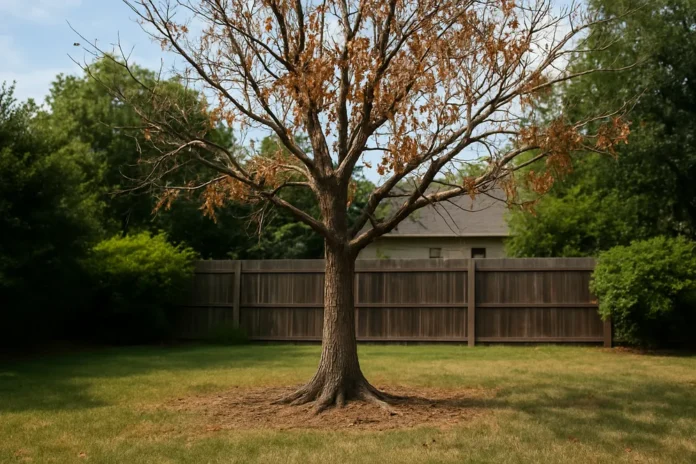
A maple tree usually starts dying because its roots, trunk, or canopy are under serious stress from drought, overwatering, disease, pests, or physical damage. The cause is often revealed by whether decline starts in the leaves, branches, bark, or root zone.
When a maple starts looking thin, scorched, or bare long before it should, something is interrupting the tree's ability to move water and energy where it needs to go. Maple tree decline is often blamed on a single issue, but in home landscapes it is usually a chain reaction: root stress leads to weak growth, weak growth invites pests or disease, and the canopy starts dying back.
I have found that the most useful clue is not just that the tree looks bad, but how the damage is showing up. Leaves that crisp at the edges suggest one kind of stress, branches dying back from the tips suggest another, and bark splitting or mushrooms near the base point somewhere else entirely. Mature maples can also decline slowly for a few years before the problem becomes obvious.
The good news is that not every stressed maple is dying beyond repair. If enough healthy canopy, bark, and roots remain, you can often stop the decline. The key is reading the symptoms in the right order and avoiding fixes that add even more stress.
What a Dying Maple Tree Usually Looks Like
A maple rarely dies overnight unless there has been severe root loss, lightning, flooding, or major trunk injury. More often, the tree shows a pattern of decline that gets worse over one or more seasons. The leaves may emerge smaller than normal, develop brown edges, yellow too early, or drop during summer. Small twigs may die first, followed by larger branches.
- Leaves wilting, curling, browning, or dropping early
- Sparse canopy or bare branches on one side or in the upper crown
- Dead branch tips and reduced new growth
- Bark cracks, peeling bark, or sunken cankers on branches or trunk
- Mushrooms or fungal growth near the base
- A sudden flush of shoots from the trunk or lower branches
- Sections of the tree leafing out later than the rest
When I assess a struggling maple, I pay close attention to where the decline started. A whole-tree slowdown usually points me toward roots or soil conditions, while one dead limb or one-sided decline makes me think of injury, girdling roots, cankers, or branch-specific damage.
One important distinction is whether the tree is stressed or truly dying. A stressed tree can still produce normal buds, hold leaves through the season, and push fresh growth after conditions improve. A dying tree keeps losing canopy, shows brittle dead twigs, and fails to replace lost growth.
Water Stress Is One of the Most Common Causes
Drought and Shallow Watering
Maples are sensitive to extended dry periods, especially young trees and shallow-rooted varieties planted in lawns. If the soil dries too often, leaves may scorch at the margins, curl, or drop early. The tree may survive one dry spell, but repeated drought stress weakens roots and leaves it vulnerable to secondary problems.
Overwatering and Poor Drainage
Too much water can look surprisingly similar to too little. Saturated soil drives oxygen out of the root zone, and stressed roots cannot support the canopy. Leaves may yellow, wilt, and fall even though the ground feels wet. In low areas or heavy clay, root decline can become severe enough to kill major sections of the tree.
- Drought stress often shows as dry, crisp leaf edges and reduced growth
- Waterlogged roots often cause limp leaves, yellowing, and general canopy thinning
- Frequent shallow irrigation encourages roots near the surface instead of deeper, more stable rooting
- Turf competition can make a maple drier than the surrounding lawn suggests
If a maple is struggling, I prefer slow, deep watering over frequent light sprinkling. The goal is to moisten the root zone well and then let the soil breathe, not keep the surface constantly damp.
Root Problems Can Quietly Kill a Maple
A large share of serious maple decline starts below ground. Roots may be damaged by trenching, grade changes, paving, repeated compaction, or planting too deeply. Because roots feed the entire canopy, the tree may show broad decline months or even years after the original injury.
Girdling Roots
Girdling roots wrap around the trunk or other roots and slowly restrict water and nutrient movement. This is common in container-grown trees that were never corrected at planting. A maple with girdling roots may have one-sided thinning, poor vigor, small leaves, and dieback that keeps returning.
Compacted Soil and Buried Root Flare
When the soil around a maple is repeatedly driven over, walked on, or covered with extra fill, roots lose oxygen and growth slows. Planting too deep is another frequent issue. The root flare should be visible at the base of the trunk. If the trunk goes straight into the soil like a telephone pole, the tree may be buried too deeply and more prone to rot and chronic decline.
- Construction damage near the drip line
- New patios, sidewalks, or raised beds over roots
- Soil piled against the trunk
- String trimmer or mower wounds at the base
- Trees planted too deep or mulched like a volcano
Diseases That Commonly Affect Maple Trees
Several diseases can make a maple look like it is dying, and some of them genuinely can kill the tree. The challenge is that disease symptoms often overlap with environmental stress. A stressed tree is also more likely to succumb to infection.
Verticillium Wilt
Verticillium wilt is one of the most serious diseases for maples. It is caused by a soilborne fungus that blocks water movement inside the tree. Symptoms often include sudden wilting, yellowing or browning leaves, branch dieback, and decline on one side of the canopy. In some cases, cutting into a recently affected branch reveals olive or dark streaking in the sapwood.
Cankers and Branch Dieback Diseases
Cankers are dead, sunken, or cracked areas on bark that can girdle branches or sections of trunk. Once a canker interrupts flow under the bark, everything beyond it may wilt and die. Cankers are especially common after drought, winter injury, or other stress weakens the tree.
Root Rot
Poorly drained soil can lead to root rot organisms that destroy root function. A maple with root rot may leaf out weakly, show gradual canopy thinning, and fail rapidly during hot weather because the remaining roots cannot keep up with demand. Mushrooms at the base or decaying wood around roots can be warning signs.
I get especially concerned when a maple declines fast after looking fine the year before and the soil has stayed wet. That combination makes me think less about fertilizer and more about a vascular or root disease that is shutting down water movement.
Insects and Borers Can Push a Stressed Tree Over the Edge
Most insect problems do not kill a healthy, established maple by themselves, but they can seriously damage a tree that is already under stress. The insects to worry about most are the ones attacking bark, wood, or sap flow.
Borers
Boring insects tunnel beneath bark or into wood, interrupting the tree's transport system. You may notice small holes, sawdust-like frass, bark splitting, or dead patches in the canopy. Borers are often a sign that the tree was weakened first by drought, root injury, sunscald, or disease.
Scale, Aphids, and Other Sap-feeders
Heavy populations of scale or aphids can weaken a maple by removing sap and coating leaves and branches with sticky honeydew. Sooty mold may then grow on the residue. These pests usually cause decline rather than sudden death, but repeated infestations reduce vigor over time.
- Tiny exit holes in bark
- Loose bark or bark falling away from dead areas
- Fine sawdust on the trunk or branch crotches
- Sticky leaves, black sooty mold, or heavy ant activity
- Dead branch sections with no obvious leaf disease
Weather, Salt, and Site Conditions Matter More than Many Gardeners Expect
Maples can be sensitive to conditions that seem minor in the landscape but add up over time. Heat reflected from driveways, deicing salt, late spring freezes, strong wind, and winter sun injury can all damage tissues or dry roots enough to cause decline.
Leaf Scorch and Heat Stress
In hot, dry, or windy weather, maple leaves may turn brown at the edges while veins or inner tissue stay greener at first. This is classic scorch and usually means roots cannot replace water as quickly as the canopy is losing it. It can be caused by drought, restricted roots, or root disease rather than heat alone.
Winter Injury and Frost Damage
A warm spell followed by a hard freeze can damage buds, twigs, and bark. Some branches may leaf out normally while others remain bare. Young trunks can also suffer sunscald in winter, which later opens the door to cankers and dieback.
Salt Exposure
Road salt and deicing products can burn roots and interfere with water uptake. Trees planted near streets, sidewalks, or snowy parking areas often show marginal browning, thin growth, and long-term stress that gets worse each winter.
How to Tell Whether Your Maple Can Still Be Saved
A maple has a better chance of recovery when at least half the canopy is still alive, the trunk is mostly sound, and the root flare area is not rotting or heavily damaged. Trees with scattered dead branches can often recover if the underlying cause is corrected. Trees with major trunk decay, extensive bark loss, or severe root failure are much less likely to bounce back.
- Good recovery potential: live buds, healthy leaf size on some branches, firm bark, and a mostly intact trunk
- Poor recovery potential: more than half the crown dead, mushrooms from the base, large trunk cracks, hollow sections, or bark sloughing around the circumference
- Urgent removal concern: large dead limbs over a home, driveway, play area, or sidewalk
You can do a light twig scratch test on small twigs. Green tissue just under the bark suggests the twig is alive, while dry brown tissue suggests it is dead. This is useful for checking branch tips, but it does not replace a professional assessment for trunk stability or root failure.
What to Do Next for a Declining Maple Tree
Start by reducing stress rather than reaching for fertilizer. A struggling maple usually benefits more from correct watering, mulch, and root-zone protection than from extra feeding. Fertilizer can actually worsen problems when roots are compromised or when drought is the main issue.
- Water deeply during dry periods, especially if the tree has been planted within the last few years.
- Apply a 2 to 3 inch layer of mulch over the root zone, but keep it several inches away from the trunk.
- Stop string trimmer and mower damage around the base.
- Do not pile soil, compost, or stone over the root flare.
- Prune out dead branches only when you can make clean cuts back to healthy wood or proper branch collars.
- Avoid soil compaction from vehicles, heavy foot traffic, or repeated digging near roots.
- Have a certified arborist inspect the tree if you see trunk decay, large dead limbs, mushrooms, or rapid canopy loss.
If disease or borers are suspected, proper diagnosis matters before treatment. Some issues can be managed, while others require long-term monitoring or removal. A lab test or arborist evaluation is especially helpful for suspected verticillium wilt, serious cankers, and structural decay.
Common Mistakes That Make Maple Decline Worse
Well-meant care can backfire when the real problem is misunderstood. The biggest mistakes usually involve doing too much, too fast, around a tree that needs stability.
- Watering a little every day instead of soaking deeply and less often
- Adding fertilizer before addressing water, roots, or drainage
- Stacking mulch against the trunk
- Pruning heavily during active stress
- Treating leaf symptoms without looking at bark, roots, and site conditions
- Ignoring construction or grade changes that affected roots months earlier
- Waiting too long to remove hazardous dead limbs
One of the hardest lessons for homeowners is that a tree can show symptoms far from the actual problem. Brown leaves do not always mean a leaf problem. On maples, they often trace back to roots, trunk injury, or blocked water movement.
FAQ
Can a Maple Tree Recover After Losing Many Leaves in Summer?
Yes, if the loss was caused by temporary stress such as drought or heat and the buds, branches, and roots are still healthy. Recovery is less likely if the tree also has major dieback, trunk damage, or root disease.
Why Is Only One Side of My Maple Tree Dying?
One-sided decline often points to a localized problem such as girdling roots, trunk injury, cankers, construction damage, or root loss on that side. It is usually more specific than a whole-tree watering issue.
Should I Fertilize a Dying Maple Tree?
Usually not until you know the cause. If the tree is stressed by poor drainage, root injury, or disease, fertilizer may add stress without solving the real problem.
What Does Verticillium Wilt Look Like on a Maple?
It often causes sudden wilting, yellowing, browning, or dieback on one branch or one side of the canopy. In recently affected branches, the sapwood may show olive or dark streaking when cut.
Can Too Much Mulch Kill a Maple Tree?
Yes. Mulch piled against the trunk can keep bark wet, encourage decay, hide pests, and contribute to root flare problems. Mulch should be spread flat over the soil, not heaped around the trunk.
When Should I Call an Arborist for a Dying Maple?
Call an arborist if the tree has large dead limbs, trunk cracks, mushrooms at the base, rapid canopy decline, or is close to a house, driveway, or sidewalk. Those are signs that both diagnosis and safety matter right away.
Need help choosing the right treatment or deciding whether removal is safer? Read our maple tree care and problem-solving guides to compare fixes, tools, and next-step options fast.
