

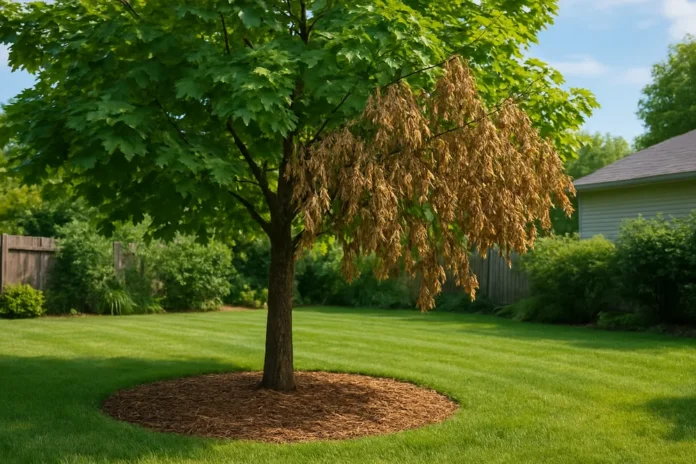
Maple tree leaves usually wilt because the tree is struggling to move enough water from its roots to its leaves. Drought, root damage, soil problems, heat, and certain diseases are the most common reasons.
Wilting leaves on a maple tree can be unsettling, especially when the tree looked fine just days earlier. In my experience, maple tree leaves wilting is rarely a random event. It usually means the tree is under water stress, root stress, or disease pressure, and the leaf pattern often gives you the first clue.
Maples can wilt from something as straightforward as a dry spell, but they can also react to compacted soil, recent construction, girdling roots, transplant shock, or serious issues like verticillium wilt. The key is to look at which leaves are wilting, how fast it happened, and whether the branches, bark, or soil show other warning signs.
The good news is that not every wilted maple is dying. Some problems are reversible if you catch them early, while others call for quicker action to protect the rest of the tree and nearby plants.
What Wilting Usually Means on a Maple
When maple leaves wilt, the tree is failing to keep enough moisture moving into the leaf tissue. That can happen because the soil is too dry, because roots cannot absorb water properly, or because the water-conducting tissues inside the tree are blocked or damaged. Leaves may droop, curl, feel limp, or hang downward even while staying green at first.
Wilting is different from normal seasonal color change. A healthy maple in fall changes color gradually and the leaves stay fairly firm before dropping. Wilted leaves often look soft, tired, or collapsed. In summer, they may scorch at the edges, turn brown while still attached, or shrivel on one side of the canopy.
- If the whole tree wilts during hot weather, drought or root stress is often involved.
- If only one limb or one side wilts, think about branch injury, root damage, or vascular disease.
- If leaves wilt and then blacken or scorch, the problem may have progressed beyond simple dryness.
- If wilting follows planting or digging nearby, transplant stress or disturbed roots are likely suspects.
When I diagnose a maple, I compare leaves from several parts of the canopy before I assume the tree just needs water. A uniform wilt points me toward environmental stress, while one-sided wilting makes me look much harder for root injury or disease.
Drought and Heat Stress Are the Most Common Causes
Dry Soil Can Make Leaves Droop Fast
During hot, windy, or unusually dry weather, maple roots may not be able to take up water fast enough to keep up with what the leaves are losing. The leaves wilt first because they are the farthest point from the water source. Japanese maples and young maples are especially prone to this, but mature shade trees can show it too during extended drought.
Early drought wilt often shows up in the afternoon, then improves slightly overnight. If the dry spell continues, the wilt becomes constant and leaves may develop crispy brown margins. You may also notice smaller new leaves, early leaf drop, or a thinning canopy.
Hot Reflected Heat Can Worsen the Problem
Maples growing near driveways, sidewalks, stone walls, or south-facing exposures can wilt even when the rest of the yard seems acceptable. Heat reflected off hard surfaces raises leaf temperature and dries the root zone faster. Shallow-rooted maples often struggle most in these spots.
- Leaves droop most during the hottest part of the day
- Leaf edges turn tan or brown after repeated stress
- The soil feels dry several inches down
- Recent weather has been hot, windy, or rain-free
I would much rather water a maple deeply and less often than give it quick daily sprinkles. Light watering keeps the surface damp but does very little for the deeper roots that actually support the canopy.
Too Much Water Can Look Like Too Little Water
One of the most confusing things for gardeners is that overwatered maples can wilt too. Roots need oxygen as much as they need moisture. In waterlogged soil, roots begin to suffocate and decline, so the tree cannot move water upward efficiently. The result can look almost identical to drought stress at first glance.
This is common in clay soil, low spots, lawns with frequent irrigation, or areas where downspouts dump near the tree. If the soil stays soggy for days, the problem can escalate into root rot. Wilted leaves may also yellow, and growth may stall even though the ground feels wet.
- Soil stays wet and sticky well below the surface
- Leaves wilt but also turn pale or yellow
- The tree sits in a poorly drained area
- There is a sour smell or obvious standing water after rain
If you have been watering regularly and the tree still wilts, resist the urge to add even more water until you know what the soil is doing. Constantly wet soil can keep a stressed maple from recovering.
Root Problems Often Drive Maple Leaf Wilt
Damaged Roots Reduce Water Uptake
Maple roots are sensitive to disturbance. If someone trenched nearby, cut roots during landscaping, parked heavy equipment over the root zone, or added a lot of fill soil, the tree may respond with wilted foliage. A maple does not need all its roots destroyed to show stress. Losing a meaningful portion of active feeder roots can be enough.
The timing matters here. Wilt that begins shortly after construction, patio work, driveway expansion, or repeated foot traffic often points to root injury or compaction. Sometimes the damage happened weeks earlier, and the leaves wilt only once heat pushes the tree beyond what its reduced root system can handle.
Buried Root Flares and Girdling Roots Create Chronic Stress
Many landscape maples are planted too deep or smothered under mulch piled against the trunk. Over time, the root flare disappears below soil level, roots circle the trunk, and the tree becomes less efficient at moving water and nutrients. Chronic wilt, sparse foliage, and dieback can follow.
- The trunk goes straight into the soil with no visible flare
- Mulch is piled against the bark
- One side of the canopy declines more than the other
- Recent digging, grading, or compaction happened in the root zone
I pay close attention to the base of a struggling maple because a buried flare is easy to miss and surprisingly common. Trees with hidden root collars often get treated for watering problems for years when the real issue starts at the trunk.
Transplant Shock Can Make a Young Maple Wilt
If your maple was planted recently, wilting may simply be transplant stress. A newly planted tree has a limited root system compared with its top growth, so it has trouble supporting all those leaves until new roots spread into the surrounding soil.
This is especially common in balled-and-burlapped or container-grown maples planted in late spring or summer. Leaves may droop, scorch, or curl, and the tree may hold on but look tired through its first hot season. That does not always mean the tree is failing, but it does mean its care has to be steady and appropriate.
- The tree was planted this season or last season
- Wilting began after a stretch of heat
- New leaves are small or sparse
- The root ball may be drying out faster than the surrounding soil
With newly planted maples, both underwatering and overwatering are common. The original root ball can dry out even when nearby soil feels damp, but it can also stay too wet if the planting hole drains poorly.
Disease Can Cause Wilting, Especially Verticillium Wilt
Verticillium Wilt Is a Serious Possibility in Maples
Maples are among the trees that can be affected by verticillium wilt, a soilborne fungal disease that invades the vascular system. Instead of water moving freely through the tree, the flow becomes restricted. Leaves may suddenly wilt on one branch, one side of the tree, or eventually across larger portions of the canopy.
Leaves on affected branches may wilt, curl, turn yellow or brown, and die without recovering overnight. Small twigs may die back. If you cut into a recently affected branch, you may see olive-green, gray, or brown streaking in the sapwood, although that symptom is not always obvious.
Other Diseases and Cankers Can Also Contribute
While verticillium gets a lot of attention, other issues can weaken a maple enough to produce wilt-like symptoms. Cankers, root rots, and trunk injuries can all interfere with water movement. Trees already stressed by drought, poor planting depth, or compacted soil are more vulnerable to these secondary problems.
- Wilting is limited to one branch or one section at first
- Affected leaves do not perk back up after cooler nights
- Twigs or branches begin dying back
- There is discoloration in the sapwood or visible trunk injury
There is no simple spray that cures verticillium wilt in a tree. Care usually focuses on confirming the problem, pruning dead wood, reducing stress, and helping the tree maintain as much healthy canopy as possible.
Pests and Sap Flow Problems Are Less Common but Possible
Most maple wilting cases come back to water, roots, or disease, but severe insect pressure can occasionally contribute. Borers, scale infestations, or heavy aphid activity usually do not cause classic whole-tree wilting by themselves, yet they can weaken an already stressed tree and make symptoms worse.
Mechanical injury can do the same. A string trimmer wound, cracked bark, lightning injury, or a partially broken branch can disrupt sap flow enough to wilt leaves beyond the damaged point. This type of wilting is often localized instead of uniform across the tree.
- Wilting is concentrated beyond a bark wound or split branch
- You see sawdust-like frass, honeydew, or heavy scale buildup
- Only one limb is affected while the rest of the tree looks normal
- There was storm damage or trunk injury earlier in the season
How to Tell Which Cause Is Most Likely
The fastest way to narrow the problem is to combine the leaf pattern with recent weather and site history. Maple wilt is much easier to decode when you stop asking only, "Does it need water?" and start asking, "Why can't this tree keep its leaves hydrated?"
- Look at the distribution. Whole-tree wilting usually suggests a root-zone or environmental problem, while one-sided or branch-specific wilting raises concern about injury or disease.
- Check the soil 4 to 6 inches deep. Bone-dry soil supports drought stress, while saturated soil points toward drainage or overwatering issues.
- Review recent changes. Planting, trenching, grading, lawn irrigation changes, and heat waves all matter.
- Inspect the trunk base. A buried flare, mulch volcano, bark damage, or mushrooms near the root zone can all be useful clues.
- Watch the timing. Afternoon-only wilting often leans toward temporary moisture stress, while round-the-clock wilting is more serious.
If you change several things at once, it becomes much harder to tell whether the maple is improving. I prefer to correct the most likely root-zone problem first and judge recovery by the condition of new growth, not by badly damaged old leaves.
What to Do for a Wilted Maple Tree
If Drought Is the Issue
Water deeply so moisture reaches the active roots, then allow the upper soil to begin drying slightly before watering again. Add a 2 to 3 inch layer of mulch over the root zone, keeping it several inches away from the trunk. This helps stabilize soil moisture and reduce heat stress.
If the Soil Is Staying Too Wet
Cut back irrigation, redirect downspouts, and improve drainage if possible. Do not keep watering on a fixed schedule if the soil remains soggy. Avoid fertilizing a stressed tree in wet conditions because that can push weak growth while roots are struggling.
If Roots Were Damaged or Compacted
Protect the root zone from further traffic, digging, or grade changes. Keep the area mulched rather than covered in turf, and maintain even moisture without oversaturating. Root recovery takes time, so improvement may be gradual.
If Disease Is Suspected
Prune out dead branches as needed, sanitize tools between cuts, and consider lab testing or an arborist evaluation if verticillium wilt is a possibility. Avoid unnecessary fertilizing or aggressive pruning, both of which can add stress. The goal is support and accurate diagnosis, not random treatment.
- Water based on soil moisture, not habit
- Mulch the root zone but keep mulch off the trunk
- Do not wound the bark with mowers or trimmers
- Skip high-nitrogen fertilizer until the cause is clear
- Call a certified arborist if large limbs, trunk symptoms, or one-sided wilt appear suddenly
When Wilting Means the Tree May Be in Serious Trouble
Some wilted maples recover well, but a few warning signs suggest a more urgent problem. Sudden wilting on major limbs, progressive dieback, bark splitting, fungal growth near the base, or repeated wilt despite adequate soil moisture can all indicate structural root problems or vascular disease.
Large mature trees are worth evaluating quickly because decline can become expensive and hazardous if dead branches start failing. If more than a third of the canopy is affected, if the trunk shows wounds or cankers, or if the tree is near a house, driveway, or play area, it is smart to get a professional opinion rather than guessing.
FAQ
Can a Maple Tree Recover From Wilted Leaves?
Yes, if the cause is temporary stress like drought, heat, or mild transplant shock. Recovery depends on correcting the underlying problem and waiting for healthy new growth, since badly wilted leaves may not return to normal.
Should I Water My Maple Every Day if the Leaves Are Wilting?
Usually no. Daily shallow watering can make the problem worse by keeping the surface wet while deeper roots stay stressed. Deep watering based on actual soil moisture is usually more effective.
Why Are Only One Side of My Maple Tree Leaves Wilting?
One-sided wilting often points to root damage, a branch injury, trunk damage, or a vascular disease such as verticillium wilt. It is less typical of a simple whole-tree drought problem.
What Does Overwatered Maple Wilt Look Like?
Leaves may droop and look limp just as they do in dry soil, but you may also see yellowing, poor growth, and consistently soggy ground. The key difference is that roots are failing from lack of oxygen rather than lack of moisture.
Can Mulch Cause Maple Leaves to Wilt?
Yes, if mulch is piled against the trunk or applied too thickly. Excess mulch can trap moisture against the bark, hide the root flare, and contribute to root and trunk stress over time.
Is Verticillium Wilt Common in Maple Trees?
Maples are among the trees that can be affected by verticillium wilt. It is not the cause of every wilted maple, but it is an important one to consider when wilting is sudden, one-sided, or followed by branch dieback.
Do Wilted Maple Leaves Always Turn Brown?
Not always at first. Leaves may begin by drooping while still green, then later develop scorched edges, yellowing, or full browning if the stress continues.
Need help choosing the right fix for a stressed tree? Read our guide to tree watering tools, mulch options, and maple care products so you can treat the problem with confidence.
