

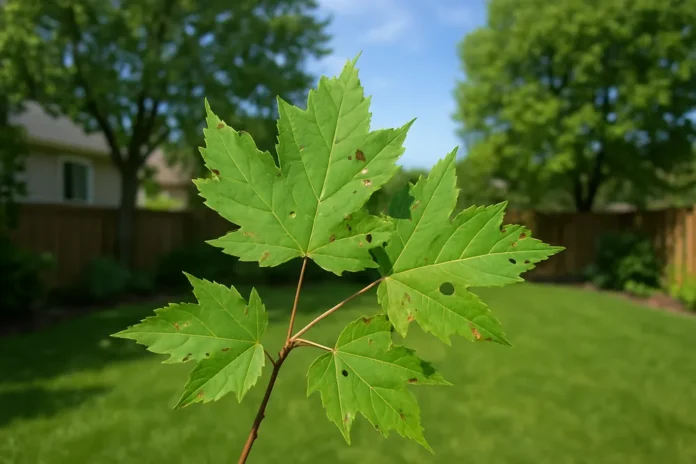
Maple tree leaves usually get holes from chewing insects, leaf diseases that leave dead tissue behind, or wind and hail damage that tears soft new growth. In many cases the tree looks worse than it is, especially if the damage appears early in the season.
Seeing maple leaves with holes can be alarming, especially when a tree was full and healthy just a week or two earlier. In most home landscapes, though, holes in leaves do not automatically mean the tree is in serious trouble. Maples often keep growing well even when the foliage has been nibbled, spotted, or battered by rough spring weather.
The key is to look at the pattern of damage. Clean round holes suggest a different problem than ragged edges, brown spots that fall out, or shredded new leaves at the branch tips. Once you know whether insects, disease, or weather is the likely cause, the fix becomes much clearer.
I usually tell gardeners to focus less on the fact that holes exist and more on where they appear, how neat they look, and whether the tree is putting out healthy new growth. That combination tells you far more than a single damaged leaf ever will.
What Holes in Maple Leaves Usually Mean
Holes form in maple leaves in three main ways. The first is direct chewing from insects like caterpillars, beetles, and sawfly larvae. The second is when part of the leaf dies from disease, dries up, and drops away, leaving a hole behind. The third is physical damage from hail, wind, or leaves rubbing while they are still soft and expanding.
A maple can tolerate a surprising amount of leaf damage without long-term harm. Mature trees especially have enough stored energy to replace some foliage or continue growing despite cosmetic injury. The bigger concern is whether the damage is light and temporary or whether it repeats heavily year after year.
- Small, scattered holes with smooth edges often point to insect feeding.
- Holes surrounded by brown or black margins often start as leaf spot disease.
- Torn, shredded, or split leaves usually suggest weather or physical injury.
- Damage mostly on fresh spring leaves often happens during a short seasonal window.
- Severe defoliation across much of the canopy is more serious than a few affected branches.
When I diagnose maple leaf damage, I do not start with the ugliest leaf. I compare several leaves from different heights and sides of the canopy, because a single leaf can mislead you while a repeated pattern usually reveals the real cause.
Chewing Insects Are the Most Common Cause
Caterpillars, Sawflies, and Beetles
If the holes look eaten rather than torn, insects are the first thing to suspect. Various caterpillars feed on maple leaves in spring and early summer. Beetles may chew between veins or along the outer margin. Sawfly larvae can skeletonize leaves or leave irregular holes as they feed.
In many cases, you will not catch the culprit because feeding often happens at night or only for a short period. By the time you notice the damage, the insect may already be gone. That is frustrating, but it is also a clue that the problem may be self-limiting rather than ongoing.
What Insect Feeding Usually Looks Like
- Irregular holes in the center of the leaf blade
- Notches or missing sections along the leaf edge
- Leaves that look partly skeletonized, with veins left behind
- Tiny dark droppings on leaves or nearby surfaces
- Rolled leaves, webbing, or insects hiding on the undersides
Light insect feeding rarely requires treatment on an established maple. If less than about a quarter of the canopy is affected and the tree is otherwise vigorous, the best response is often simple observation. Beneficial insects and birds frequently reduce the problem without any spraying.
When Insect Damage Needs Action
Consider treatment only if a young tree is losing large amounts of foliage, feeding is still active, and you can identify the pest well enough to choose the right control. Hand-removing reachable caterpillars, pruning a few infested twigs, or using a targeted product can be reasonable on small trees. Broad insecticide use on a large shade tree is often unnecessary and can harm beneficial insects more than it helps.
If you are trying to decide whether to treat, look for active feeding now, not just old holes. Old damage cannot be undone, so I save treatments for times when I can actually find larvae, fresh frass, or newly chewed leaves.
Leaf Diseases Can Create a Shot-hole Look
Some fungal and bacterial leaf diseases begin as small spots. As the dead tissue dries, the center can crack or fall away, making the leaf look like it has been punched with tiny holes. Gardeners often assume insects caused the damage when the real issue started as infection.
How Disease-related Holes Differ From Chewing
Disease holes usually have a visible story around them. Instead of a clean opening in healthy green tissue, you may see tan, brown, black, or purplish margins around the missing area. The spots may be numerous and fairly even in size, especially after cool, wet spring weather.
- Brown or dark borders around the hole
- Many small spots and holes across the same leaf
- Damage appearing after rainy, humid conditions
- Spots on both leaf surfaces
- Premature yellowing or early leaf drop in heavier infections
Common Maple Leaf Diseases Behind Holes
Maples can develop several leaf spot diseases, and anthracnose is one of the better-known spring problems. Anthracnose often causes irregular blotches along veins or leaf edges, especially during cool, wet weather. As damaged tissue dries, sections may tear or drop out. Other minor leaf spots can do something similar, though they are often more cosmetic than dangerous.
For most home landscape trees, fungicide is not needed once symptoms are visible. Good sanitation is more practical. Rake and discard heavily infected fallen leaves, improve air flow where possible, and avoid wetting the foliage with overhead irrigation. A healthy mature maple usually outgrows a moderate leaf spot episode by summer.
Weather Can Tear Leaves and Mimic Pest Damage
Spring weather is rough on tender maple foliage. Leaves that are just unfurling can be punctured by hail, shredded by strong wind, or nicked when they rub against twigs before fully expanding. Once the leaf stretches out, those early injuries show up as holes, splits, or ragged patches.
This type of damage often appears suddenly across many leaves at once, especially on the windward side of the tree. The edges may look torn rather than eaten, and there may be no insects, frass, spotting, or other signs of disease.
- Shredded or tattered leaves after storms
- Long splits that follow the direction of leaf expansion
- Damage concentrated on exposed outer branches
- Many leaves affected at the same time
- Healthy new leaves emerging normally afterward
Weather damage looks dramatic but is often the least serious cause. If the tree continues to leaf out and the newest growth looks normal, no treatment is usually necessary. The damaged leaves may remain unattractive for the season, but they still contribute some energy unless they are mostly destroyed.
How to Tell Which Cause Is Most Likely
You can narrow the cause quickly by checking a few details. Start with the shape and edge of the holes. Then look at when the problem appeared, whether the damage is evenly distributed, and whether you can find insects or disease spotting.
- Look at several leaves, not just one damaged leaf.
- Check whether the hole edges are smooth, ragged, or bordered by dead tissue.
- Inspect the undersides for insects, eggs, webbing, or droppings.
- Think back to recent weather, especially hail, heavy wind, or cold rain.
- Notice whether the newest leaves are healthy or whether damage is continuing.
Clues That Point to Insects
Choose insects as the likely cause if the leaf tissue looks actively chewed, especially when you see missing edges, frass, or actual feeders on the plant. Feeding may be heavier on lower branches or in pockets rather than perfectly uniform across the whole tree.
Clues That Point to Disease
Choose disease as the likely cause if the holes are associated with spots, blotches, dark margins, or widespread spotting after wet weather. Disease damage often looks flatter and more patterned than insect feeding.
Clues That Point to Weather
Choose weather if the damage appeared all at once after a storm and looks ripped, torn, or stretched rather than eaten. Uniform injury on the outer canopy is another strong hint.
New growth tells the truth. If fresh leaves are coming in clean while older leaves still show damage, I usually treat the problem as past stress rather than an active emergency.
What to Do Right Now for a Maple with Holey Leaves
The best response depends on severity, but in many yards the right move is supportive care rather than aggressive treatment. A maple under light stress benefits more from stable growing conditions than from a rushed spray program.
- Water deeply during dry spells, especially for young or recently planted maples.
- Mulch the root zone with 2 to 3 inches of mulch, keeping it away from the trunk.
- Rake up badly diseased fallen leaves at the end of the season.
- Avoid high-nitrogen fertilizer unless a soil test or obvious deficiency suggests it is needed.
- Do not prune heavily during stress unless you are removing dead, broken, or clearly infested branches.
If you do find an active insect problem on a small tree, target the pest instead of spraying blindly. Hand-picking or pruning out a localized infestation is often enough. If disease seems to be the issue, sanitation and improving tree vigor usually help more than late-season fungicide applications.
Try not to remove every damaged leaf. Even imperfect leaves still help feed the tree. Unless a leaf is mostly dead or contributing to disease cleanup at season's end, it is usually better to let the tree keep it.
When Holes Are a Sign of a Bigger Maple Health Problem
Leaf holes alone are often cosmetic, but they matter more when paired with other symptoms. If your maple also has canopy thinning, branch dieback, premature fall color, oozing bark, or repeated severe defoliation, the issue may be larger than a one-time leaf problem.
- The tree loses most of its leaves early in the season
- New growth is sparse or stunted
- Leaves are small, pale, or dropping rapidly
- Twigs or branches are dying back
- The problem returns year after year and worsens each season
Younger maples are less tolerant of repeated defoliation than established shade trees. A newly planted tree that keeps losing foliage may struggle to root in well. In that case, improving water management and reducing stress becomes especially important.
If the tree is valuable, large, or near a home, an arborist can help distinguish between a mostly cosmetic foliar issue and a deeper structural or health concern. That is especially worthwhile when symptoms extend beyond the leaves.
How to Prevent Holes in Maple Leaves Next Season
You cannot prevent every hole, especially from storms or occasional insects, but you can make the tree less vulnerable and easier to manage. Healthy maples bounce back faster and usually show less severe damage over time.
- Keep the tree watered during extended dry periods, especially in its first few years.
- Maintain mulch over the root zone to reduce stress and protect shallow roots.
- Clean up fallen diseased leaves in autumn to reduce overwintering pathogens.
- Inspect new spring growth early so you can catch active insect feeding while it is still localized.
- Avoid unnecessary pesticide use that can disrupt beneficial predators and pollinators.
- Prune for good structure and airflow during the proper dormant season when needed.
I also like to set expectations with maples. A perfect canopy all season is rare, especially in wetter springs. A few damaged leaves do not mean you failed the tree. The goal is a healthy canopy overall, not spotless foliage on every branch.
FAQ
Will Holes in Maple Leaves Kill My Tree?
Usually no. Light to moderate hole damage is often cosmetic, especially on mature trees. It becomes more concerning when a young tree loses a large share of its foliage or when the damage repeats heavily year after year.
Should I Spray My Maple Tree for Leaves with Holes?
Not automatically. Spray only if you can confirm an active pest problem and the damage is significant enough to justify treatment. Old holes will not heal, so spraying after feeding has stopped often provides little benefit.
Can Fungal Leaf Spots Cause Actual Holes in Maple Leaves?
Yes. Some leaf spot diseases kill small sections of tissue that later dry and fall out, leaving a shot-hole appearance. Look for brown, black, or purplish margins around the missing tissue.
Why Do the Holes Show Up Mostly in Spring?
Spring leaves are tender and easy to damage. Insects feed heavily then, diseases spread well in cool wet weather, and storms can tear soft new foliage before it fully expands.
Should I Remove Damaged Maple Leaves?
Usually no during the growing season. Even damaged leaves still help the tree unless they are mostly dead. It is more useful to clean up fallen infected leaves at the end of the season if disease is part of the problem.
What if Only One Side of the Tree Has Leaves with Holes?
That often points to weather exposure or a localized insect issue. Wind, hail, or feeding concentrated on one side can create uneven damage, while many diseases tend to look more broadly distributed.
Are Japanese Maples Affected the Same Way as Other Maples?
Yes, though Japanese maples can show damage more dramatically because their leaves are thinner and more delicate. They may tear more easily in wind and can look worse from minor feeding or weather stress.
Need help choosing the right treatment or deciding whether your maple damage is serious? Read our tree pest and disease guides to find targeted fixes, trusted products, and next-step care for healthier maples.
