

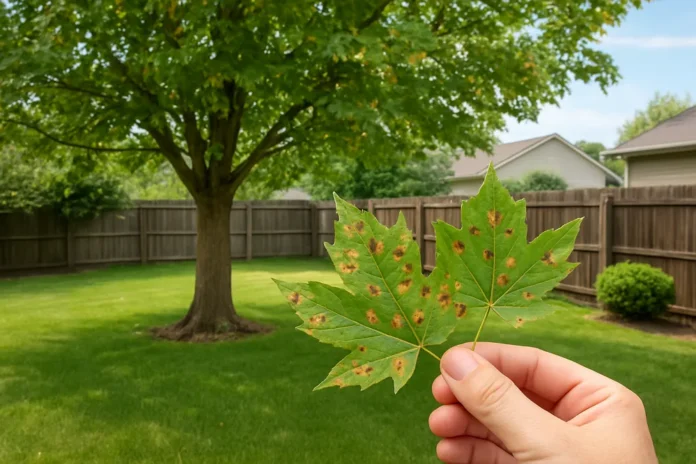
Maple tree leaves get brown spots most often from fungal leaf diseases, drought stress, heat scorch, or insect damage. Sometimes the spots are mostly cosmetic, but widespread spotting can also signal a tree under stress.
Seeing maple leaves with brown spots can be unsettling, especially when the tree looked fine a week earlier. In many cases, the problem is not immediately dangerous, but the pattern of the spots matters a lot. Some maples develop small, scattered lesions from leaf fungi, while others show larger brown patches from heat, dry soil, or wind exposure.
I usually start by looking at where the spots appear and how quickly they spread. Spots that stay mostly round and distinct often suggest disease. Browning that starts at the edges or between veins can lean more toward stress, scorch, or root problems. A healthy, established maple can often tolerate a mild bout of spotting, but repeated damage year after year is worth paying attention to.
The good news is that brown spots on maple leaves are often diagnosable without guessing too much. If you match the leaf pattern, the season, and the tree's growing conditions, you can usually narrow it down to a few likely causes and respond appropriately.
What Brown Spots on Maple Leaves Usually Mean
Brown spotting is a symptom, not a single disease. On maples, the most common explanations are fungal leaf spots, anthracnose, tar spot in its early stages, leaf scorch from environmental stress, inconsistent moisture, and occasional insect feeding. Less commonly, herbicide drift, compacted soil, root injury, or nutrient imbalance can contribute.
The most helpful clue is the shape and placement of the damage. Small circular spots with a darker border often point to a leaf spot fungus. Irregular blotches along leaf veins can suggest anthracnose. Browning at tips and margins usually fits scorch or drought stress better than disease. If the tree dropped leaves early last year and is doing it again, long-term stress may be involved.
When I am diagnosing a maple, I do not study just one damaged leaf. I compare leaves from the outer canopy, inner canopy, lower branches, and freshly fallen leaves. If every area shows the same pattern, I suspect a site-wide stress like heat or moisture problems. If damage is patchy, disease or localized injury moves higher on my list.
Fungal Diseases That Cause Brown Spotting
Leaf Spot Diseases
Several fungi can create brown spots on maple leaves, especially during cool, wet spring weather. These spots are often round to irregular, tan to dark brown, and may have a purplish or darker margin. In humid conditions, multiple spots can merge into larger dead patches.
Leaf spot fungi usually begin on tender new foliage and are most noticeable after rainy stretches. The good news is that they often look worse than they are. On established trees, they are commonly a cosmetic issue unless the infection is severe year after year.
Anthracnose
Anthracnose is a common spring problem on maples, especially during extended periods of cool, damp weather. It tends to cause irregular brown blotches, dead areas along veins, curling, and sometimes early leaf drop. On some trees, new growth later in the season replaces the damaged leaves.
This disease can be more noticeable on lower and inner branches where airflow is poor and moisture lingers longer. If you are seeing spotty leaves along with twisted or partially blighted young shoots, anthracnose becomes a stronger possibility.
Tar Spot in Early Development
Many gardeners recognize tar spot only after it turns into dramatic black patches, but it can begin as pale yellow or light brown spots before darkening. Norway maples are especially prone, though other maples can get it too. It is unsightly, but it rarely causes serious harm to a mature tree.
- Small, defined spots after rainy weather often point to leaf spot fungi.
- Irregular blotches that follow veins are more suggestive of anthracnose.
- Spots that later become thick black patches are classic tar spot progression.
Environmental Stress That Looks Like Disease
Leaf Scorch From Heat, Wind, and Dry Soil
Not all brown spotting is caused by pathogens. Maples often develop brown patches or crispy edges when roots cannot keep up with moisture loss from hot sun, drying winds, reflected heat from pavement, or shallow, compacted soil. Japanese maples are especially prone to this kind of damage, but any maple can show it during stressful weather.
Scorch usually starts at the margins or tips, then expands inward. The tissue often looks dry and papery rather than spotted with neat circular lesions. On exposed trees, one side of the canopy may look worse than the rest.
Drought Stress and Uneven Watering
A maple that swings between very dry and very wet soil can show leaf spotting, browning, curling, and premature drop. Newly planted maples are especially vulnerable because their roots have not spread far into surrounding soil. If the tree is near lawn irrigation, it may also be getting frequent shallow watering that keeps the surface damp but leaves deeper roots thirsty.
If I suspect moisture stress, I water more deeply and less often rather than sprinkling lightly every day. That approach tells me more about the tree’s response and helps roots grow where the soil stays cooler and more stable.
Late Frost and Weather Injury
Freshly emerged maple leaves can be marked by a sudden late frost, hail, or a harsh cold wind. Damaged tissue later turns brown and may resemble spotting. Frost damage often appears suddenly across much of the canopy after one weather event, rather than creeping in gradually.
Insects, Chemicals, and Root Problems
Sap-feeding Insects and Chewing Damage
Some insect issues can leave behind brown specks, stippling, or dead patches. Leafhoppers, lace bugs, mites, and other sap-feeders remove cell contents, which can later show up as tiny tan or brown areas. Caterpillars and beetles may leave ragged damage that dries brown around the edges.
Insect-related spotting is often accompanied by other signs such as fine webbing, visible insects on the underside of leaves, black specks of waste, or distorted new growth. A hand lens is surprisingly useful here.
Herbicide Drift and Chemical Injury
Weed killers drifting from lawn treatments or nearby spraying can cause spots, browning, cupping, and distorted leaves. If the problem appeared shortly after a weed treatment, and neighboring plants show odd twisting or scorch too, chemical exposure belongs on the list of suspects.
Compacted Soil and Root Stress
Maples growing in heavily trafficked lawns, near driveways, or in sites with poor drainage can struggle at the root level. When roots are damaged or oxygen-starved, leaves may show browning that looks like random spotting at first. If growth has been weak, leaves are smaller than normal, or the canopy is thinning, root stress may be the bigger story behind the leaf symptoms.
How to Tell Which Cause Is Most Likely
Start with the timing. Spring spotting during cool, wet weather often points to anthracnose or leaf spot fungi. Mid to late summer browning during heat waves leans more toward scorch and drought stress. Sudden damage after spraying or a cold snap usually has a clearer environmental trigger.
- Look for round, distinct lesions if you suspect fungal spotting.
- Look for edge burn and crisp tissue if you suspect scorch.
- Check whether one side of the tree is worse, which often suggests sun, wind, or chemical exposure.
- Inspect the underside of leaves for insects, webbing, eggs, or waste.
- Notice whether new growth later in the season looks healthier, which is common after spring fungal issues.
Also consider the tree's age and site. A mature maple with a few ugly leaves after a rainy spring is usually less concerning than a newly planted tree with canopy-wide browning in hot weather. Young trees have less margin for error because they have smaller root systems and dry out faster.
One pattern I trust is whether the newest leaves are improving. If old leaves are marked but fresh growth comes in mostly clean, the tree may already be moving past a temporary spring disease or weather event. If new leaves keep emerging damaged, I look harder at active stress, insects, or root problems.
What to Do About Brown Spots on Maple Leaves
Clean Up Fallen Leaves
If fungal disease is the likely cause, rake up and dispose of infected fallen leaves in autumn. Many leaf spot fungi and tar spot organisms overwinter in leaf litter, then reinfect the tree the following spring. Good sanitation will not fix every case, but it reduces disease pressure.
Improve Watering Habits
Water deeply during dry spells, especially for newly planted maples. The goal is to moisten the root zone several inches down rather than wetting only the surface. A 2 to 3 inch mulch layer helps hold moisture and moderate soil temperature, but keep mulch a few inches away from the trunk.
Reduce Stress Around the Root Zone
Avoid piling soil over roots, repeated foot traffic, string trimmer injury, and overfertilizing. Stressed roots lead to stressed leaves. If the tree sits in a lawn, reducing turf competition under the canopy can make a noticeable difference over time.
Prune for Airflow when Appropriate
Selective pruning can improve airflow and light penetration in dense canopies, which helps foliage dry faster after rain. Do not overprune, and avoid heavy pruning during periods of active stress. For large or mature trees, structural pruning is best left to a qualified arborist.
Use Fungicides Only when They Are Truly Warranted
Fungicides are usually preventive, not curative, and many home gardeners do not need them for mild maple leaf spotting. They are most useful when a valuable tree has a history of severe recurring disease and the product is applied at the correct stage in spring. If the canopy is high and the tree is large, treatment is usually more practical through a professional.
When Brown Spots Are Serious and when They Are Mostly Cosmetic
A few spotted leaves are often more of a visual issue than a health emergency. Mature maples can usually handle minor fungal spotting without lasting harm. If the tree leafs out well, grows normally, and the damage is limited, observation and better care may be all it needs.
The situation becomes more serious when spotting is paired with repeated early defoliation, branch dieback, very small leaves, poor annual growth, cracks in the trunk, mushrooms at the base, or widespread canopy thinning. Those signs suggest the leaves may be reflecting deeper stress rather than a simple leaf disease.
- Mostly cosmetic: scattered spots, normal growth, no major leaf drop, healthy canopy density.
- Potentially serious: heavy spotting across most of the canopy, repeated yearly defoliation, dieback, or stress symptoms beyond the leaves.
- Urgent: browning plus trunk injury, root disturbance, sudden canopy collapse, or signs of vascular disease.
When to Call an Arborist
Call an arborist if a large shade maple is losing a major portion of its leaves, if symptoms return every year and worsen, or if you see structural issues like dead limbs and trunk cracks. You should also get professional help if the tree is near a house, sidewalk, or power line and overall health seems to be declining.
A certified arborist can rule out more serious problems such as verticillium wilt, root damage, girdling roots, or chronic site stress that a leaf-only diagnosis might miss. That is especially helpful when a tree has sentimental value or would be expensive to replace.
FAQ
Will Brown Spots on Maple Leaves Kill the Tree?
Usually not. Mild leaf spot diseases and seasonal scorch are often cosmetic on established trees. The bigger concern is when spotting comes with repeated early leaf drop, dieback, or poor growth.
Should I Remove Spotted Maple Leaves From the Tree?
You generally do not need to strip affected leaves off the tree. It is more helpful to clean up fallen leaves from the ground, especially if a fungal disease is involved.
Can I Spray Fungicide Once I See the Brown Spots?
In many cases, no. Most fungicides work best preventively before or very early in disease development. Once leaves are visibly spotted, the damaged tissue will not turn green again.
Why Does My Japanese Maple Get Brown Spots Every Summer?
Japanese maples often react to heat, afternoon sun, wind, and drying soil with scorch that can look spotty at first. If the pattern repeats in hot weather, environmental stress is often more likely than a serious disease.
Can Overwatering Cause Brown Spots on Maple Leaves?
Yes. Saturated soil can stress roots and limit oxygen, which may lead to browning, spotting, curling, and leaf drop. Overwatering can also create conditions that favor fungal problems.
Are Tar Spot and Leaf Spot the Same Thing?
No. Tar spot is a specific fungal disease that often starts as pale or brownish spots and later develops dark black patches. Leaf spot is a broader term for several fungi that create smaller brown lesions.
What Time of Year Are Maple Leaf Diseases Most Common?
Many fungal leaf problems show up in spring or early summer after cool, wet weather. Heat scorch and drought-related browning are more common in mid to late summer.
Need help choosing the right treatment or care products for a stressed tree? Read our guide to the best tree watering tools, mulches, and disease-control options so you can protect your maple with confidence.
