

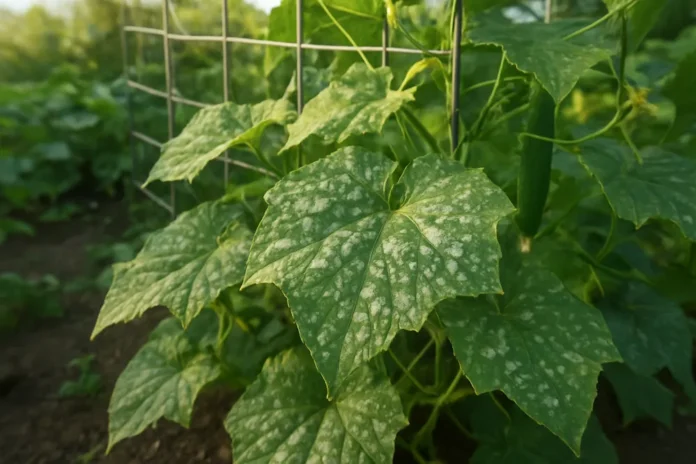
White spots on cucumber leaves are most often caused by powdery mildew, pest damage, or sun and moisture stress. Sometimes the spots are harmless residue, but a spreading dusty coating usually points to fungal disease.
Seeing cucumber leaves with white spots can be alarming, especially when the plants looked perfectly healthy a few days earlier. In my garden, this symptom usually falls into one of a handful of categories: fungal disease, pest feeding, environmental stress, or something superficial sitting on the leaf surface.
The good news is that the pattern of the spotting tells you a lot. A white dusty film points in a very different direction than tiny pale speckles, bleached patches, or crusty mineral residue. Once you know which kind you are looking at, it gets much easier to protect the plant and keep the problem from spreading through the rest of your cucumber patch.
Below, I will walk through the most common causes of white spots on cucumber leaves, how to tell them apart, and which fixes are worth your time.
What the White Spots Usually Mean
White spotting is a symptom, not a diagnosis by itself. On cucumbers, the most common cause is powdery mildew, which starts as small pale spots and quickly becomes a white, dusty coating. But not every white mark is disease. Spider mites and leafhoppers can leave fine stippling, sunscald can bleach sections of tissue, and hard water or spray residue can dry into pale blotches.
Start by asking a few simple questions. Does the white area sit on top of the leaf like powder? Are the spots tiny and evenly scattered? Did the problem appear after a hot sunny stretch, overhead watering, or a foliar spray? Is it mainly on older leaves, lower leaves, or the entire plant? Those clues matter more than people think.
- A dusty or flour-like coating usually suggests powdery mildew.
- Fine pale speckles, often with webbing underneath, point toward spider mites.
- Silvery or bleached scarring can come from insect feeding or sun stress.
- Chalky spots that wipe off may be mineral deposits or dried spray residue.
- Angular pale lesions that later turn papery may signal downy mildew or another leaf disease.
When I diagnose cucumbers, I compare several leaves before I decide. If every affected leaf shows the same pattern in the same part of the plant, I suspect disease or environmental stress. If the spotting is random and some leaves look stippled while others are clean, I start looking harder for pests.
Powdery Mildew Is the Most Common Culprit
Powdery mildew is one of the most common reasons cucumber leaves develop white spots, especially in mid to late season. It often begins as small white patches on the upper leaf surface and expands into a powdery coating that can cover large sections of the leaf. Infected leaves may eventually yellow, curl, crisp, and die back.
Despite the name, powdery mildew does not need soaking wet leaves to show up. It thrives when days are warm, nights are cooler, and air circulation is poor. Plants that are crowded, shaded, or pushing lots of lush growth are especially prone to it.
Signs That Point to Powdery Mildew
- White spots look dusty, fuzzy, or talc-like
- The coating often starts on older leaves first
- Spots grow larger and merge together
- Leaves may yellow around the white areas over time
- The problem spreads steadily through the plant instead of appearing overnight in one sharp event
What to Do if It Is Powdery Mildew
Remove the worst infected leaves if the plant still has plenty of healthy foliage. Thin surrounding growth if vines are tangled and airflow is poor. Water at the soil level rather than splashing the foliage, and avoid high-nitrogen feeding that encourages tender new growth the disease can quickly cover.
If the infection is spreading, use a garden fungicide labeled for powdery mildew on cucurbits and follow the label closely. Neem-based products, sulfur, potassium bicarbonate, and some biological fungicides can help, but they work best early. Once a leaf is heavily coated, it will not turn back to normal, so success is measured by keeping new growth cleaner.
I try not to spray everything at once out of panic. With powdery mildew, I prune, improve airflow, and then treat the plant on schedule. The real sign of progress is that the newer leaves stay healthier than the old damaged ones.
Pest Damage Can Create Pale Speckles and White Stippling
Several sucking pests feed on cucumber leaves by piercing the tissue and removing plant juices. This creates tiny pale dots, stippling, or silvery-white specks that can look disease-related at first glance. If you only focus on the color and not the shape of the damage, it is easy to misdiagnose.
Spider Mites
Spider mites are a common cause of tiny white or yellowish speckles, especially during hot, dry weather. The upper leaf surface develops fine stippling while the undersides may show delicate webbing and moving dots. Heavy infestations can make leaves look dusty, faded, or bronzed.
A hard spray of water on leaf undersides can knock populations back early. In bigger outbreaks, insecticidal soap or horticultural oil may help if the product is labeled for cucumbers and used during cooler parts of the day.
Leafhoppers and Thrips
Leafhoppers and thrips can also leave pale stippling or silvery scarring. Thrips damage often looks more scraped or streaked than mite damage, while leafhoppers may cause a generally speckled, faded appearance. These pests are small and easy to miss unless you inspect the undersides of leaves or tap foliage over a white sheet of paper.
How Pest Spotting Differs From Mildew
- Pest damage is usually inside the leaf tissue, not sitting on top like powder
- The spots tend to be tiny and numerous rather than fuzzy patches
- Damage often appears with webbing, insects, black specks, or distorted new growth
- Hot, dry weather often makes mite problems worse
Environmental Stress Can Bleach Cucumber Leaves
Not all white spotting is caused by a living pathogen or pest. Cucumbers are fast-growing plants with broad, tender leaves, and those leaves can bleach when conditions swing too quickly. Strong sun, reflected heat, drought stress, wind exposure, or sudden changes after transplanting can leave pale patches that look almost white.
Sunscald and Heat Stress
Leaves exposed to intense afternoon sun, especially after a period of cloudy weather or after hardening off was rushed, can develop bleached areas. These patches are often larger and less powdery than mildew. The tissue may later become thin, papery, or brittle.
Water Stress
Inconsistent watering does not usually create perfect white dots on its own, but it weakens the plant and can make leaves more prone to scorch, edge burn, and general bleaching. Cucumbers do best with steady moisture, especially once they start climbing and setting fruit.
Cold Nights and Transplant Shock
Young cucumber plants can show pale spotting or washed-out patches after cold nights, rough wind, or transplant shock. This kind of damage often appears suddenly and then stops, rather than spreading from leaf to leaf the way fungal disease does.
- Bleached areas from stress are often irregular and dry-looking
- The damage may be worst on the most exposed leaves
- New growth may look healthy once the weather stabilizes
- These spots do not wipe off like residue and do not look fuzzy like mildew
Residue, Hard Water, and Spray Burn Can Mimic Disease
Sometimes the white spots are not coming from the leaf at all. Hard water can leave chalky deposits after overhead watering. Foliar feeds, insecticidal soap, neem, baking soda mixtures, or other homemade sprays can dry into pale spots or cause minor burn if applied in hot sun or mixed too strongly.
This is one reason I always ask what was sprayed recently. A leaf that looked fine before treatment but developed white marks the next day may be reacting to the product, the timing, or the weather conditions during application.
Clues That Suggest Residue or Spray Injury
- White marks appear soon after spraying or overhead watering
- The spotting follows droplet patterns or leaf runoff lines
- Residue may partially wipe away with a damp finger
- Burned areas may later turn tan or brown at the center
- Only the treated leaves are affected, while new growth emerges normally
If residue is the issue, there is often little long-term harm. If spray burn occurred, avoid repeating the same mix or timing. Products labeled safe can still injure leaves when applied during heat, in direct sun, or at overly concentrated rates.
Less Common Diseases That Can Start with Pale Spots
Powdery mildew gets most of the attention, but cucumbers can develop other leaf diseases that begin with pale or whitish spotting. These diseases do not always look bright white for long. Many start as light lesions and then turn yellow, tan, gray, or brown as the tissue dies.
Downy Mildew
Downy mildew usually causes angular yellow to pale spots bounded by veins on the upper leaf surface. In humid conditions, the undersides may develop a grayish or purplish growth. Gardeners sometimes describe the early upper-side spotting as whitish because it looks washed out before it deepens in color.
Bacterial and Fungal Leaf Spots
Angular leaf spot, anthracnose, and other leaf diseases can start as water-soaked or pale lesions. As they mature, the spots often become more defined, may tear out, or develop brown centers. Unlike powdery mildew, these problems usually do not look like a soft dusting on top of the leaf.
If your cucumbers are declining fast, the spots are sharply outlined, or nearby cucurbits are also affected, it may be worth comparing symptoms with a local extension service disease guide for your state.
How to Tell Which Cause Fits Your Plant
A close inspection saves time and prevents treating the wrong problem. The best place to start is with the leaf surface itself, then the undersides, and then the overall pattern in the bed.
Questions to Ask While Inspecting
- Do the spots look powdery and sit on the surface, or are they part of the leaf tissue?
- Are older lower leaves affected first, or is the damage mostly on exposed upper leaves?
- Can you see webs, tiny insects, black specks, or distorted growth?
- Did the spotting appear after a spray, heat wave, or overhead irrigation?
- Are the spots spreading to new leaves, or staying limited to the original damaged foliage?
Simple Ways to Narrow It Down
- Wipe a spot gently. If it smears or lifts, think mildew or residue.
- Flip the leaf over and inspect with a hand lens. Mites and their webbing often hide underneath.
- Compare old and new leaves. Ongoing disease usually advances, while weather injury often stays put.
- Look at neighboring squash, melons, or cucumbers. Shared symptoms can point to a spreading disease issue.
I trust new growth more than damaged old leaves. If the newest leaves are coming in clean after you adjust watering, spacing, or treatments, you are usually on the right track even if the older leaves still look rough.
How to Treat Cucumber Leaves with White Spots
The right treatment depends on the cause, but a few general practices help in almost every case. Keep plants evenly watered, avoid wetting foliage late in the day, improve airflow, and remove leaves that are heavily diseased or badly damaged. Clean up dropped foliage so problems do not build up around the base of the plant.
If the Cause Is Powdery Mildew
- Prune out the worst leaves if the plant can spare them
- Space and train vines for better air movement
- Use a labeled fungicide early rather than waiting for full coverage
- Avoid excess nitrogen that pushes soft leafy growth
If the Cause Is Pests
- Check undersides of leaves regularly
- Rinse mites off with water before infestations get heavy
- Use insecticidal soap or horticultural oil only as labeled
- Repeat treatments as directed because eggs and hidden pests may survive the first round
If the Cause Is Stress or Residue
- Stabilize watering and mulch to hold moisture
- Protect young plants from sudden intense sun when possible
- Avoid spraying in midday heat
- Use the correct dilution for foliar products and test new sprays on a small area first
How to Prevent White Spots on Future Cucumber Crops
Healthy cucumbers are not trouble-free, but prevention goes a long way. Most white-spot problems become worse when plants are crowded, stressed, or left unchecked until the vines are dense and hard to inspect.
- Plant cucumbers with enough space for airflow
- Trellis vining types to keep leaves drier and easier to inspect
- Water at the soil line instead of overhead when practical
- Mulch to reduce soil splash and moisture swings
- Inspect leaf undersides weekly during hot weather
- Remove diseased plant debris at the end of the season
- Rotate cucurbits when possible rather than planting them in the same spot every year
- Choose disease-resistant varieties if powdery mildew is a regular problem in your area
In my experience, the most effective prevention is not one magic spray. It is catching the first few suspicious leaves early, before a whole cucumber planting turns into a tangled patch of stressed vines and spreading disease.
FAQ
Can Cucumber Leaves Recover After White Spots Appear?
Damaged areas usually do not turn green again. What you want to see is healthy new growth after you correct the underlying issue.
Should I Remove Cucumber Leaves with White Spots?
Remove badly affected leaves if the plant still has enough healthy foliage to keep growing. Avoid stripping too many leaves at once, especially during hot weather.
Is Powdery Mildew on Cucumbers Dangerous to People?
Powdery mildew on cucumber leaves is not considered dangerous to touch, but it weakens the plant and reduces production. Wash harvested cucumbers as you normally would before eating.
Do White Spots on Cucumber Leaves Always Mean Fungus?
No. White spots can also come from spider mites, thrips, sunscald, hard water residue, or foliar spray burn.
Can I Still Harvest Cucumbers From a Plant with White-spotted Leaves?
Usually yes, as long as the fruit is healthy and the plant is still producing. The bigger concern is whether the leaf problem is reducing vigor and future yields.
Why Are Only the Lower Cucumber Leaves Getting White Spots?
Lower leaves are often the first to show powdery mildew because they are older and get less airflow. Soil splash and dense foliage can also make lower leaves more vulnerable.
Will Overhead Watering Cause White Spots on Cucumber Leaves?
It can contribute indirectly by encouraging some diseases and leaving mineral deposits on the foliage. Repeated leaf wetness also makes diagnosis harder because residue and disease can look similar at first.
Need a treatment that actually works? Read our guide to the best fungicides and pest controls for cucumbers so you can choose the right product before the damage spreads.
