

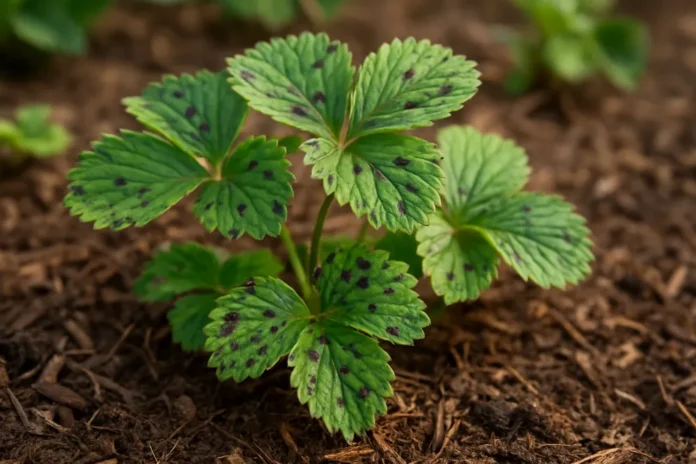
Strawberry leaves usually develop black spots because of fungal leaf diseases such as leaf spot or leaf scorch. Wet foliage, poor airflow, and crowded plants often help those infections spread.
If your strawberry leaves have black spots, the most common cause is disease rather than insects or simple cosmetic damage. In home gardens, I usually see this show up after stretches of rain, overhead watering, crowded growth, or old plant debris left around the patch.
The good news is that black spotting does not always mean your strawberries are doomed. Sometimes the damage stays mostly on older leaves, and sometimes you can slow it down enough to protect the rest of the plant and still get a decent crop. The key is figuring out whether you are dealing with a fungal leaf disease, environmental stress, or a less common issue like nutrient problems or pest injury.
When I diagnose black spots on strawberry leaves, I look at the shape of the spots, whether they have purple or tan centers, how fast they are spreading, and whether the berries and stems are affected too. Those clues usually point you toward the right fix much faster than treating everything at once.
The Most Likely Cause Is a Fungal Leaf Disease
In most backyard strawberry beds, black spots point to one of several common fungal diseases. The exact disease matters less than the pattern they share: spores spread in wet conditions, splash from soil or infected leaves, and take hold when foliage stays damp for long periods. Once that cycle starts, the oldest leaves often show symptoms first.
Leaf Spot
Strawberry leaf spot often begins as small, round, purplish spots. As the spots mature, the centers may turn tan, gray, or nearly white while the margins stay darker. On heavily infected leaves, the dead tissue can merge until the leaf looks blotchy and worn out. Some gardeners describe the later stages as black spotting because the outer edges darken and the damaged tissue looks charred from a distance.
Leaf Scorch
Leaf scorch usually creates many tiny dark purple to black specks that can enlarge and run together. Unlike classic leaf spot, the centers often do not turn pale. Instead, the leaf can take on a burned or dried look, especially around the margins. If your strawberry patch looks as if the foliage has been lightly singed, leaf scorch moves high on my suspect list.
Leaf Blight
Leaf blight tends to make larger V-shaped or irregular lesions, often starting near the leaf edge. The dead areas can become dark brown to black, and infected leaves may collapse faster than they do with simple spotting diseases. This one can make a healthy patch look tired in a hurry.
When I am not sure which leaf disease I am seeing, I compare the newest leaves to the oldest ones. If the oldest leaves are heavily marked but fresh center growth still looks mostly clean, I usually treat it as a manageable leaf disease problem rather than a whole-plant decline.
How to Tell Which Problem You Are Seeing
A close look at the spots will tell you a lot. Strawberry diseases do not all mark the leaf the same way, and that is helpful because the general care response is similar but the urgency can differ.
- If spots are small, round, and purple edged with lighter centers, leaf spot is likely.
- If spots stay tiny, dark, and numerous and the leaf begins to look scorched, leaf scorch is more likely.
- If lesions are larger, irregular, or wedge-shaped, especially from the edge inward, think leaf blight.
- If leaves are blackening after a cold snap, frost damage may be part of the problem.
- If only a few leaves are affected and you see torn tissue, chewed edges, or insect activity, the dark areas may be secondary damage rather than the primary issue.
Also pay attention to location. Disease usually shows up on multiple leaves across the planting, especially where foliage overlaps and air movement is poor. A random spot here and there is less convincing than a repeating pattern throughout the patch.
Conditions That Make Black Spots Worse
Even when a fungus is the direct cause, growing conditions usually decide how serious the outbreak becomes. I see the worst black spot problems in beds that stay damp, dense, and shaded longer than they should.
- Overhead watering that keeps leaves wet for hours
- Rainy spells or heavy dew
- Crowded plants with poor airflow
- Mulch or soil splashing onto lower leaves
- Old infected leaves left in the bed
- Too much nitrogen, which pushes soft leafy growth
- Weedy beds that trap humidity around the plants
Strawberries naturally form dense crowns and runners, so they create their own humidity pocket when neglected. That is why a patch can look fine one week and then suddenly show widespread spotting after warm wet weather.
If you water in the evening, try switching to early morning. I have seen that single change make a noticeable difference because leaves dry faster and fungi get fewer hours of ideal conditions.
Less Common Causes of Black or Dark Spotting
Disease is the front-runner, but it is not the only explanation. A few other issues can create dark marks that look similar at first glance.
Frost or Cold Injury
After a late frost, strawberry leaves can develop water-soaked patches that later turn dark brown or black. The damage often appears more suddenly than fungal spotting and may affect exposed leaves more than protected inner ones. If the weather turned sharply cold just before symptoms appeared, that timing matters.
Sunscald and Heat Stress
Strong sun, reflective heat, and drought stress can leave crispy, darkened areas on the leaf edges. This usually looks more like scorched margins than neat circular spots, and it often comes with wilting or dry soil.
Bacterial Issues
Some bacterial problems can cause angular dark lesions, but they are less common in the average home strawberry patch than fungal leaf diseases. If you see water-soaked spots that seem to follow leaf veins, bacteria may be involved.
Pesticide or Fertilizer Burn
Concentrated sprays, strong liquid feeds, or accidental chemical drift can mark leaves with dark patches. This damage tends to appear soon after application and may show up most heavily where spray droplets sat.
What to Do Right Now
Once strawberry leaves are badly spotted, those damaged areas will not heal. Your goal is to slow the spread, protect clean growth, and reduce the amount of infectious material in the bed.
- Remove the worst infected leaves, especially those lying low in the canopy or touching mulch and soil.
- Throw diseased material in the trash rather than composting it if your compost pile does not run hot.
- Water at the base of the plants instead of wetting the leaves.
- Thin excess runners and overcrowded growth to improve airflow.
- Pull weeds that trap moisture around the patch.
- Refresh clean mulch under plants to reduce soil splash.
Do not strip every leaf off the plant unless the infection is extreme and you are in a renovation period after harvest. Strawberries still need enough healthy foliage to feed the crown and support future growth. I usually remove the ugliest leaves first, then reassess a week later.
Avoid making several major changes on the same day, like heavy fertilizing, hard pruning, and fungicide spraying all at once. When strawberries are already stressed, a gentler sequence usually gives cleaner results and makes it easier to judge what actually helped.
Should You Use a Fungicide?
For mild cases in a home garden, cultural cleanup is often enough to slow black spot diseases. If the problem is spreading quickly, returning every season, or threatening a large patch, a labeled fungicide for strawberries can be worth considering. Products vary by state and by whether you garden conventionally or organically, so always read the label closely and confirm the plant and disease are listed.
Fungicides work best as protectants, not miracle cures for heavily damaged leaves. That means they are most useful when you catch symptoms early or apply them preventively during weather that favors disease. If half the foliage is already blackened, spraying alone will not restore that tissue.
- Use only products labeled for edible strawberries.
- Follow harvest interval directions carefully.
- Cover upper and lower leaf surfaces as directed.
- Reapply only at the interval stated on the label.
- Rotate active ingredients when possible to reduce resistance pressure.
How Black Spots Affect Fruit and Harvest
A few spotted leaves do not automatically ruin the crop. The bigger concern is that repeated leaf loss weakens the plant over time. Strawberries rely on healthy foliage to fuel flowering, berry sizing, and next season's crown development. A plant that keeps losing leaves to disease may produce fewer berries and smaller berries, even if the fruit itself never shows spots.
If you also see mold on fruit, sunken berry lesions, or rotten crowns, then you may be dealing with more than a simple leaf spot issue. In that case, widen your diagnosis because fruit rots and crown diseases need a broader management plan.
How to Prevent Black Spots Next Season
Prevention is where strawberry care really pays off. Once a bed has had a fungal leaf problem, I assume spores can linger on plant debris and nearby soil splash zones. A few routine habits make a big difference.
- Plant strawberries with enough spacing for air movement.
- Keep rows narrow instead of letting runners form a solid mat.
- Use straw or another clean mulch to reduce splash-up.
- Water at soil level with drip irrigation or a soaker hose when possible.
- Clean out dead and diseased foliage during the season and after harvest.
- Avoid overfeeding with nitrogen, especially in spring.
- Rotate beds when practical instead of growing strawberries in the same exact spot for too many years.
- Start new plantings with healthy disease-free plants.
Renovation matters too for June-bearing strawberries. After harvest, thinning and cleanup can reset the patch so it does not carry a heavy disease load into the next growth cycle. Everbearing and day-neutral types benefit from lighter but regular cleanup through the season.
In older strawberry beds, I often notice that disease pressure rises before gardeners realize the patch itself is aging out. If a planting keeps getting dense, weak, and disease-prone even with decent care, starting a fresh bed from healthy stock may outperform another year of rescue efforts.
When Black Spots Are a Sign to Replace Plants
Sometimes the smartest move is not treatment but replacement. If the bed has repeated disease every year, plants are overcrowded, yields are dropping, and you are constantly cutting out infected foliage, the patch may be past its prime. Strawberries are productive plants, but they are not forever plants.
Consider replacing or relocating the planting if you notice several of these signs together:
- Most leaves are affected year after year
- Fruit production keeps declining
- The bed is packed with old crowns and tangled runners
- You have poor sun exposure or chronic dampness in that area
- New leaves emerge infected soon after cleanup
Starting over is frustrating, but fresh plants in a sunnier, cleaner, better spaced bed often solve a problem that endless spraying never fully fixes.
FAQ
Can Strawberry Plants Recover From Black Spots on the Leaves?
Yes, they often can if the crown and new growth stay healthy. The spotted tissue will not turn green again, but plants can keep growing once you improve airflow, reduce leaf wetness, and remove the worst infected leaves.
Should I Cut Off All Strawberry Leaves with Black Spots?
No, not usually. Remove the most badly infected leaves first, but leave enough healthy foliage for the plant to photosynthesize. Stripping too much at once can stress the plant more than the disease itself.
Are Black Spots on Strawberry Leaves Contagious to Other Plants?
They can spread to other strawberry plants easily, especially in wet weather. Some fungal pathogens are host-specific, so they may not infect unrelated vegetables the same way, but they can move quickly through a strawberry patch.
Is It Safe to Eat Strawberries if the Leaves Have Black Spots?
Usually yes, if the berries themselves are healthy, firm, and free of mold or rot. Wash harvested fruit well and discard any berries that are soft, spotted, or diseased.
Do Black Spots Mean My Strawberries Have Too Much Water?
Not exactly, but excess moisture often contributes to the problem. Wet leaves, poor drainage, and damp crowded conditions make fungal diseases much more likely to spread.
Can Neem Oil Fix Black Spots on Strawberry Leaves?
Neem oil may help suppress some fungal issues when used early and according to label directions, but it will not repair damaged leaves. It also works best as part of a broader plan that includes sanitation and better watering practices.
Why Are Only the Older Strawberry Leaves Getting Black Spots?
That is common with leaf diseases because older outer leaves stay damp longer and are exposed to soil splash first. The pattern can actually be a good sign if the center of the plant is still producing clean new leaves.
Need a treatment plan that actually works? Read our guide to the best fungicides, mulches, and watering tools for healthier strawberry plants and cleaner harvests.
