

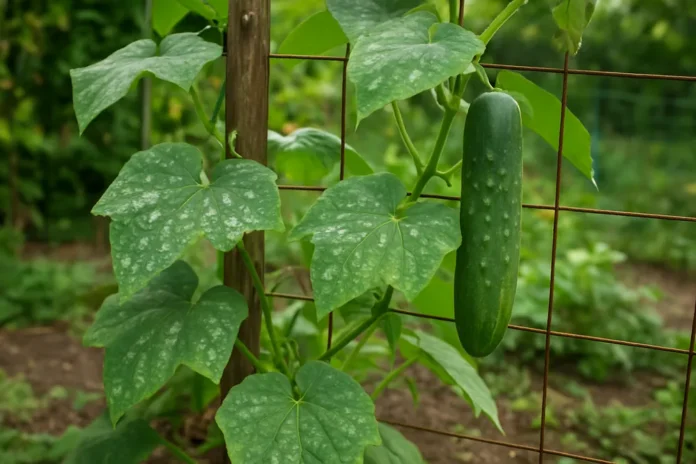
White patches on cucumber leaves are most often caused by powdery mildew, especially when the spots look dusty or spread across older leaves. They can also come from pest damage, sunscald, or harmless residue left on the leaf surface.
Seeing cucumber leaves with white patches can be alarming, especially when the plants were growing fast just a few days earlier. In my garden, this symptom most often turns out to be powdery mildew, but not every pale or white mark is a disease. The shape, texture, and location of the patch matter a lot.
Some white areas sit on the leaf like dust. Others look bleached, stippled, papery, or even silvery. Those differences help you sort out whether you are dealing with fungal growth, insect feeding, sun damage, spray injury, or simple residue from hard water or garden products.
The good news is that cucumbers usually give you clues early. If you catch the cause while the plant still has plenty of healthy green growth, you can often slow the problem down and keep harvesting.
What the White Patches Usually Mean
When cucumber leaves develop white patches, the most common cause is powdery mildew. It usually starts as small pale spots on older leaves, then becomes a white, dusty coating that spreads. Cucumbers are especially prone to it in warm weather with humid nights and crowded growth.
That said, white patches are not always mildew. Spider mites can leave fine pale speckling that eventually makes leaves look washed out. Thrips can create silvery scars. Sunscald can bleach exposed leaf tissue, and some foliar sprays or mineral-heavy water can leave a chalky residue on the surface.
- A dusty or flour-like coating usually points to powdery mildew.
- Fine pale stippling, often with webbing underneath, suggests spider mites.
- Silvery streaks or scarring can mean thrips feeding.
- Large bleached areas on exposed leaves may be sunscald.
- A patch that wipes off easily may just be residue from sprays, soap, or hard water.
When I diagnose cucumbers, I always compare several leaves instead of focusing on one bad leaf. If the pattern repeats across older outer leaves, I lean toward disease. If damage is random and concentrated on tender new growth or leaf undersides, I start thinking pests or spray injury.
How to Tell Powdery Mildew From Other Causes
Signs That Fit Powdery Mildew
Powdery mildew often begins as small, pale blotches on the upper leaf surface. Before long, those spots develop a white coating that looks as if someone dusted the leaf with flour. It can spread over stems and petioles too, and affected leaves may yellow, curl, and dry out as the infection advances.
Unlike many other fungal problems, powdery mildew does not need leaves to stay wet for long periods. It thrives when air circulation is poor, vines are dense, and days are warm. By late summer, it is one of the most common cucumber problems in many U.S. gardens.
Signs That Do Not Fit Powdery Mildew
If the white area looks smooth and bleached rather than fuzzy or dusty, think beyond mildew. Sunscald tends to create flat, pale tissue, often on leaves suddenly exposed to intense afternoon sun. Chemical burn from sprays can leave irregular light patches or scorched edges, especially after applying products in heat.
If the patch is really a collection of tiny dots, inspect the leaf undersides. Spider mites are tiny, but their feeding leaves a pale stippled look that can merge into larger whitish areas. Thrips create a more silvery sheen, sometimes paired with black specks of frass.
Common Causes of White Patches on Cucumber Leaves
Powdery Mildew
This is the leading cause in most home gardens. The fungus starts on older foliage and spreads quickly when leaves overlap and airflow is limited. Plants may still produce fruit for a while, but heavy infection weakens the vine, reduces photosynthesis, and shortens the harvest window.
Spider Mites
Spider mites are more likely during hot, dry weather. Their feeding removes chlorophyll cell by cell, leaving tiny pale flecks that can blend into whitish patches. Severe infestations cause leaves to look dull, bronzed, or dusty, and fine webbing may appear between veins or along the underside.
Thrips
Thrips rasp the leaf surface and suck up plant juices, creating silver-white scars. These marks are usually more streaky than powdery mildew and do not look fuzzy. You may also notice distorted new leaves or tiny dark droppings on the foliage.
Sunscald and Heat Stress
Cucumber leaves can bleach when the plant is stressed and exposed to intense sun, especially after pruning, transplant shock, inconsistent watering, or a sudden heat wave. The damaged tissue often looks pale tan to white and papery instead of powdery.
Spray Residue or Phytotoxicity
Insecticidal soap, horticultural oils, neem products, baking soda sprays, and even some fertilizer mixes can leave visible residue. If applied in strong sun or mixed too heavily, they may also damage the leaf surface. In that case, the white patch may be accompanied by browning, crisp edges, or a patterned splash effect.
Hard Water or Dust Deposits
Sometimes the simplest explanation is the right one. Mineral-rich irrigation water can dry into a whitish film, and dusty gardens can leave leaves looking pale. These marks usually sit on the surface and wipe away without exposing damaged tissue underneath.
How to Diagnose the Problem Quickly
You do not need a lab test to make a useful diagnosis. Start by rubbing a white patch gently with your finger. If it smears or lifts like dust, powdery mildew is very likely. If it does not move, look more closely at the leaf texture and where the damage appears on the plant.
- Check whether the patch is powdery, smooth, silvery, or papery.
- Look at both the top and underside of affected leaves.
- Compare older outer leaves with tender new growth.
- Notice whether the issue is spreading plant to plant.
- Think back to recent weather, spraying, pruning, or watering changes.
A spreading dusty coating in midsummer almost always deserves treatment as powdery mildew. A pale patch that appeared right after a foliar spray or heat spike is more likely injury. If pests are involved, you will often see the damage concentrated where they like to feed, especially on leaf undersides.
If you are unsure, isolate the decision by checking the newest healthy-looking leaf each day for three to five days. New fuzzy spots suggest active mildew. New stippling or webbing points more toward mites. Watching the newest damage pattern is often clearer than staring at the oldest injured leaves.
What to Do for Powdery Mildew on Cucumbers
If powdery mildew is the cause, act early. Removing a few badly infected leaves can reduce spore load and improve air movement, but avoid stripping the plant too hard. Cucumbers still need plenty of foliage to support fruit production.
- Cut off the worst infected leaves and discard them in the trash.
- Space or trellis vines so air moves through the canopy.
- Water the soil, not the leaves, and do it early in the day.
- Avoid excess nitrogen, which pushes soft, crowded growth.
- Use a labeled fungicidal product if the disease is spreading fast.
Home gardeners often use sulfur, potassium bicarbonate, neem-based fungicidal products, or biological fungicides labeled for powdery mildew. Always follow the label, because cucumbers can be sensitive to some products in high heat. Spraying during the coolest part of the day helps reduce leaf injury.
Do not expect damaged leaves to turn green again. Your goal is to protect newer foliage and slow the spread. If new leaves stay mostly clean and the plant keeps flowering, your treatment is doing its job.
What to Do if Pests Are Causing the White Patches
For spider mites, the first step is usually a strong rinse of the leaf undersides with water. That alone can knock populations back if you catch them early. In dry weather, keeping plants evenly watered also reduces stress that makes mite damage worse.
If mites or thrips keep building, insecticidal soap or a garden oil labeled for cucumbers can help. Thorough coverage matters more than force. You need to reach the undersides of leaves where the pests are actually feeding.
- Rinse undersides of leaves to physically reduce pests.
- Remove heavily damaged leaves if the plant has enough healthy growth left.
- Apply soap or oil sprays only according to label directions.
- Avoid spraying in hot afternoon sun.
- Repeat only as directed, since one spray rarely solves a heavy infestation.
I treat pest damage differently from mildew because timing matters more than product choice. If I spray once and then ignore the plants for a week, mites usually rebound. A short interval of close follow-up works better than a single aggressive treatment.
What to Do for Sunscald, Spray Injury, or Residue
If the white patches appeared after a heat wave, pruning session, or transplanting into strong sun, the issue may be sunscald. In that case, focus on reducing stress. Keep soil moisture even, avoid further pruning, and let the plant push new leaves before making more changes.
If a foliar product caused the damage, stop using that mix until you review the label and the conditions under which you applied it. Many leaf burns happen because a safe product was applied at the wrong concentration or in the wrong weather.
For harmless residue, simply rinse a leaf or wipe a small area with damp fingers. If the white material lifts off and the tissue underneath looks green and healthy, no treatment is needed. Just adjust your spraying or watering method if the appearance bothers you.
Can the Plant Recover?
Usually, yes. Cucumbers grow quickly, and a healthy root system can replace damaged foliage if the problem is caught early. The real question is not whether the marked leaves recover, because most will not. The question is whether the plant keeps producing healthy new growth.
Mild powdery mildew or minor pest damage rarely ruins a season on its own. Severe disease, repeated mite pressure, or widespread leaf burn can reduce yield because the plant loses too much leaf area. The more green canopy you preserve, the better your odds of continued harvest.
- Old damaged leaves usually stay damaged.
- Recovery shows up as cleaner new leaves and steady vine growth.
- Fruit set often continues if at least half the foliage stays functional.
- Plants decline faster when stress stacks up, such as heat plus drought plus disease.
How to Prevent White Patches Next Time
Prevention is mostly about reducing plant stress and improving airflow. Cucumber vines love to sprawl, but a crowded patch traps humidity and makes it easier for mildew and pests to settle in. A little structure early in the season saves trouble later.
- Grow cucumbers with generous spacing or on a trellis.
- Water deeply and consistently at the soil line.
- Mulch to reduce splash, soil drying, and plant stress.
- Avoid overfeeding with nitrogen.
- Inspect leaf undersides weekly in hot weather.
- Choose mildew-tolerant cucumber varieties when possible.
- Remove plant debris at season's end to reduce carryover issues.
I have found that gardeners often wait too long because the first white spot seems minor. On cucumbers, early action matters. One or two suspect leaves are much easier to manage than a whole tangle of vines covered in white growth.
FAQ
Can I Eat Cucumbers From a Plant with White Patches on the Leaves?
Usually yes, as long as the fruit itself is healthy and the plant has only leaf issues like powdery mildew or minor pest damage. Wash the cucumbers well, and discard any fruit that is soft, misshapen from severe stress, or visibly diseased.
Will Powdery Mildew Kill My Cucumber Plant?
It can weaken the plant enough to shorten the harvest, especially late in the season, but it does not always kill it outright. Early control often keeps the plant productive for much longer.
Do White Patches Mean I Am Overwatering My Cucumbers?
Not directly. Overwatering can stress the plant and contribute to disease pressure, but white patches themselves are more commonly caused by powdery mildew, pests, residue, or sun injury.
Why Are Only the Older Cucumber Leaves Getting White Spots?
That pattern strongly suggests powdery mildew, since it often starts on older leaves first. Older leaves are also more likely to show early stress from crowding and reduced airflow.
Should I Remove Every Leaf with White Patches?
No. Remove the worst leaves, especially if they are heavily infected or badly damaged, but keep enough healthy foliage for the plant to photosynthesize and support fruit. Taking too many leaves can stress cucumbers even more.
Can Baking Soda Treat White Patches on Cucumber Leaves?
Some gardeners use baking soda sprays for powdery mildew, but cucumbers can be sensitive to homemade mixes if the concentration is off. A labeled product is usually a safer choice because the directions are designed to reduce leaf injury.
How Fast Does Powdery Mildew Spread on Cucumbers?
It can spread very quickly in warm weather once vines are dense. A few spots can become a widespread coating within days to a couple of weeks if conditions favor the fungus.
Need a treatment that actually works? Read our guide to the best powdery mildew sprays and cucumber-safe fungicides so you can protect new growth and keep the harvest coming.
