

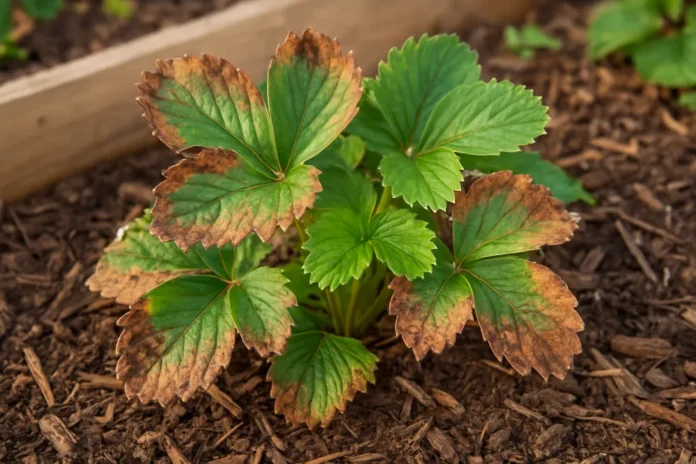
Strawberry leaves usually look burnt because the plant is under stress from dry soil, excess fertilizer, salt buildup, strong sun, disease, or spray damage. The brown, crispy edges are the plant’s way of showing that leaf tissue has died back.
When strawberry leaves look burnt, the problem is usually not heat alone. In most home gardens, that scorched, brown, crispy look comes from some kind of stress that damaged the leaf edges or surface, such as uneven watering, fertilizer burn, foliar disease, salt buildup, or a sudden blast of intense sun and wind.
I usually start by looking at the pattern. If the oldest leaves are browning around the edges, I suspect moisture stress or salts. If spots show up first and then the leaf tissue dies, disease moves higher on my list. If the whole plant looks singed after feeding or spraying, I think chemical injury. Strawberry leaf scorch symptoms can look surprisingly similar at first, so a careful look at where and how the damage starts matters.
The good news is that strawberries often recover well when you correct the underlying cause early. Existing brown tissue will not turn green again, but healthy new leaves can tell you that the plant is back on track.
What Burnt Strawberry Leaves Usually Look Like
Burnt-looking strawberry leaves can show up in a few different ways. Sometimes the margins turn tan, then dark brown, and finally crisp. Sometimes patches between veins bleach or dry out. In other cases, small purple or reddish spots expand and the surrounding tissue dies, making the leaf look scorched from a distance.
- Dry, brown edges on older leaves often point to water stress or salt buildup.
- Bleached areas on exposed leaves can suggest sun scorch or hot reflected light.
- Browning after feeding may indicate fertilizer burn.
- Dark spots that merge into dead areas can signal fungal or bacterial leaf problems.
- Sudden damage after spraying is often chemical injury rather than disease.
When I am diagnosing strawberries, I pay more attention to the newest undamaged leaves than the ugliest old ones. Old leaves tell you what happened, but new growth tells you whether the problem is still active.
Water Stress Is One of the Most Common Causes
Dry Soil and Inconsistent Watering
Strawberries have relatively shallow roots, so they react quickly when the top several inches of soil swing from wet to dry. If plants dry out hard between waterings, leaf edges can brown and crisp, especially during fruiting or in hot weather. Containers are even more vulnerable because potting mix dries faster than garden soil.
This kind of damage often starts on older leaves first. You may also notice drooping during the hottest part of the day, smaller berries, and soil that pulls away from the sides of the pot or feels dusty an inch or two down.
Overwatering Can Lead to a Similar Scorched Look
Too much water sounds like the opposite problem, but strawberries with soggy roots can also develop browned leaf edges. Roots need oxygen. When soil stays saturated, the roots weaken and cannot move water efficiently into the leaves. The result can look like drought damage even when the soil is wet.
- Underwatering is more likely if soil is dry, leaves wilt in heat, and mulch is thin or missing.
- Overwatering is more likely if soil stays wet for days, leaves look dull or limp, and crowns sit in poorly drained spots.
- Raised beds usually dry faster than in-ground plantings, while heavy clay tends to stay too wet longer.
If strawberries are struggling, I prefer deep, even watering over frequent light sprinkling. Light watering often wets only the surface, which encourages shallow roots and makes the next hot day hit harder.
Fertilizer Burn and Salt Buildup Can Scorch the Leaf Edges
Strawberries do not need heavy feeding, and they can react badly when too much fertilizer is applied at once. Excess nitrogen or soluble salts pull moisture away from root tissue and interfere with water uptake. One of the classic signs is browned leaf margins that look as if they were singed.
This is especially common in containers, hanging baskets, and strawberry towers where salts collect faster. It also happens when granular fertilizer is applied too heavily, when liquid feed is mixed too strong, or when manure-based amendments are fresher or richer than expected.
- Damage appears soon after feeding or becomes worse within several days.
- Leaf edges burn first, sometimes with a yellow band before the tissue turns brown.
- The soil surface may show a whitish crust in pots, indicating salt accumulation.
- Plants may stop pushing healthy new leaves even if the soil is moist.
If your strawberries were growing reasonably well and then looked burnt after a feeding, fertilizer is a strong suspect. A plant that is truly nutrient deficient usually yellows or grows weakly before tissue crisps. Burn from overfeeding often looks more abrupt.
Sun Scorch and Heat Exposure Can Damage Tender Foliage
Strawberries like full sun, but that does not mean every leaf handles every heat wave gracefully. Plants that were recently transplanted, not fully hardened off, or suddenly exposed to intense afternoon sun can develop scorched patches. The damage is often worse when high heat combines with dry wind or reflective surfaces like pale walls, gravel, or metal edging.
Sun scorch usually affects the most exposed leaves first. Instead of starting only at the margins, you may see irregular pale, tan, or crispy patches on the upper surface. The crown may still be healthy, and shaded inner leaves can look better than outer ones.
- Newly planted strawberries are more vulnerable than established clumps.
- Dark containers heat up root zones faster and can intensify stress.
- A sudden jump from cool cloudy weather to hot sun often triggers damage.
- Heat stress is more likely if leaves burn during a hot spell without obvious spotting patterns.
Leaf Diseases Can Make Strawberries Look Scorched
Leaf Scorch
One common disease name that matches the symptom is strawberry leaf scorch. This fungal disease often begins as many small dark purple spots. As those spots multiply, the leaf can take on a burned or dried appearance. Tissue between spots may remain green at first, then the whole leaf looks reddish, bronzed, or scorched.
Leaf Spot and Blight
Other leaf diseases, including leaf spot and leaf blight, may also create dead areas that mimic burn. The clue is that disease usually creates distinct lesions, spots, or irregular patches before the tissue dries out. Humid weather, crowded plants, overhead watering, and old infected leaves increase the odds.
With disease, damage may progress even when watering seems right. Lower leaves often show symptoms first because they stay damp longer and get splashed with spores from the soil.
- Look for purple, red, brown, or tan spots rather than simple edge crisping.
- Check whether leaves stay wet for long periods after rain or irrigation.
- Notice whether the problem is worse in dense, poorly ventilated patches.
- Remove a damaged leaf and inspect both sides for spotting patterns.
If every damaged leaf shows a similar spot pattern before it dries out, I lean toward disease. When the edges alone crisp first and there are no clear lesions, I usually investigate watering, salts, or root stress before reaching for a fungicide.
Chemical Injury From Sprays and Drift Is Easy to Miss
Strawberry foliage can be sensitive to foliar sprays, especially in hot weather. Insecticidal soap, horticultural oil, neem products, strong homemade mixtures, and even some foliar fertilizers can cause leaf burn if applied when temperatures are high or if the product is too concentrated.
Herbicide drift is another possibility. A nearby lawn treatment or weed spray can distort, yellow, or scorch strawberry leaves even if you did not spray the patch directly. In that case, the pattern may appear suddenly across several exposed plants at once.
- Damage often shows up within a day or two of spraying.
- Burn may appear on upper leaf surfaces or along the edges where droplets dried.
- Only the side facing the spray source may be affected if drift is the cause.
- The newest leaves may come in twisted as well as burnt if herbicide exposure occurred.
Root and Crown Problems Can Show Up as Burnt Leaves
Sometimes the leaves are not the true starting point at all. Strawberries with damaged roots or crown issues may produce scorched-looking leaves because the plant cannot move water and nutrients normally. Root rot is more common in heavy, wet soils or containers without enough drainage. Crowns planted too deep can also stay too wet and decline.
If the whole plant looks weak, stunted, or wilted despite proper irrigation, check the crown area closely. A healthy crown should feel firm. Mushy, darkened, or collapsing tissue suggests trouble below the leaf level.
- Roots should be pale and firm, not brown, slimy, or foul smelling.
- Waterlogged beds are more likely to create chronic root stress than a single dry spell.
- Plants in compacted soil often look burned because roots never established well.
- Blackened crowns usually point to a more serious issue than simple sun or fertilizer burn.
How to Tell Which Cause Is Most Likely
A quick diagnosis comes down to timing, pattern, and growing conditions. Ask what changed recently. Did you fertilize, spray, transplant, hit a heat wave, or let the bed dry out? Then compare old leaves, new leaves, and the soil itself.
- Look at where the damage started. Leaf edges suggest moisture or salts, while distinct spots suggest disease.
- Check whether the newest leaves are healthy. Clean new growth often means the main stress has already passed.
- Feel the soil several inches down instead of judging by the surface alone.
- Review anything applied in the last week, including fertilizer and sprays.
- Compare plants in different spots. If only the hottest or driest area is affected, environment is likely involved.
- Inspect the crown and roots if the entire plant is declining.
In many backyard patches, more than one factor is at work. A plant may start with drought stress, then become more vulnerable to leaf disease or salt injury. That is why the overall pattern matters more than any single brown edge.
What to Do Next to Help Strawberries Recover
Once leaf tissue has turned brown and crisp, it will not heal. The goal is to protect the crown, support healthy roots, and encourage clean new growth. Start with the least disruptive corrections first.
- Water evenly so the root zone stays consistently moist but not soggy.
- Add mulch such as clean straw or pine needles to moderate soil moisture and reduce splash-up.
- Pause fertilizer until the plants begin pushing healthy new leaves again.
- Flush container plants with plain water if you suspect salt buildup.
- Trim off the worst damaged leaves if they are mostly dead or clearly diseased.
- Improve spacing and air movement if foliage stays crowded and damp.
- Avoid spraying in midday heat and always follow label dilution rates.
If disease is clearly involved, sanitation is important. Remove infected leaves, keep water off the foliage when possible, and avoid letting old debris accumulate around the plants. If you decide to use a fungicide, match it to the disease and your edible-garden needs rather than applying a general product at random.
I try not to change five things at once with stressed strawberries. Fix watering first, stop any questionable feeding or spraying, and then watch the next round of leaves. That makes it much easier to tell whether you solved the real problem.
How to Prevent Burnt-looking Leaves in the Future
Healthy strawberries are much less likely to develop scorched foliage when their basics stay steady. Prevention is mostly about keeping root conditions even and foliage reasonably dry.
- Plant strawberries in well-drained soil or raised beds.
- Use mulch to reduce moisture swings and prevent soil from splashing onto leaves.
- Water at the base instead of overhead whenever possible.
- Feed lightly and according to the plant's stage of growth rather than on a heavy schedule.
- Give plants enough space for air movement.
- Harden off transplants before moving them into stronger sun.
- Watch containers closely during heat because they dry much faster than garden beds.
- Keep herbicides and strong foliar sprays far from edible planting areas.
A lot of strawberry problems look dramatic before they become fatal. If the crown stays firm and new growth remains green, plants often bounce back nicely with more stable care.
FAQ
Will Burnt Strawberry Leaves Turn Green Again?
No. Brown, crispy tissue is dead and will not recover. What you want to see is healthy new leaves replacing the damaged ones.
Should I Cut Off Burnt Strawberry Leaves?
Yes, if the leaves are mostly dead, badly diseased, or lying damp against the plant. Leave lightly damaged leaves in place if the plant still needs them for energy and the crown is otherwise healthy.
Can Too Much Fertilizer Make Strawberry Leaves Look Burnt?
Yes. Excess fertilizer or salt buildup often causes brown leaf edges, especially in containers or after strong liquid feeding.
Do Strawberries Get Sunburn?
They can. Sudden intense sun, extreme heat, and dry wind can scorch exposed leaves, especially on newly transplanted or drought-stressed plants.
How Often Should I Water Strawberries to Prevent Leaf Burn?
Water often enough to keep the root zone evenly moist but not waterlogged. The exact schedule depends on your soil, weather, and whether the plants are in the ground or in containers.
Can a Leaf Disease Look Like Burnt Strawberry Leaves?
Yes. Leaf scorch, leaf spot, and leaf blight can all create brown or scorched-looking foliage, usually with visible spots or lesions before the tissue dries out.
Why Do Only the Edges of My Strawberry Leaves Look Burnt?
Edge burn is commonly linked to moisture stress, fertilizer salts, or root stress. When water movement through the plant is disrupted, the leaf margins are often the first parts to dry out.
Need the right fix fast? Read our strawberry care and treatment guides to choose the best fertilizer, mulch, watering tools, and disease controls for healthier plants and cleaner harvests.
