

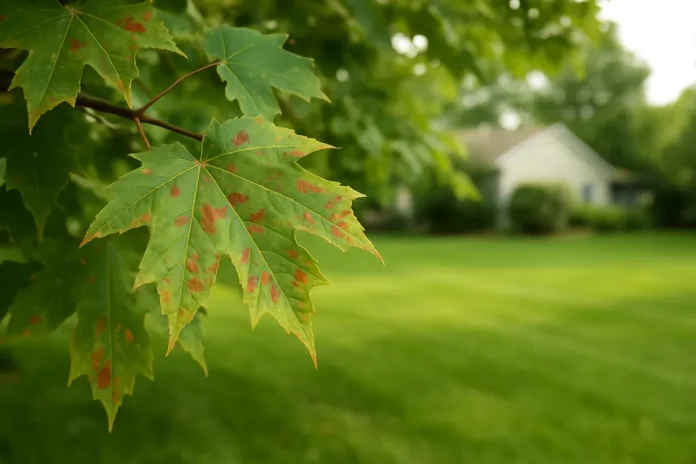
Maple tree leaves usually get red spots from fungal leaf spot diseases, pest feeding, or stress that triggers pigment changes in the foliage. In some cases, small red spotting is mostly cosmetic and does not seriously harm the tree.
Seeing maple tree leaves with red spots can be unsettling, especially if the tree looked perfectly healthy a week or two earlier. In most home landscapes, this symptom is tied to a fairly short list of causes, and many of them are more cosmetic than catastrophic.
What matters most is the pattern. I look at where the spots start, whether they stay small or merge together, whether the leaf is also curling or dropping, and what time of year the problem showed up. A red-speckled leaf in cool, wet spring weather points me in a different direction than scattered red blotches during hot, dry summer conditions.
The good news is that red spots on maple leaves are often manageable once you narrow down the cause. Some issues call for simple cleanup and watering adjustments, while others are a sign that the tree needs closer attention over the next season.
What Red Spots Usually Mean on Maple Leaves
Red spotting on maple leaves is usually a symptom, not a diagnosis by itself. The red color often comes from pigments called anthocyanins that develop when leaf tissue is stressed, damaged, or reacting to infection. That is why several different problems can create a similar look.
On maples, the most common culprits are fungal leaf spots, tar spot in its early stage, feeding damage from tiny pests like mites, and environmental stress such as drought or root disturbance. Less commonly, nutrient problems, chemical drift, or natural seasonal shifts can create reddish speckling or blotching.
- Small, scattered red or purple spots that stay mostly separate often suggest a fungal leaf spot.
- Raised or darkening spots that later turn black may be an early tar spot infection.
- Fine stippling with bronzing, curling, or a dusty look can point to mites.
- Large irregular red patches near leaf edges may be related to heat, drought, or root stress.
- Uniform red coloring in late summer or fall can be part of normal seasonal change rather than disease.
When I diagnose leaf spotting, I always compare newly affected leaves with older damaged ones. If every stage looks different, from pale flecks to red spots to black lesions, I start suspecting a disease cycle rather than simple weather stress.
Fungal Leaf Spot Is One of the Most Common Causes
Several fungi can cause red, reddish-brown, or purple spots on maple leaves. These diseases often show up after cool, wet weather in spring or early summer, especially when the canopy stays damp for long periods. Young leaves are especially vulnerable because the tissue is tender and easily colonized.
How Fungal Spotting Usually Looks
Fungal leaf spots tend to begin as small, distinct lesions. They may be red, maroon, purple, or brown with a reddish border. Over time the spots can enlarge, merge together, or develop pale centers. If the infection is heavy, leaves may yellow around the spots, curl slightly, or drop earlier than usual.
- Spots often appear on multiple leaves, not just one branch tip.
- The pattern is commonly worse on lower or inner branches where air movement is poor.
- Rainy springs and overhead irrigation make symptoms more likely.
- The tree usually survives, but repeated yearly infections can make it look tired and thin.
What to Do About It
For established landscape maples, treatment is usually focused on sanitation and tree vigor rather than aggressive spraying. Rake and remove infected leaves in fall, prune lightly if the canopy is crowded, and water deeply during dry spells so the tree is not dealing with both disease and drought stress. Fungicides are usually most useful as a preventive step on trees with a serious history of recurring infection, not as a cure after leaves are already covered in spots.
Early Tar Spot Can Begin as Red or Yellowish Spots
Tar spot is a well-known maple disease, and many gardeners expect it to start as obvious black splotches. In reality, early infections can begin as lighter discolored areas, including yellow, tan, or reddish spots, before they darken into the classic tar-like patches later in the season.
Norway maple is especially prone to tar spot, but other maples can get it too. Wet spring weather helps spread the fungal spores, and symptoms often become much more noticeable as summer progresses.
How to Tell It Apart From Other Leaf Spots
- Spots may start small and pale, then develop a darker center.
- Later in the season, lesions become black, thickened, and very distinct.
- Affected leaves are often still attached to the tree even when they look blotchy.
- The problem is usually dramatic-looking but not seriously harmful to a mature tree.
The best control is cleanup. Remove fallen leaves in autumn because the fungus overwinters there and reinfects the tree the following spring. In most home gardens, that single habit makes the biggest difference.
Mites and Other Tiny Pests Can Create Red Stippling
Not all red spotting is disease. Spider mites and certain other sap-feeding pests can leave tiny reddish or bronze flecks across the leaf surface. Instead of round lesions with clean edges, this damage often looks more like fine stippling or a rusty cast over the leaf.
Mite problems are more common in hot, dry weather and on stressed trees. The undersides of leaves may have very fine webbing, and the leaves may feel dry, dull, or slightly curled. Severe feeding can cause premature leaf drop, especially on younger trees.
Signs That Point Toward Pest Damage
- The spots are extremely tiny and numerous rather than blotchy.
- Leaves may look bronzed or faded overall.
- Damage is often worst during extended heat or drought.
- A white sheet of paper shaken under a branch may catch moving specks from leaf undersides.
If I suspect mites, I avoid reaching for a broad insecticide first. Those products can wipe out beneficial predators and sometimes make mite outbreaks worse a week or two later.
A strong water spray to leaf undersides, better irrigation, and avoiding unnecessary pesticide use can help on mild infestations. Heavy outbreaks on valuable young trees may justify a more targeted treatment, but accurate identification matters before spraying.
Weather and Root Stress Can Also Trigger Red Blotches
Maples respond quickly to environmental stress, and leaves often show it first. Drought, compacted soil, recent transplanting, construction damage, root competition from turf, or sudden heat can all interfere with water movement through the tree. When that happens, leaves may develop red margins, irregular red patches, or blotchy discoloration between veins.
Stress-related spotting often does not look as neat as fungal lesions. Instead of many clean, round spots, you may see uneven areas of discoloration, some edge scorch, curling, or a papery texture. The symptoms may be heavier on the sunny side of the tree or after a stretch of harsh weather.
Common Stress Triggers Around Maples
- Inconsistent watering, especially for recently planted trees
- Soil compaction from foot traffic or parked vehicles
- Mulch piled against the trunk
- String trimmer or mower damage near the base
- Root cutting during sidewalk, patio, or utility work
- Extended reflected heat from pavement or walls
When stress is the main driver, the solution is less about treating the leaves and more about improving growing conditions. Deep watering, proper mulching, and protecting the root zone are usually more helpful than any foliar product.
Could Nutrient Issues Be Causing the Red Spots?
Nutrient deficiencies are not the first thing I suspect when a maple develops red spots, but they can contribute to unusual coloration. Phosphorus stress and some general root uptake problems may cause purpling or reddening in leaves, especially if the soil is cold, compacted, or poorly drained. Iron deficiency is more likely to cause yellowing between green veins, though stressed trees can show mixed symptoms.
A tree that is planted in the wrong pH, trapped in soggy soil, or struggling with damaged roots may not access nutrients well even if the soil technically contains them. In those cases, fertilizing blindly can waste money and sometimes worsen the root environment.
I rarely recommend feeding a spotted maple until the root-zone problem is understood. When leaves show both discoloration and scorch, the issue is often uptake stress, not a simple shortage that fertilizer can quickly fix.
If your tree has been weak for more than one season, or if multiple symptoms keep returning, a soil test can be more useful than guessing. It helps separate a true deficiency from a drainage, pH, or root-health problem.
When Red Spots Are Mostly Harmless
A lot of maple leaf spotting looks worse than it is. Mature trees can tolerate a fair amount of cosmetic leaf damage, especially late in the season. If the canopy is still reasonably full, branch growth is normal, and the tree is not dropping large numbers of leaves in early summer, the problem may be more visual than urgent.
Some maple varieties also show naturally stronger red pigments than others, particularly when nights are cool or the tree gets mild stress. That does not mean the tree is unhealthy. The key is whether the red spots are isolated and stable, or whether they are spreading, deforming leaves, and combining with dieback.
- A few scattered spots late in the season are often minor.
- Older established trees usually handle light foliar disease well.
- Symptoms limited to one weather cycle may not return next year.
- New growth that looks clean is a good sign even if older leaves stay marked.
How to Tell when the Problem Is Serious
Red spots deserve closer attention when they are part of a larger decline pattern. Leaf symptoms are often the earliest visible clue that the tree is under more pressure than it can comfortably handle.
Warning Signs to Watch For
- Heavy spotting appears early in spring or early summer
- Leaves are dropping long before fall
- Twigs or branch tips are dying back
- The canopy looks thinner than last year
- Leaves are small, scorched, or misshapen across much of the tree
- The trunk has wounds, oozing, cracking bark, or visible root damage
If you are seeing several of those signs together, it is worth taking the issue more seriously. Repeated leaf disease can weaken a tree over time, but root problems, girdling roots, trunk injury, and chronic drought stress are often the bigger long-term concern.
What to Do Next for a Healthier Maple
Start with the simplest support steps that help regardless of the exact cause. Keep the root zone evenly moist during dry weather, but do not keep the soil soggy. Apply a 2 to 3 inch mulch layer over the root area, keeping it a few inches away from the trunk. Clean up fallen leaves at the end of the season, and avoid wounding the bark with lawn equipment.
If the tree is young, recently planted, or located in a difficult site, be especially consistent with care. Newer maples have less margin for error when disease, heat, and uneven moisture stack together.
Situations That Justify Expert Help
- The tree is losing leaves heavily for two seasons in a row
- Large branches are dying back
- You suspect root injury from digging or construction
- The trunk shows cankers, cracks, or fungal growth
- A valuable specimen tree has repeated severe spotting every year
An arborist can determine whether you are dealing with a manageable foliar issue or a more serious structural or root-zone problem. That distinction matters, because leaves can only tell part of the story.
FAQ
Are Red Spots on Maple Leaves Always a Disease?
No. Fungal disease is a common cause, but red spotting can also come from mites, drought stress, root disturbance, heat, or normal pigment changes in some seasons.
Will Red Spots Kill My Maple Tree?
Usually not by themselves. Light to moderate leaf spotting is often cosmetic, especially on mature trees, though repeated severe defoliation or combined root stress can weaken the tree over time.
Should I Spray Fungicide on My Maple Right Away?
Usually no, especially once spots are already visible. Fungicides work best as preventive treatments for trees with a known history of severe recurring disease, and many home landscape cases improve with sanitation and better tree care.
Can Overwatering Cause Red Spots on Maple Leaves?
Indirectly, yes. Soggy soil stresses roots and can lead to poor nutrient uptake, weak growth, and leaf discoloration. Wet foliage and humid canopies also encourage fungal leaf diseases.
Do I Need to Remove Spotted Leaves From the Tree?
You generally do not need to strip leaves off the tree during the growing season. It is more helpful to rake and remove fallen infected leaves in autumn to reduce future disease pressure.
Why Do Only Some Branches Have Red-spotted Leaves?
That can happen when one side of the tree stays wetter, gets more sun stress, or has poorer airflow. It can also point to localized root damage or a branch-specific pest problem.
When Should I Call an Arborist About Leaf Spots?
Call if the spotting is heavy early in the season, the tree is dropping leaves well before fall, branch tips are dying back, or you see trunk wounds, root damage, or decline over more than one year.
Want to protect your maple before minor spotting turns into bigger stress? Read our guide to maple tree care products and proven treatments to choose the right mulch, watering tools, and disease prevention options.
