

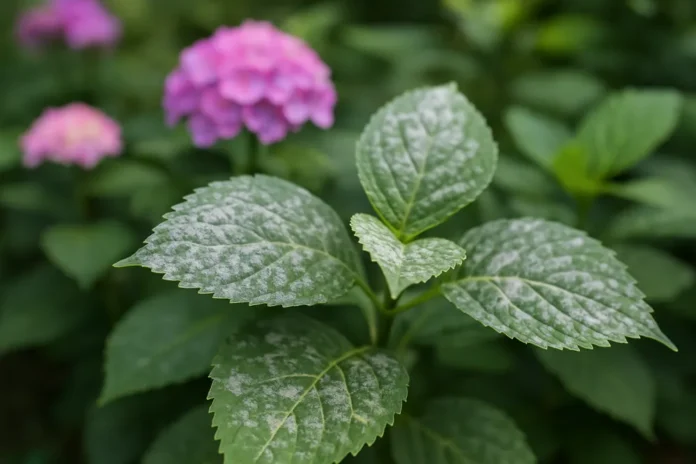
The white powder on hydrangea leaves is usually powdery mildew, a common fungal disease. It often shows up when air is humid and leaves stay in still, shaded conditions.
If you have noticed a dusty white coating on your hydrangea, the most likely culprit is powdery mildew on hydrangea leaves. It can look alarming at first, especially when it spreads across several leaves in a short time, but it is one of the more common hydrangea problems home gardeners run into.
In my garden, this usually appears during warm, muggy stretches when the plant has plenty of leafy growth but not quite enough air movement. The good news is that white powder does not always mean the shrub is in serious danger. The key is figuring out whether you are looking at true powdery mildew, harmless residue, or a less common pest problem so you can respond appropriately.
What the White Powder Usually Is
Most of the time, white powder on hydrangea leaves is powdery mildew, a fungal disease that sits on the leaf surface and gives foliage a dusty, flour-like look. Unlike many leaf diseases that need standing water, powdery mildew often develops when conditions are humid but leaf surfaces are not necessarily soaked. That is why gardeners are sometimes surprised to see it during periods that do not seem especially rainy.
Powdery mildew can begin as small pale blotches and then expand into a broader white coating on the upper leaf surface. In heavier cases, leaves may curl, yellow, look distorted, or drop early. Hydrangeas usually survive mild infections, but repeated outbreaks can weaken the plant, reduce vigor, and make the shrub look tired through the rest of the season.
When I am diagnosing hydrangea mildew, I look at the newest affected leaves first. If the white coating seems to sit on top of the leaf like dust and spreads in patches rather than neat circles, powdery mildew is usually my first suspect.
How to Tell Powdery Mildew From Other White Stuff
Powdery Mildew
This looks like a soft white or grayish powder dusted across the leaf. It may start as spots and then merge together. It does not usually look sticky, foamy, or cottony. The coating often rubs off a little on your fingers, though the leaf may still look damaged underneath.
Pesticide or Hard Water Residue
Sometimes a white film is simply residue from a foliar spray, overhead irrigation, or mineral-heavy water drying on the leaves. This tends to look more even or spotted in droplets rather than fuzzy or spreading like a living disease. Residue often appears suddenly after spraying and does not continue expanding onto untouched leaves.
Mealybugs or Cottony Insects
Mealybugs look more like little tufts of cotton gathered along stems, leaf joints, or the undersides of leaves. They do not usually create a broad dusting over the entire top of the leaf. If the white material is clumped around veins or stems and you see sticky honeydew, think insects rather than mildew.
Natural Leaf Texture or Sunscald
A few hydrangea leaves can develop pale scarring, bleaching, or rough patches from sun stress or physical damage. These areas are usually flat and discolored rather than powdery. If you cannot wipe anything off and the patch stays in the same place without spreading, it may not be fungal at all.
Why Hydrangeas Get Powdery Mildew
Powdery mildew thrives when a hydrangea has lush growth, warm temperatures, and poor air circulation. Many hydrangeas are planted in partly shaded beds, which they often enjoy, but dense shade plus heavy foliage can create still, humid pockets around the leaves. That is exactly the kind of environment mildew likes.
- Crowded planting with branches pressed against fences, walls, or neighboring shrubs
- Too much shade and not enough airflow through the center of the plant
- Warm days with humid nights, especially in late spring through early fall
- Overhead watering that keeps the area around the plant damp and stagnant
- Excess nitrogen fertilizer that pushes soft, leafy growth more prone to infection
- Repeated disease carryover from infected leaves left around the plant
Not every hydrangea variety gets mildew equally badly. Some bigleaf hydrangeas seem to pick it up more readily than others, especially when they are planted in a sheltered corner that stays muggy. A shrub can look perfectly healthy one week and then suddenly show a light dusting after a spell of humid weather.
What Powdery Mildew Does to the Plant
A light case is mostly cosmetic. The plant may keep flowering and continue growing, even with a few dusty leaves. A more serious infection interferes with photosynthesis, stresses the shrub, and can lead to yellowing, browning, curling, and premature leaf drop. When that happens year after year, the plant can lose vigor and produce less attractive growth.
The white powder itself is on the surface, but that does not mean it is harmless. Once a good portion of the canopy is covered, the plant has to work harder to support itself. If the hydrangea is already stressed from drought, heat, or poor siting, mildew tends to show up faster and linger longer.
Do not judge recovery by whether old infected leaves become spotless again. I look for healthier new growth and a slowdown in fresh white patches, because that tells me the plant is moving in the right direction.
How to Treat White Powder on Hydrangea Leaves
If only a few leaves are affected, you may not need aggressive treatment. Start by removing the worst leaves if that can be done without stripping the shrub. Clean up fallen infected foliage around the base, since that helps reduce ongoing disease pressure and improves the look of the planting right away.
Next, improve the plant's environment. Thin out nearby plants if they are crowding the hydrangea. If the shrub itself is extremely dense, selective pruning after the appropriate flowering period can open the canopy and let more air move through it. Water at the base instead of spraying the leaves, and avoid high-nitrogen feeding that pushes tender new growth.
When Fungicide Helps
A fungicide can help slow or prevent powdery mildew, especially if the plant gets it every year. Products labeled for powdery mildew on ornamentals may include sulfur, potassium bicarbonate, neem oil, or other active ingredients. The important part is using a product specifically labeled for hydrangeas or ornamental shrubs and following the label exactly.
Fungicides work best when started early, before the leaves are heavily coated. They do not usually make damaged foliage look new again, but they can protect cleaner growth from becoming infected. Reapplication intervals matter, especially during long humid stretches.
- Remove badly infected leaves when practical
- Rake up fallen leaves and plant debris
- Switch to watering at the soil level
- Reduce crowding around the plant
- Avoid overfertilizing with nitrogen
- Use a labeled fungicide early if infections are persistent or severe
When the Problem Is Not Powdery Mildew
If the white substance looks crusty, spotty, or linked to watering patterns, it may be mineral residue rather than disease. In that case, the fix is often simple. Stop overhead spraying, rinse leaves with plain water earlier in the day if appropriate, and avoid foliar products that leave visible deposits unless they are truly needed.
If you see cottony clusters on stems, undersides of leaves, or where leaves join the stem, inspect closely for mealybugs or soft scale. Those pests are often accompanied by sticky honeydew and sometimes black sooty mold. That is a different issue entirely and calls for pest management rather than disease control.
I also keep location in mind. A hydrangea near a sprinkler that leaves chalky deposits may show a fake mildew look, while one tucked into a shady, crowded foundation bed is much more likely to have the real thing.
How to Prevent Powdery Mildew From Coming Back
Prevention usually comes down to reducing the conditions mildew prefers. You cannot control the weather, but you can make the plant less inviting to disease. A hydrangea with decent spacing, measured feeding, and better airflow is much less likely to stay coated in white through the season.
- Plant hydrangeas with enough room for mature width
- Prune thoughtfully to open dense interiors when appropriate for the variety
- Water the roots instead of the foliage
- Avoid heavy fertilizer applications that trigger excessive soft growth
- Remove diseased leaves from the ground at the end of the season
- Choose more disease-tolerant hydrangea varieties when replanting
In gardens where mildew returns every summer, I usually find the site matters as much as the plant. Even a healthy hydrangea struggles if it is wedged between a wall and other shrubs where the air barely moves.
When to Worry and when to Relax
A small amount of powdery mildew late in the season is often more annoying than dangerous. If the hydrangea is otherwise growing well, flowering normally, and only a handful of leaves are affected, you can usually manage it with cleanup and better cultural care.
You should pay closer attention if the white coating is spreading quickly over much of the plant, if leaves are curling and dropping early, or if the shrub seems weak year after year. Repeated heavy infections may mean the site is too crowded or too stagnant for that particular hydrangea to thrive without regular intervention.
Also be cautious if the diagnosis does not fit. White powder that is sticky, webby, cottony, or tied to visible insects suggests a pest issue. White patches that turn brown and papery after intense sun may point to environmental scorch. Good diagnosis saves time, money, and unnecessary spraying.
FAQ
Can Powdery Mildew Kill a Hydrangea?
It usually does not kill an established hydrangea by itself, especially if the infection is mild. Severe or repeated infections can weaken the plant over time and make it more vulnerable to heat, drought, and other stress.
Should I Cut Off Leaves with White Powder on Them?
If only a limited number of leaves are badly affected, removing them can help tidy the plant and reduce some disease pressure. Avoid stripping too much foliage at once, because the shrub still needs leaves to support itself.
Will Rain Wash Powdery Mildew Off Hydrangea Leaves?
Not reliably. Powdery mildew can persist even after rain, and humid weather often helps the disease continue spreading.
Is White Powder on Hydrangea Leaves Always Fungus?
No. It is often powdery mildew, but white residue can also come from hard water, foliar sprays, or cottony insect pests such as mealybugs.
Can I Use Neem Oil on Hydrangea Powdery Mildew?
Neem oil is sometimes labeled for powdery mildew on ornamental plants, but you should only use products that specifically list ornamental use and follow the label carefully. Oils can also cause plant injury if applied in hot weather or at the wrong rate.
Why Does My Hydrangea Get White Powder Every Year?
Recurring mildew usually points to favorable conditions such as crowding, shade, humid air, poor airflow, and dense leafy growth. Some hydrangea varieties are also more prone to it than others.
Can I Still Enjoy Blooms if the Leaves Have Powdery Mildew?
Yes, many hydrangeas continue blooming despite mild mildew. The bigger concern is long-term plant vigor and appearance if infections become heavy or return season after season.
Need a treatment that actually works? Read our guide to the best fungicides and hydrangea-safe disease controls so you can choose the right product with confidence.
