

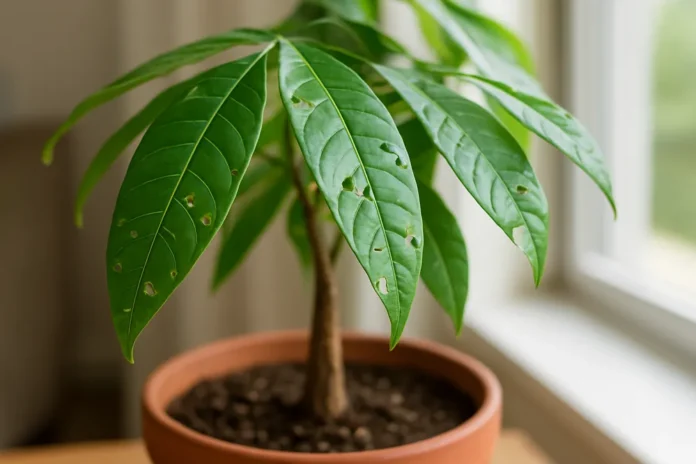
Money tree leaves usually get holes from pest feeding, physical tears, or damage that happened while soft new leaves were opening. Older damage stays visible even after the underlying problem improves.
Seeing holes in a money tree leaf can be confusing because the plant may still look mostly healthy otherwise. Unlike yellowing or drooping, holes often point to damage that happened at a specific moment, not necessarily a whole-plant decline happening right now.
In my experience, the most common reasons are chewing pests, rough handling, dry or stuck new growth, and leaves that were damaged before they fully opened. The key thing to remember is that a hole will not heal over. Once that leaf tissue is gone, your goal is to figure out what caused it and make sure the next flush of growth comes in clean.
A money tree with holes in leaves is often easier to diagnose than people think if you pay attention to where the holes appear, whether they show up on old or new leaves, and whether the leaf edges look clean, ragged, brown, or silvery.
What Holes in Money Tree Leaves Usually Mean
Holes form when part of the leaf tissue dies, gets eaten, or tears apart. On a money tree, that usually falls into one of three buckets: pest damage, physical damage, or developmental damage while the leaf was still soft and folded.
If the holes have irregular edges, insects are a strong possibility. If the holes look more like splits or tears along a crease line, the leaf probably got damaged while unfurling or from being bumped. If the area started as a brown or translucent spot and then dropped out, the leaf tissue likely died first and left a hole later.
- Clean-edged splits often point to tearing, sticking, or handling damage.
- Ragged holes or missing chunks can point to chewing pests.
- Brown-edged holes often mean tissue died first from stress, scorch, or infection.
- Damage only on brand-new leaves usually suggests an issue during unfurling rather than an old pest attack.
When I diagnose this on houseplants, I pay more attention to the newest leaves than the ugliest ones. Old damaged leaves tell you what happened. New clean leaves tell you whether the problem is still active.
Chewing Pests That Can Leave Holes
Caterpillars, Crickets, and Other Occasional Chewers
Money trees kept indoors do not usually attract a lot of large chewing insects, but it can happen, especially if the plant spends part of the year outdoors, sits near open windows, or came home recently from a garden center. Caterpillars, earwigs, crickets, and even slugs can chew actual holes through leaf blades.
This kind of damage usually looks irregular, as if part of the leaf was bitten out. The edges may look ragged rather than neatly split. You might also notice black specks of frass, faint chewing along the edges, or damage that seems to appear overnight.
Thrips and Other Sap-feeding Pests
Thrips do not chew classic bite marks, but they can scar and weaken developing leaves so badly that the tissue tears or collapses into holes later. On money trees, this can show up as silvery streaks, distorted new growth, tiny black dots, and leaves that emerge looking scratched, papery, or shredded.
Spider mites and aphids are less likely to create true holes by themselves, but they can stress leaves enough to make them thin and more fragile. If the foliage also looks stippled, dusty, curled, or webbed, broaden the diagnosis beyond simple mechanical tearing.
- Look under leaves and along midribs for pests, eggs, webbing, or black specks.
- Check the newest growth first because pests often target soft tissue.
- Inspect at night if you suspect larger chewing insects, since some feed after dark.
- Isolate the plant from nearby houseplants until you know what you are dealing with.
Damage That Happens While New Leaves Are Unfurling
This is one of the most common non-pest causes I see on indoor money trees. New leaves emerge thin, folded, and delicate. If the air is very dry, the leaf can stick to itself as it opens. When it finally pulls free, it may tear and leave small holes or elongated splits.
You may notice this most often on the freshest leaves near the growing tips. The rest of the plant can still look healthy. The holes often follow fold lines or appear where a stuck section ripped open. In severe cases, the leaf looks crinkled, misshapen, or partly shredded.
Low humidity is not the only reason this happens. Inconsistent watering, sudden temperature swings, crowded growth pressed against furniture or curtains, and rough handling while the leaf was emerging can all lead to the same end result.
If new leaves keep tearing open, I focus on consistency more than extremes. Steady soil moisture, moderate humidity, and giving the growing tips physical space usually solve more of these cases than chasing one dramatic fix.
Physical Tearing and Accidental Damage
Money tree leaves are softer than many people realize, especially when the plant is actively growing. A leaf can tear from brushing against a wall, getting pinched during watering, rubbing on packaging during transport, or being bent while you rotate the pot.
Pets and children can also leave mysterious holes that look like a plant disease at first glance. Even a fan blowing one stem repeatedly against another object can cause mechanical damage over time. In these cases, the holes usually appear random and isolated rather than spreading systematically across the plant.
- Damage appears on a few leaves rather than across the whole canopy.
- There are no visible pests or signs of active feeding.
- The leaf may have bent, creased, or split before the hole formed.
- Newer growth looks normal once the plant is left undisturbed.
Brown Spots That Turn Into Holes
Sometimes a leaf does not start with a hole at all. It starts with dead tissue. If a spot becomes dry and brittle, the damaged center can break away and leave a hole behind. When that happens, the edges of the hole are usually brown, tan, or crispy rather than fresh-looking.
Sun Scorch and Heat Stress
Money trees like bright light, but strong direct afternoon sun through glass can scorch tender leaves. A scorched patch may first look pale, bleached, or brown. Later, that dead patch can crack and fall out. This is more common after a sudden move from a dim spot to a bright window.
Water Stress and Tissue Collapse
Very erratic watering can cause cells to collapse in parts of the leaf, especially on vulnerable new growth. Severe underwatering can make leaves brittle and easy to tear. Chronic overwatering can weaken the plant overall and lead to soft, damaged tissue that does not develop normally.
Leaf Spot Disease
Fungal or bacterial leaf spot is less common than cultural damage, but it is worth considering if you see multiple round lesions with dark borders, yellow halos, or wet-looking spots. As those lesions dry, the dead centers can sometimes drop out and create a shot-hole effect. This usually comes with spotting, not just clean holes by themselves.
How to Tell Which Cause Is Most Likely
The pattern matters more than the hole itself. A single damaged leaf is very different from a plant that keeps producing hole-riddled new growth. Try to read the whole plant before assuming the worst.
- Check whether the holes are on old leaves, new leaves, or both.
- Look closely at the hole edges. Ragged suggests feeding, while split edges suggest tearing.
- Inspect the underside of leaves for pests, eggs, webbing, silvering, or black specks.
- Think about recent changes such as a move outdoors, stronger sun, dry indoor air, shipping, or repotting.
- Watch the next set of leaves. Fresh damage on new growth means the issue is ongoing.
If only one or two older leaves are damaged and everything new looks normal, the problem may already be over. If each new leaf opens with holes, twists, or scars, focus first on pests and unfurling stress.
I get suspicious of thrips when the newest leaves look scraped, narrow, or distorted before the holes even appear. I get suspicious of dry-air tearing when the rest of the plant looks healthy and the damage follows the folded lines of a newly opened leaf.
What to Do Right Now
You do not need to panic-prune every damaged leaf. A hole is cosmetic unless it is part of a bigger issue. Start by stabilizing conditions and ruling out active pests.
- Isolate the money tree if you suspect insects.
- Inspect stems, leaf undersides, and growing tips with bright light.
- Rinse foliage or wipe leaves if dust and pests may be hiding.
- Remove only the worst damaged leaves if they bother you or if they have active disease spots.
- Keep watering even and avoid letting the plant swing from bone-dry to soaked.
- Move the plant into bright, indirect light if it has been getting harsh direct sun.
- Increase humidity modestly if your indoor air is very dry, especially during heating season.
If you actually find pests, choose a treatment that matches the pest. Insecticidal soap or horticultural oil can help with many common soft-bodied pests, while hand removal may be enough for larger chewing insects. Repeat applications matter more than a single dramatic spray because eggs and hidden insects often survive the first round.
If you do not find pests, focus on plant care consistency for several weeks. Houseplants often reveal the real answer through the next flush of growth.
Should You Cut Off Leaves with Holes
Leaves with holes can still photosynthesize as long as most of the leaf is green and healthy. I usually leave mildly damaged leaves in place because the plant still benefits from them. Removing too many at once can stress the plant more than the holes do.
Go ahead and prune if a leaf is mostly damaged, heavily spotted, actively diseased, or simply ruining the look of the plant for you. Use clean scissors and remove the leaf at the base of its petiole without tearing the stem.
- Leave leaves that are mostly green and only lightly torn.
- Remove leaves with spreading disease lesions or severe distortion.
- Avoid stripping the plant bare just for cosmetic reasons.
- Judge recovery by the quality of new growth, not whether old holes disappear.
How to Prevent Future Holes
Prevention comes down to reducing stress on new leaves and catching pests early. Money trees are fairly forgiving, but they produce the cleanest foliage when their environment stays steady.
- Keep the plant in bright, indirect light rather than harsh afternoon sun.
- Water when the top layer of potting mix has dried slightly, not on a rigid calendar.
- Avoid blasting the plant with heat vents or very dry airflow.
- Give new growth space so leaves can open without rubbing nearby objects.
- Check for pests regularly, especially after bringing plants indoors or home from a store.
- Quarantine new houseplants before placing them next to your money tree.
- Wipe dust from leaves so you can spot early pest damage more easily.
If your money tree spends summer outside, inspect it carefully before bringing it back indoors. That seasonal move is when I see many surprise pest problems start.
When Holes Are Not a Serious Problem
Not every hole means your money tree is in trouble. If the plant is putting out healthy new leaves, holding color well, and showing no active insects or spotting, a few damaged leaves may just be old evidence of a past stress event.
Home gardeners often assume any leaf imperfection means they need fertilizer, a bigger pot, or a rescue treatment. In reality, holes are usually a sign of physical damage or pests, not a basic nutrient deficiency. Unless other symptoms are piling up, keep the response targeted and simple.
FAQ
Can Money Tree Leaves Heal After They Get Holes?
No. The damaged tissue will not fill back in. What matters is whether the plant produces healthy new leaves after you correct the cause.
Do Spider Mites Cause Holes in Money Tree Leaves?
Usually not true holes by themselves. Spider mites more often cause stippling, fading, and leaf stress, which can make foliage weaker and easier to tear.
Why Do Only the New Leaves on My Money Tree Have Holes?
That usually points to damage during unfurling, very dry air, thrips, or another problem affecting soft new growth. It is less likely to be old mechanical damage if every new leaf shows the same issue.
Should I Mist My Money Tree to Stop Leaf Holes?
Misting is not a reliable fix on its own. Steadier humidity, even watering, and better airflow around new growth usually help more than occasional surface moisture.
Can Too Much Sun Make Holes in Money Tree Leaves?
Yes. Direct intense sun can scorch leaf tissue, and the dead area may later crack or fall out, leaving a brown-edged hole.
Are Holes in Money Tree Leaves Caused by Nutrient Deficiency?
Not usually. Nutrient issues tend to cause color changes, weak growth, or edge burn rather than isolated holes punched through otherwise normal leaves.
Do I Need to Repot My Money Tree if the Leaves Have Holes?
Only if the plant also shows signs of being rootbound or staying wet too long. Holes alone are more often related to pests, tearing, dry unfurling, or localized stress.
Want cleaner new growth and fewer recurring problems? Read our guide to the best money tree care products and pest treatments so you can choose the right fix fast.
