

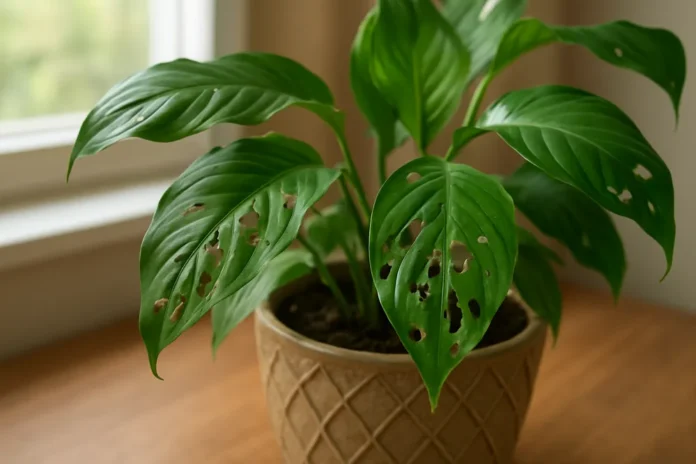
Peace lily leaves usually get holes from chewing pests, accidental tearing, or physical damage while new leaves are opening. Dry air and rough handling can make the damage more noticeable.
Seeing peace lily leaves with missing bits or punctures can be frustrating, especially when the rest of the plant seems healthy. Leaves on peace lilies are normally smooth and whole, so holes in leaves usually mean something chewed, tore, or damaged the foliage after it started growing.
In most homes, the cause is not a mysterious disease. It is usually insects like caterpillars or slugs in outdoor or porch plants, occasional houseplant pests, mechanical damage, low humidity that causes leaves to stick and rip as they unfurl, or simple wear from moving the plant around.
The good news is that hole damage can often be traced by the pattern it leaves behind. Once you know whether the holes look chewed, torn, or split, it becomes much easier to fix the problem and protect new growth.
What Holes in Peace Lily Leaves Usually Mean
Holes are different from yellowing, browning, or spots. A hole means plant tissue is physically gone. That usually happens in one of three ways: something ate the leaf, the leaf tore while opening or after being bumped, or older damaged tissue dried up and dropped out.
Peace lily leaves are fairly tender, especially when they first emerge rolled tightly from the center of the plant. If a new leaf sticks while unfurling, parts of the blade can rip and later look like neat slits or irregular holes. If the damage comes from pests, the edges often look ragged or nibbled.
- Clean, slit-like openings often point to tearing during unfurling or handling.
- Jagged holes with uneven edges usually suggest chewing pests.
- Tiny holes that enlarge over time may begin as small injuries that dry and break open.
- Damage concentrated on new leaves often points to humidity problems or pests hiding in the crown.
Chewing Pests Are a Common Cause
Outdoor Pests Can Follow Peace Lilies Indoors or Attack Patio Plants
If your peace lily spends time on a porch, patio, balcony, or near an open window in warm weather, pests like caterpillars, earwigs, slugs, and snails can chew holes overnight. These pests leave obvious missing pieces, especially along leaf margins, but they can also eat through the center of softer leaves.
Slugs and snails are especially likely if the plant sits outside in shade, where peace lilies are often placed. They feed at night and hide during the day under pots, saucers, benches, or thick mulch. Caterpillars may blend into the foliage and leave dark droppings nearby.
Indoor Pests Usually Damage Leaves in a Different Way
Most common indoor houseplant pests such as spider mites, mealybugs, aphids, and scale do not literally chew holes. They suck sap, which can weaken leaves, distort new growth, or cause stippling and sticky residue. In severe cases, damaged tissue may later tear or break away, but these pests are usually not the direct cause of large holes.
Thrips are one indoor pest worth watching closely. They scrape and feed on leaf tissue, which can leave silvery scars, distorted leaves, and damaged areas that sometimes split open as the leaf expands. On peace lilies, thrips damage often shows up on newer growth first.
- Look for ragged edges, dark droppings, slime trails, or insects hiding in the pot and crown.
- Inspect at night if you suspect slugs, snails, or caterpillars.
- Check the newest leaves and where they emerge, since pests often feed there first.
- If you see silvery scarring or black specks, thrips are more likely than chewing insects.
Tearing During Unfurling Is Very Common Indoors
A peace lily leaf begins as a tightly rolled spear. As it opens, dry indoor air, low moisture around the plant, or residue on the leaf surface can cause the layers to stick together. When the leaf finally opens, the stuck sections rip, leaving slits or holes that look like something ate them.
This kind of damage is especially common in winter, in air-conditioned homes, or in rooms with heating vents. It can also happen when the plant gets too dry between waterings and new growth loses flexibility. The tear usually looks cleaner and more linear than insect feeding.
Signs the Leaf Tore Instead of Being Eaten
- The hole follows a fold line or appears as a slit in the center of the leaf.
- The edges are smooth rather than ragged.
- Only new leaves are affected while older leaves look fine.
- There are no visible pests, droppings, or slime trails.
If the plant recently pushed several new leaves during a dry spell, tearing is one of the first possibilities to consider. It is not contagious, and the plant can recover well once conditions improve.
Physical Damage Can Leave Holes That Look Like Pest Problems
Peace lily foliage bruises and tears easily. A leaf that was bent while moving the plant, rubbed against furniture, pinched during watering, or pressed against a wall may later develop a weak spot. As the leaf expands or ages, that injured section can split or fall out, leaving a hole.
Pets and children can also create this kind of damage. Even a ceiling fan, strong draft, or repeated brushing from people walking past can stress the same leaves over time. Because peace lilies are often placed in low-light corners or narrow hallways, mechanical wear is more common than many gardeners realize.
- Damage appears mostly on outer leaves, not deep in the center.
- The plant sits in a high-traffic area.
- Only one or two leaves are affected rather than the whole plant.
- The hole is paired with creasing, folding, or torn edges nearby.
Low Humidity and Watering Stress Can Make Leaves More Fragile
Peace lilies like evenly moist soil and moderate humidity. They are famous for drooping when thirsty, and although they usually perk back up after watering, repeated drought stress weakens leaf tissue. A plant that repeatedly dries out can produce thinner, less flexible leaves that tear more easily.
Low humidity adds another layer of stress. New leaves may not expand smoothly, and edges can crack where the tissue sticks or dries unevenly. In very dry air, damage may begin as a tiny split that enlarges into a visible hole over several days.
Conditions That Raise the Risk of Tearing
- The plant wilts often between waterings.
- Indoor humidity stays very low, especially in winter.
- The pot sits near a heater, vent, or drafty door.
- New leaves emerge small, crinkled, or stuck together.
While humidity and watering issues may not directly punch holes in a leaf, they create the conditions that make holes more likely.
Can Disease Cause Holes in Peace Lily Leaves?
Leaf diseases are less common than pest or physical causes when the symptom is actual holes. Bacterial and fungal problems on peace lilies are more likely to cause spots, water-soaked patches, yellow halos, or blackened tissue. In some cases, badly infected tissue dries up and falls away, creating a shot-hole effect, but this is not the most typical explanation indoors.
If you see holes surrounded by brown, black, or yellow margins, especially on multiple leaves, disease becomes more likely. Wet foliage, poor air flow, contaminated tools, or chronically soggy conditions can make these issues worse.
- Disease-related holes are often bordered by discolored tissue.
- The damaged area may start as a spot before opening into a hole.
- Several leaves may show similar lesions at once.
- Water splashing onto leaves and staying there can increase risk.
How to Tell Which Cause Is Most Likely
The pattern of damage is your best clue. Before treating anything, compare where the holes are, what the edges look like, and whether the damage is on old leaves, new leaves, or both. This prevents unnecessary sprays and helps you fix the real issue faster.
Use the Damage Pattern as a Guide
- Ragged holes on leaf edges or centers: more likely slugs, snails, caterpillars, or other chewing pests.
- Smooth slits or tears on fresh leaves: more likely low humidity, sticking during unfurling, or handling damage.
- Holes with yellow or brown borders: more likely old injured tissue or a leaf spot issue.
- Random holes on outer leaves only: more likely bumps, pets, or physical wear.
- Deformed new leaves with silvery scarring: more likely thrips.
Also consider the plant's recent history. If it was outside recently, pests rise to the top of the list. If your home has been dry and the newest leaves look crinkled, tearing during unfurling becomes more likely.
What to Do to Stop New Holes From Forming
Damaged leaves will not heal, so the goal is to protect the next round of growth. Start with the least aggressive fix based on the most likely cause. A peace lily usually responds well once the underlying stress is corrected.
If Pests Are Causing the Damage
- Inspect leaves, stems, saucers, and the soil surface carefully, including after dark if the plant has been outside.
- Hand-remove caterpillars, slugs, or snails when found.
- Rinse the foliage and isolate the plant from other houseplants if you suspect indoor pests.
- Use insecticidal soap or neem on labeled pests such as thrips, aphids, or mealybugs, following product directions exactly.
- For persistent outdoor slug or snail issues, reduce hiding places and use pet-safe control methods appropriate for container plants.
If the Leaves Are Tearing as They Open
- Keep soil evenly moist but not waterlogged.
- Raise humidity with a humidifier or by grouping plants together.
- Move the plant away from heating vents, air conditioners, and harsh drafts.
- Avoid touching or forcing a leaf open unless it is clearly rotting or stuck for an unusual reason.
If Physical Damage Is the Issue
- Relocate the plant away from walkways and pet traffic.
- Turn the pot carefully instead of dragging leaves against nearby surfaces.
- Support large leaves when cleaning or moving the plant.
- Trim badly shredded leaves if they spoil the appearance, but leave lightly damaged leaves in place if they are still green and useful.
Care Adjustments That Help Peace Lilies Produce Cleaner New Leaves
Peace lilies grow best when their care is steady rather than perfect. Sudden swings in watering, light, and air moisture often show up first in the newest leaves. If your plant is producing holey foliage repeatedly, improving basic care can make a noticeable difference.
- Give bright, indirect light so the plant has energy to produce strong leaves.
- Water when the top inch of soil starts to dry, rather than waiting for severe wilting.
- Use a pot with drainage and empty excess water from the saucer.
- Maintain moderate humidity when possible, especially during winter heating season.
- Wipe dust off leaves gently so new growth can unfurl without extra friction.
- Repot if roots are tightly crowded and the plant dries out unusually fast.
Healthy, well-hydrated peace lilies produce more supple leaves that are less likely to split or develop weak tissue. Good routine care also helps the plant resist pests better.
When to Prune Damaged Leaves
You do not have to remove every leaf with a hole. If a leaf is mostly green, it still helps the plant photosynthesize. However, if a leaf is badly shredded, diseased-looking, or simply unattractive, you can prune it off at the base with clean scissors or pruners.
Pruning is mostly cosmetic unless disease is involved. Avoid removing too many leaves at once, especially if the plant is already stressed. It is better to fix the cause first and let healthy new leaves replace the old ones gradually.
When Holes Are a Sign of a Bigger Problem
A few isolated holes are usually not serious. Widespread damage, however, deserves closer attention. If almost every new leaf emerges damaged, the plant may be dealing with chronic low humidity, a hidden thrips infestation, or root stress that is affecting growth quality.
Watch for warning signs that go beyond simple holes, such as distorted new leaves, black specks, sticky residue, foul-smelling soil, mushy stems, or fast decline. Those clues suggest the problem is not just cosmetic and may need more targeted treatment.
- Repeated damage on new growth points to an active, ongoing issue.
- A sudden burst of holes after outdoor time strongly suggests pests.
- Holes plus discoloration may mean injury followed by infection.
- Weak growth plus wilting can point to root problems along with leaf damage.
FAQ
Will Holes in Peace Lily Leaves Heal?
No. Once leaf tissue is missing, that area will not fill back in. Focus on stopping the cause so new leaves emerge normally.
Can Spider Mites Cause Holes in Peace Lily Leaves?
Not usually. Spider mites cause stippling, dull foliage, and fine webbing rather than true holes. If you see actual missing tissue, another cause is more likely.
Do Slugs Eat Peace Lily Leaves?
Yes, especially if the plant spends time outdoors in shade. Slugs and snails can chew irregular holes and often feed at night.
Should I Cut Off Damaged Peace Lily Leaves?
Only if they are badly torn, diseased-looking, or ruining the plant's appearance. Lightly damaged green leaves can stay on the plant and still help with growth.
Can Low Humidity Make Peace Lily Leaves Get Holes?
Indirectly, yes. Dry air can make new leaves stick as they unfurl, which causes tears and slit-like holes.
Why Do Only the New Leaves Have Holes?
Damage limited to new leaves often points to tearing during unfurling, low humidity, or pests feeding in the center of the plant where fresh growth emerges.
Is a Peace Lily with Holes Safe to Keep Near Other Houseplants?
It depends on the cause. If pests may be involved, isolate it until you inspect and treat it. If the holes came from tearing or physical damage, it is fine to keep with other plants.
Want healthier, cleaner peace lily foliage fast? Read our guide to the best peace lily fertilizers, humidifiers, and pest treatments to keep new leaves lush and damage-free.
